
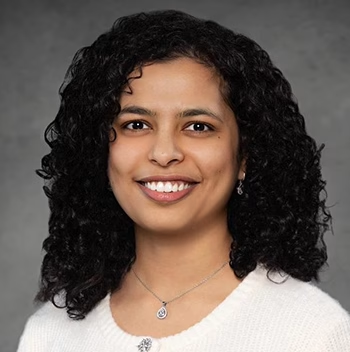
In April 2026, I traveled to Washington DC as one of 157 graduate students selected from universities across the United States to attend the American Association for the Advancement of Science (AAAS) Catalyzing Advocacy in Science and Engineering (CASE) Workshop. I am a PhD candidate in Computer Science and Informatics at Emory University, and my research sits at the intersection of artificial intelligence and health, using natural language processing to surface patient experiences, detect health misinformation, and shed light on rare and underrecognized conditions. Visiting Capitol Hill was a very different experience. However, it turned out to be one of the most clarifying professional experiences of my life.
What no one told me about science funding
The workshop opened with AAAS CEO Sudip Parikh, PhD, setting the stakes plainly: the relationship between science and federal policy has never been more fragile, and scientists can no longer afford to be absent from the rooms where funding decisions are made. That framing set the tone for everything that followed. Over three days, we moved through sessions on the federal budget process, science communication strategy, and the mechanics of congressional staffing, before heading to Capitol Hill itself.
The most visceral lesson came from a budget simulation where we were handed a real Commerce, Justice, and Science appropriations framework, and told to allocate funding while representing different political interests. We shut down our fictional government! We genuinely could not agree. That failure taught me more about the real pressures on science funding than any policy paper ever had. Most federal research funding lives in discretionary spending, meaning it must be re-justified, re-fought, and re-won every single year.
The science of talking to people who don’t speak science
The second day was devoted to communication, and it reframed something I had been getting wrong for years. The instinct as a researcher is to lead with your work, your methods, your findings. We were taught to lead with relevance. Establish that your research exists in service of the public, then connect it to what that means for the people a member of Congress represents. The goal is not to ask for charity; it is to make clear that you are reporting back to a constituent on something that affects their community.
A panel of science policy practitioners reinforced the same core lesson: preparation, human connection, and intellectual honesty are the foundations of effective advocacy. Know who the member is accountable to before you walk in. Be ready to relate on a personal level, not just a policy one. And if you do not know the answer to something, say so. Trust is not easily rebuilt once lost.
Being a woman in those rooms
I want to be honest about something the AWIS community will recognize immediately: I thought about my presence in those rooms in ways my male colleagues probably did not. Not with anxiety, but with awareness. I am a woman of color, studying a field still working to close its representation gaps, advocating for research that centers patient communities routinely overlooked by the medical system.
Unexpectedly, this was an asset. Explaining why AI in healthcare must be built on diverse, representative data is not a political argument; it is a scientific and ethical one. This message landed. Staff on both sides of the aisle engaged with it. Women in science, and particularly women of color, often carry research questions that arise from lived proximity to the problems we study. That proximity is a form of expertise. In policy spaces, it is also a form of authority we are entitled to bring into the room.
Visiting Capitol Hill
On the final day, our cohort of students from Emory University, the University of Georgia, and the Georgia Institute of Technology visited four Georgia congressional offices: Mike Collins, Hank Johnson, Lucy McBath, and Nikema Williams. Three universities, one state, making the case for why Georgia’s research ecosystem deserves sustained federal investment.
The key lesson the workshop had prepared us for: think locally first. Members of Congress answer to their constituents, and their staff filter everything through that lens. For me, that meant framing my research around what AI-driven healthcare means for patients in Atlanta, a city that is medically complex and demographically diverse. That framing opened every conversation. Staffers pushed back on indirect costs, on university endowments, on why federal dollars are necessary. I had prepared for those questions. When I did not have a perfect answer, I said so and then explained what I did know. It worked.
Why this matters for women in science
Congressional staffers told us something I keep coming back to: they genuinely want to hear from researchers. They track hundreds of policy areas simultaneously and have no way of knowing what is at stake when a funding line disappears unless someone tells them. Showing up is not a disruption. It is part of the process.
For women in science, advocacy carries an additional dimension. The most vulnerable research areas in politically uncertain times often include fields where women are most represented, and communities whose health women researchers study. Our absence from policy conversations is not neutral; it shapes outcomes. The AAAS CASE Workshop gave me a vocabulary and a framework for showing up with intention. The science does not speak for itself. We must communicate it.
Swati Rajwal is a PhD candidate in Computer Science and Informatics at Emory University’s Laney Graduate School, working at the intersection of natural language processing and health informatics. Her research spans AI bias, rare disease informatics, and the social determinants of health. She is advised by Prof. Abeed Sarker. Learn more: swati-rajwal.github.io
Read more about AAAS CASE and science communications:
Mast gets a taste of policy, advocacy during Washington science communication workshop
Empowered by Advocacy: My Experience at the 2025 AAAS CASE Workshop
CASE Workshop Experience: Bridging the Science-Policy Gap
A sociologist goes to science camp
Journal of Science Policy & Governance