
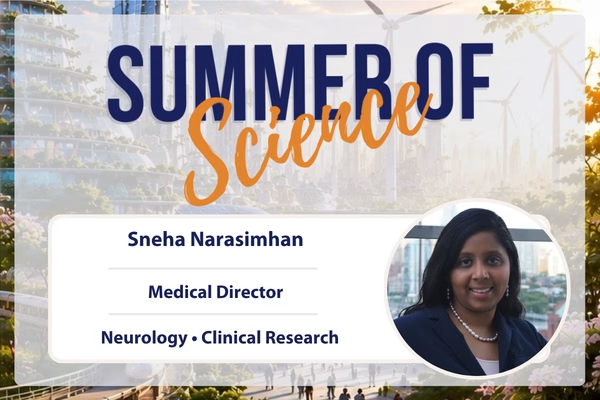
Sneha Narasimhan is a Medical Director leading Alzheimer’s clinical research at Sanofi, where she oversees the development of new therapies for one of the world’s most challenging neurodegenerative diseases. She designs and leads clinical trials that evaluate promising treatments while working alongside physicians, scientists, statisticians, and regulatory experts to move research from the laboratory to patients. Inspired by her own family’s experience with neurodegenerative disease, Sneha keeps patients and caregivers at the center of every decision she makes. Beyond advancing Alzheimer’s research, she is passionate about mentoring the next generation of women in science and helping bring new treatments closer to the families who need them most.
A Day in the Life of a Medical Director
What does a typical day in your role look like?
I lead clinical research efforts for Alzheimer’s disease at Sanofi, overseeing the studies that test new treatments and determine whether they’re safe and effective for patients.What a Typical Day Looks Like: My days are a mix of meetings, planning, and teamwork. I might start by reviewing data from ongoing Alzheimer’s trials—checking how patients are responding to treatment and whether we’re seeing any safety concerns. I spend significant time in team meetings with colleagues from different departments: talking with our medical team about study design, meeting with statisticians about data analysis, coordinating with operations to ensure trials run smoothly, and connecting with regulatory experts to make sure we’re meeting all compliance requirements.A big part of my role is preparing and refining clinical studies—working on the details of how we will test new drugs, who we will recruit as participants, and what we will measure to determine if a treatment works. I also lead cross-functional teams that bring together people with different expertise to solve problems and move projects forward. Beyond day-to-day execution, I help shape the overall strategy for our Alzheimer’s pipeline — deciding which approaches are most promising, evaluating new scientific findings, and making recommendations about which programs to prioritize. It’s about balancing the science with practical realities to ultimately get effective treatments to patients who need them.
How would you explain your field of work to a kindergarten class?
I help people’s brains stay healthy and strong. You know how sometimes grown-ups forget things, like where they put their keys? Well, some older people have a sickness called Alzheimer’s where their brains get really forgetful — so forgetful that they might forget their family members or how to do things they’ve always known how to do. It makes them very sad and confused. I work with a big team of really smart people to find medicine that can help people with Alzheimer’s remember better and feel better. I test new medicines – We give people special medicines and watch very carefully to make sure they’re safe and that they help people’s brains work better. I lead a team – Just like your teacher leads your class, I help lots of different people work together. Some people are doctors, some are scientists, some count numbers, and some make sure everything runs smoothly. We all work as a team! My job is important because I’m trying to help people like your grandmas and grandpas keep their memories and stay healthy. It’s like being a superhero for people’s brains!
The Path to Alzheimer's Research
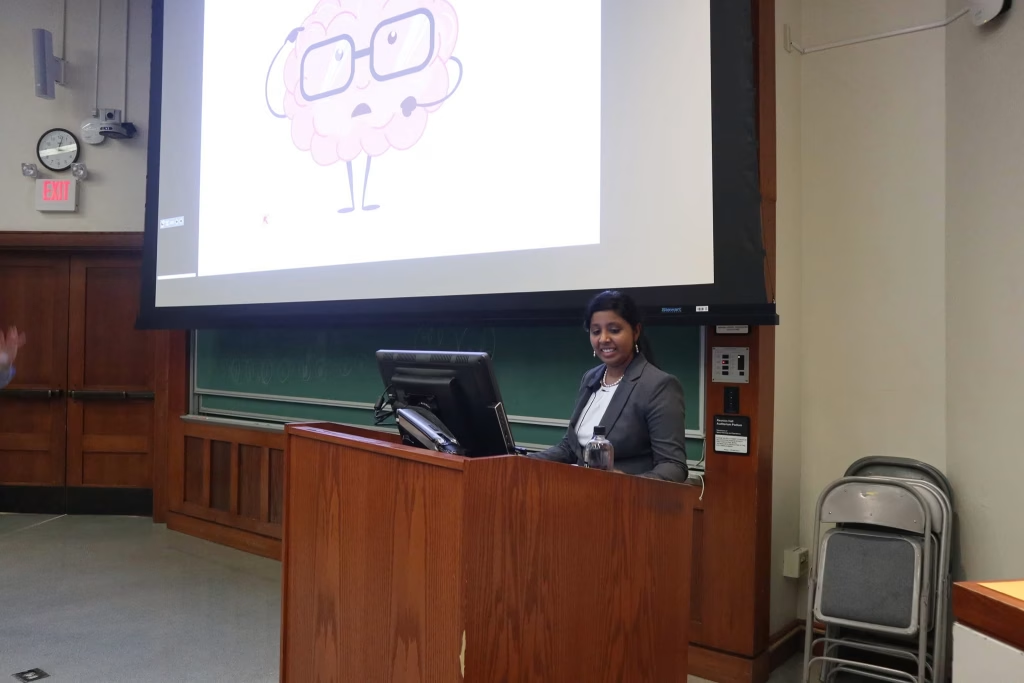
I am a physician-scientist, with an MD-PhD dual degree. My educational program combined medical school with research training, where I completed a PhD developing new mouse models of Alzheimer’s disease. After my MD-PhD, I did a neurology residency where I learned how to care for patients with a variety of neurological conditions. I then transitioned to industry, and have worked in multiple industry roles over the last four years, with a primary focus on Alzheimer’s. My education and background trained me to think like a scientist while always keeping the patient needs in focus. That blend serves me well in my current role designing new trials that take novel research and apply it to patients with unmet needs.
What inspired me to pursue medicine and science was based on my own family experiences with neurodegenerative disease My grandfather was diagnosed with ALS when I was very young, yet I still remember all the challenges my family went through for his care. I remember feeling very sad when my parents told me there was nothing they could do for him because there were no treatments. When I was older, my grandmother got diagnosed with Parkinson’s disease. My mother became her primary caregiver, and I saw firsthand the burden of caring for a loved one with neurodegenerative disease. I was in medical school when my grandmother declined and had to make the challenging decision of putting her in hospice. These experiences really shaped my drive to find new treatments for people like my grandparents, so their families would never have to go through what my family did.
I work with people all over the world and get to travel to new countries attending conferences or visiting clinical sites. I always learn something new, whether it is a few words in a new language, a new cuisine, or just making an international friend!
Being part of the team that brought a new Alzheimer’s drug to patients and families was a huge accomplishment. Now I am focused on our next trial to further slow disease progression and help families facing this devastating condition.in this devastating disease.
The Science That Moves Us Forward
How has AWIS helped you professionally/or personally?
I have been a part of AWIS since 2023 just as I transitioned to industry. I particularly enjoy the networking events and workshops that help with career development and address challenges specific to women. I believe mentorship for women is critical to make progress for us in science, and AWIS provides an incredible community to accomplish that.
How has your work/research helped drive discovery, innovation, or impact?
I was very lucky to join industry at a pivotal time in Alzheimer’s research and clinical care. I joined Eisai about a year before we launched a new drug to treat Alzheimer’s disease, one of the first in about 30 years. It was thrilling to be part of the team involved in preparing fo and executing that launch. There was excitement in the field about this new drug, but also trepidation – we still did not know how well it would work and it did come with side effects. I learned the challenges of trying to shape an entire clinical field that had been stagnant for decades. My experience at Eisai made me want to go back to early-phase clinical development so I could bring my learnings from the end of the pipeline to the beginning. I am now leading a Phase 2 clinical study testing a new oral therapy for Alzheimer’s disease, which could be a game-changer since current drugs are adimnistered intravenous or subcutaneous. I always keep the patient and family perspective in mind when designing new trials for Alzheimer’s disease – I want to make sure we can actually address their unmet need with any new innovation.
Where do you see your work heading next?
I work on early-phase clinical trials for Alzheimer’s disease now, and my hope is to see at least one successfully move to Phase 3 and approval. I believe targeting multiple components of Alzheimer’s pathophysiology will be crucial to improve upon the efficacy and safety of current treatments and provide several options for patients and families.
How do you see your work helping shape the future of STEM?
Beyond discovering new treatments for Alzheimer’s disease (which is a tall order in itself!), I hope to shape the next generation of female physicians and scientists. I believe women supporting women is the best way to bring progress and equality to science. I hope as I build and lead my own teams, I can serve as a mentor to other female physician-scientists and help their career journey, as a way to give back for what my mentors have done for me.
To a Future Scientist Just Starting Out
What advice would you give to your younger self / someone just starting out in your field?
There is not one set path in this career, so be open to new opportunities. My younger self would be horrified that I left academia to move to industry. But it has been the best decision for me, as I now get to do what I always dreamed of – translating new treatments from bench to bedside for Alzheimer’s disease. I would tell anyone starting in this field not to be afraid to try new things as you never know where they might take you.
What are some strategies you use to maintain resilience and persistence in the face of obstacles?
It can be really hard to maintain resilience in the face of obstacles, and there have been many times where I have felt hopeless with a difficult challenge. One of the key strategies I use is to incorporate self-care into my routine, whether that is making time to do kickboxing for physical activity, reading a good book, or exploring the outdoors with my family. Another key strategy is taking a step back from a problem to see whether it is worth pushing through the problem or finding an alternate. Sometimes the amount of effort needed to “solve” a problem is not worth the end result, and it makes more sense to find an alternative path. Resilience does not just mean pushing through impossible obstacles, but sometimes making the tough decision to move on from one.
What message would you share with future scientists about the power they hold to make a difference?
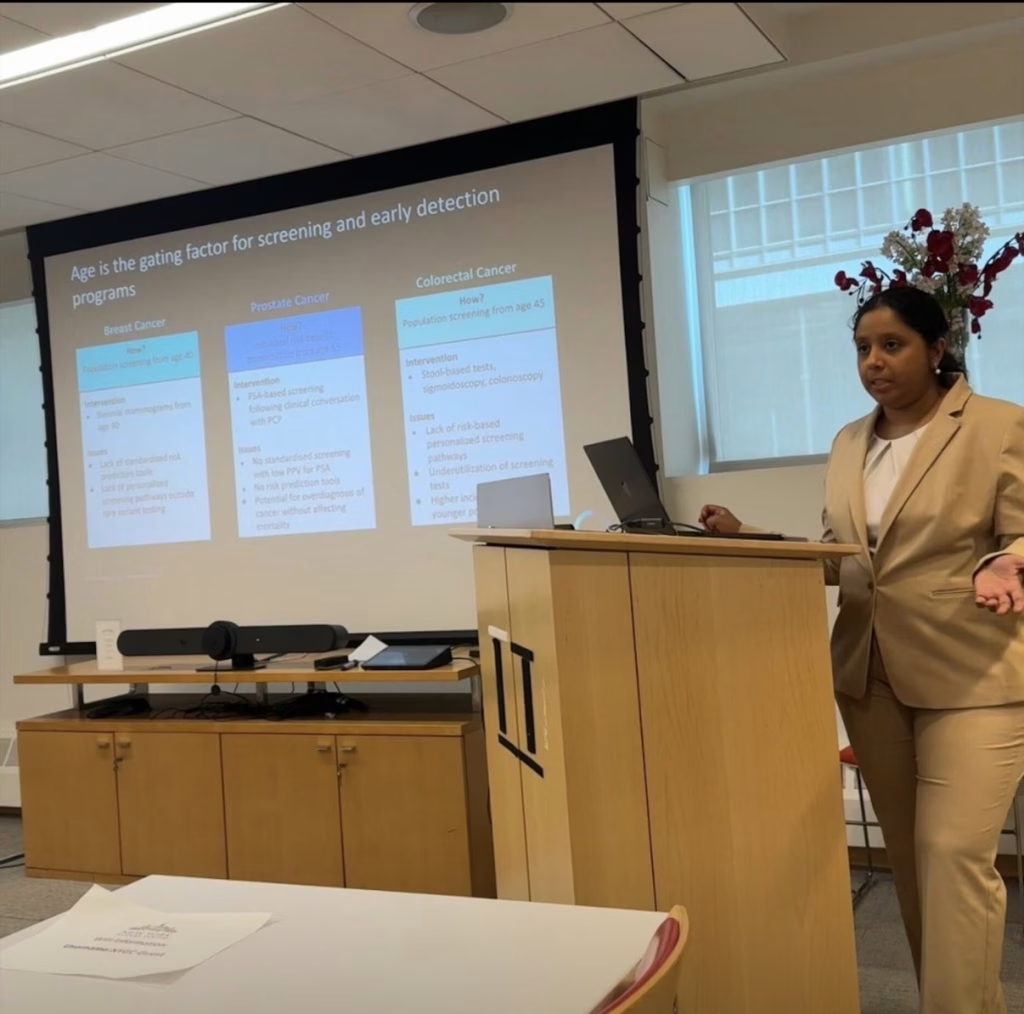
The work you choose to do has the power to change lives in ways you may never fully see — but trust that it matters deeply. Every experiment you run, every question you ask, and every late night spent searching for answers brings us one step closer to helping real people: a grandmother who wants to remember her grandchildren’s names, a father who wants to stay present for his family, a patient who deserves more time. There will be setbacks, failed trials, and moments of doubt. You don’t have to cure a disease overnight. You just have to show up, stay curious, and keep going. The breakthroughs that change the world are built on the small, steady contributions of people who refused to give up. You have more power than you know. Use it for the patients who are waiting.