
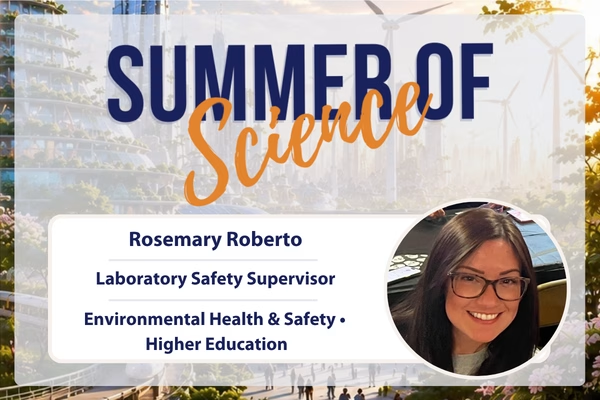
Rosemary Roberto is the Laboratory Safety Supervisor in Environmental Health and Safety at Rowan University, where she helps create safe research environments across science and engineering disciplines. Through laboratory inspections, researcher training, and hazard assessments, she supports the work happening behind scientific discovery every day. Rosemary believes safety isn’t just about knowing the science—it’s about communicating it clearly, building systems people will follow, and creating environments where researchers can thrive. Alongside her work in laboratory safety, she studies equity in STEM and advocates for more inclusive research and learning environments.
A Day in the Life of a Laboratory Safety Supervisor
What does a typical day in your role look like?
As Laboratory Safety Supervisor in Environmental Health and Safety at Rowan University, I oversee the safety of faculty, staff, and students working across an incredibly wide range of disciplines – physics, biology, chemistry, environmental science, chemical engineering, mechanical engineering, and civil engineering, to name a few. A typical day might start with a lab inspection, move into training new researchers on proper safety protocols, and end with reviewing a hazard assessment for a new research project. I also teach a graduate-level course, Industrial Health and Safety, in the Environmental Sciences department, so some days include stepping into the classroom to help train the next generation of safety professionals. No two days look exactly alike, but the goal is always the same: making sure people can do their best work without getting hurt.
How would you explain your field of work to a kindergarten class?
My job is to help keep scientists safe while they do their experiments. Just like you wear a helmet when you ride your bike, scientists need special gear and rules to stay safe when they’re working with things that could be hot, sharp, or a little bit dangerous. I visit labs all around campus to make sure everyone has what they need to stay safe, and I teach people the smart way to do their work, so nobody gets hurt.
The Path to Laboratory Safety
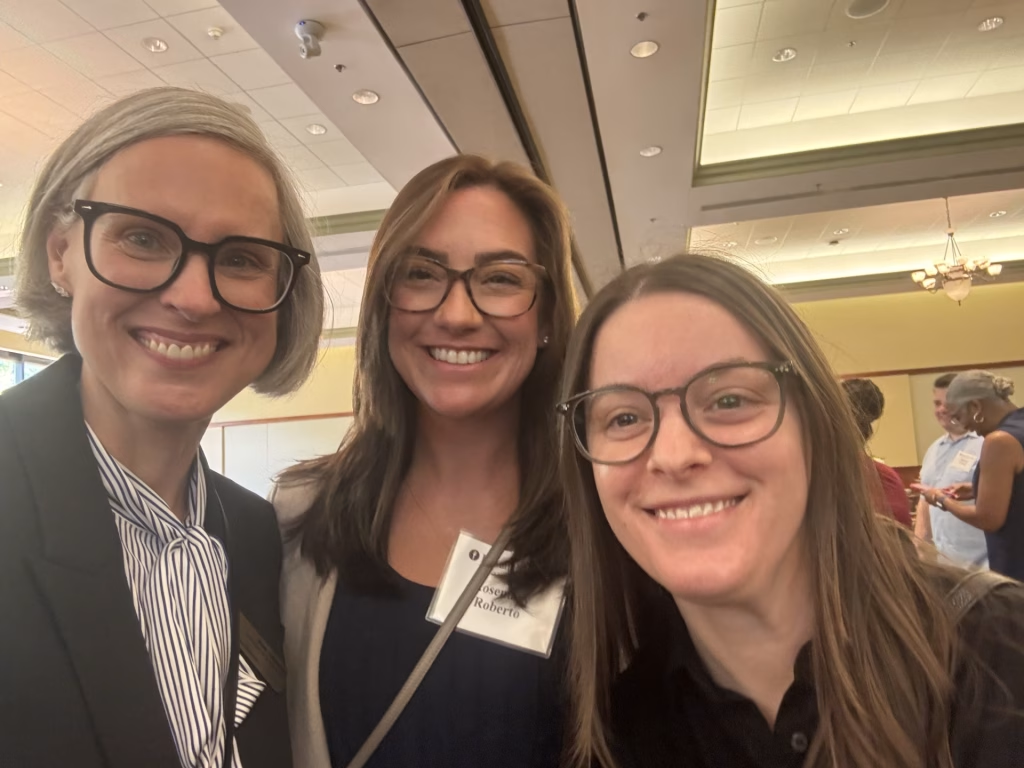
I earned my A.S. in Sciences, my B.S. in Biological Sciences, my M.S. in Business Management, and, in 2025, my Ed.D. in Educational Leadership. Before moving into higher education, I worked in healthcare and the pharmaceutical industry. That combination – a science background, a business lens, and a leadership degree – has shaped how I approach my role today. Safety isn’t just about knowing the science; it’s about communicating it clearly, building systems people will actually follow, and leading with empathy across departments that don’t always speak the same technical language.
I’ve always loved the sciences and genuinely enjoy learning new things – that curiosity is what first pulled me in. Over the years, though, I’ve become just as passionate about advocating for underrepresented communities, particularly women, in STEM. What keeps me excited today is the chance to combine both: staying connected to science while pushing for a field that’s more equitable for the people coming up behind me. Watching my niece and nephew discover new things and grow their own love for science has reignited that drive – I want to help build a future where the barriers myself and others navigated are dismantled, and they have every opportunity to pursue whatever they want.
A lesser-known part of my job is just how many different scientific “languages” I have to speak in a single day. The safety considerations for a chemistry lab, a physics lab, and a civil engineering research site are all completely different, so I’m constantly shifting context – reviewing chemical compatibility one hour and structural or mechanical hazards the next. It keeps me learning across disciplines I never formally studied, and it’s probably the part of the role people outside the field would find most surprising.
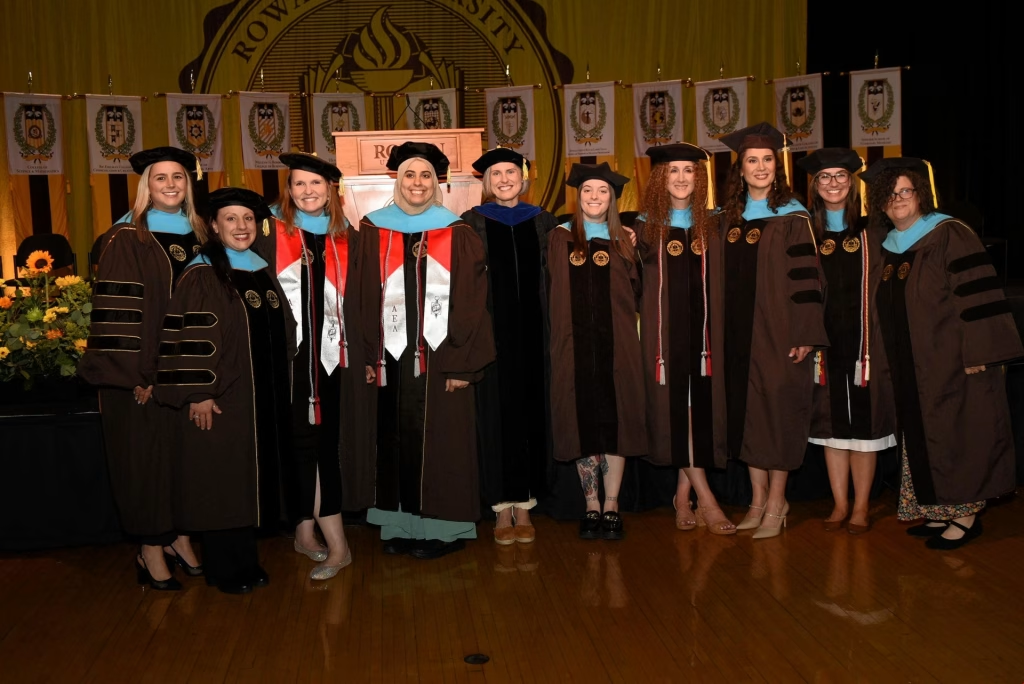
Graduating with my doctorate in 2025 was a milestone, as was having my blog featured on AWIS’s The Nucleus. I’m also finalizing two publications: “Disrupting Homeostasis in the Classroom” for The American Biology Teacher, and “The Myth of Equity” for the Journal of Women and Gender in Higher Ed.
The Science That Moves Us Forward
How has AWIS helped you professionally/or personally?
I became an AWIS member because I was looking for community – other people who feel as passionately as I do about advocating for women in STEM. I work mostly with men, so having outside support, and seeing other women succeed and lead, has been genuinely meaningful, both personally and professionally.
How has your work/research helped drive discovery, innovation, or impact?
My work sits at the intersection of safety and science – making sure that faculty, staff, and students across physics, biology, chemistry, environmental science, and multiple engineering disciplines have the training and systems in place to do rigorous research safely. Beyond the day-to-day safety oversight, my research and writing focus on equity in STEM – looking critically at whether representation numbers actually translate into inclusive, equitable environments, and giving faculty practical tools to address sexism in their classrooms. My upcoming piece, “Disrupting Homeostasis in the Classroom,” captures that idea directly: just like a biological system, a classroom in balance isn’t necessarily a classroom that’s fair, and sometimes real progress means disrupting that balance on purpose.
Where do you see your work heading next?
I hope to eventually find a role where I can stay connected to the sciences while advocacy plays an even larger part of my work. My research on equity and representation in STEM feels like the beginning of that next chapter, and I’m looking forward to continuing to build on it.
How do you see your work helping shape the future of STEM?
I think real progress in STEM requires looking honestly at whether the numbers we celebrate – more women enrolled, more women hired – actually reflect equity, or just visibility. My work pushes on that question, and I hope it encourages other departments and institutions to look past headcounts and examine the day-to-day experience of the women in their programs.
To a Future Scientist Just Starting Out
What advice would you give to your younger self / someone just starting out in your field?
Don’t let fear of the unknown or the need for perfectionism drive your decisions – allow yourself to make mistakes. What matters isn’t avoiding them, it’s how you respond once you realize you’ve made one. That mindset is what freed me to follow what I was actually passionate about, even when it took my career somewhere I didn’t originally plan. For years, I thought science and caring about people were separate tracks, but the most meaningful work I’ve done combines both. So don’t feel like you have to choose – and remember, advocating for others isn’t optional. It’s everyone’s responsibility.
What are some strategies you use to maintain resilience and persistence in the face of obstacles?
Community has been essential for me — finding people who understand what it’s like to advocate for change in spaces that don’t always welcome it. I was very fortunate to have a great group of people in my cohort for my doctoral program. Once we graduated, our regular meeting obviously stopped so I started looking for groups to join and found AWIS. I also try to stay curious even when things are hard; treating a setback as something to learn from, rather than something that defines me, has helped me keep going through a doctorate, a career change, and years of pushing for equity in spaces dominated by men.

What message would you share with future scientists about the power they hold to make a difference?
Your voice matters more than you realize. Keep asking questions, and don’t settle for “this is how it’s always been” as an answer. Push your thinking so you can continue to learn and grow. And remember that advocacy is part of science – asking hard questions about who’s represented, who’s supported, and who’s actually thriving in our field is just as important as the research itself. Diverse teams bring diverse perspectives, and diverse perspectives are what drive the kind of innovative thinking that moves science forward. You don’t have to wait until you’re in a position of power to start pushing for change. Start where you are, with the community you have, and it adds up.