
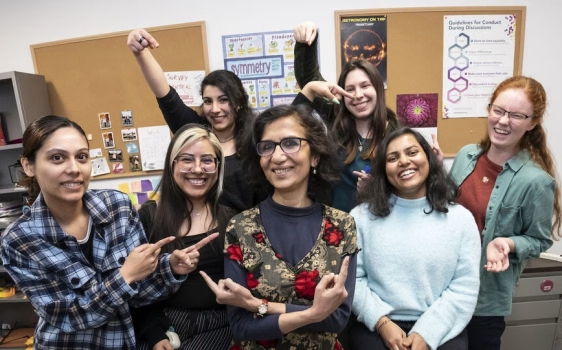
When Sarvagna Bonangi, a Penn State undergraduate student, walked into her introductory calculus-based physics class, she found that she was one of only a few women in the room. Although she excelled in solving physics problems, she felt intimidated and wondered if she belonged in a traditionally male-dominated field.
Experiences like hers can leave even the most motivated and talented students feeling isolated or out of place. This common situation raises an important question: What helps women students stay in physics?
Researchers in physics education have spent decades studying this question. Their findings suggest that improving representation alone is not enough. Students more readily stay in physics if they experience a supportive environment and develop a sense of belonging. Distinguished Professor of Physics and Physics Education researcher Dr. Chandralekha Singh, who works at the University of Pittsburgh, explains that fostering a sense of belonging is one of the most powerful ways departments can support undergraduate women in physics.
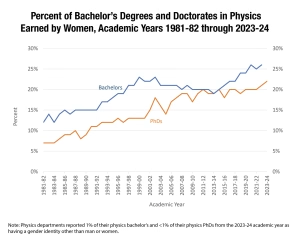
Despite progress, women still earn only 25% of bachelor’s degrees in physics. [Figure 1] This statistic signals the need to transform their undergraduate experience. Conversations with Dr. Singh and three current women physics students reveal several critical supports that promote student retention, beginning with helping them build confidence. These supports are not unique to physics but are relevant across STEM disciplines.
Confidence Gap
Bonangi’s experience is not unique, according to Dr. Singh’s research on self-efficacy (an individual’s belief in their capacity to reach specific goals). Her work suggests that many women in physics report lower confidence than their male peers report, even when they achieve similar academic results. One striking finding of Dr. Singh’s collaborative work concerns how women who score an A grade often report confidence levels comparable to men who have a C. Furthermore, her study finds that undergraduate women in physics report lower confidence in their ability to succeed than their male peers report. This finding suggests a difference in self-perception rather than a difference in achievement.

Indeed, Dr. Singh describes this difference as a confidence gap that does not reflect women’s actual ability. She argues that the confidence gap is due to low self-efficacy, which stems from stereotypes about scientific brilliance, lack of representation, and a classroom culture that unintentionally undermines confidence. “Some women question their place in physics, asking themselves, ‘Why am I here in the first place? Am I really interested in this?’” she notes. When capable students experience such doubts, it can decrease their confidence. Science departments can build the self-assurance of women by giving them a sense of belonging.
Why Belonging Matters
According to Dr. Singh, “Struggling is good, and you should pat yourself on the back when you are struggling; it means you are learning.” Struggling, however, should not consist of a personal, isolated experience. When students openly acknowledge their academic challenges, their peers realize that they are not alone. In one study, Dr. Singh and her colleagues implemented an “ecological belonging intervention.” The intervention involved students reflecting on their academic challenges, reading testimonials from other students, and discussing strategies to overcome obstacles. The intervention resulted in improved academic outcome among women students. “Such interventions shift students from a fixed to a growth mindset, normalizing struggle and encouraging persistence,” she notes.
Building Community
The impact of belonging should extend beyond classroom interventions. It also springs from everyday interactions with peers, instructors, and mentors. Bonangi describes how group chats and collaborative study sessions helped her succeed in her physics courses: “Over time, collaboration with peers replaced intimidation.” She also found that approachable and supportive professors and teaching assistants increased her interest in physics. In fact, research from the American Institute of Physics shows that women often credit their teachers and professors for inspiring them to pursue physics. [Figure 2]
Another student, Vaarsha Venkitesh, a junior physics major at Rutgers University, echoes this sentiment: “I also met more physics majors as I moved into advanced classes, which increased my motivation because we were able to collaborate and support one another,” she notes. These experiences align with Dr. Singh’s findings that peer support and positive recognition from instructors prove critical for students’ persistence in physics.
According to Dr. Singh, departments can also foster a sense of community by providing welcoming common spaces like student lounges. However, she emphasizes that having these spaces is not enough; departments must also set clear expectations for respectful behavior, so all students feel comfortable participating.
Visibility and Research Opportunities
Opportunities for involvement in the broader physics community are also important. Unfortunately, many undergraduate students do not learn about these options until later in their academic journey. Bonangi shares, “I didn’t know [that wider opportunities were] possible for undergraduate students until the summer of my sophomore year.” Similarly, Venkitesh wishes she had known more about clubs and internships: “Having more awareness of these opportunities earlier in my academic career would likely have encouraged me to become more involved outside the classroom, she says.”
Dr. Singh says that in her department, “Generally, about half of our undergraduate physics majors participate in research as a part of the Undergraduate Research Experience program. But we need to do more to ensure that all students, especially women, are aware of these opportunities in their freshman year.” She also emphasizes that early research experiences help our students understand the work of physicists. Students begin to develop a physics identity while learning the importance of persistence in the field. She suggests that paid internships and positions should also be widely advertised. For example, programs such as the Conference for Undergraduate Women in Physics provide valuable opportunities for networking and exposure to various career pathways in physics. Dr. Singh adds that mentoring relationships with graduate students and postdoctoral researchers further strengthen students’ sense of belonging, provide professional development opportunities, and help them see themselves as future physicists.
Finding a Place in Physics
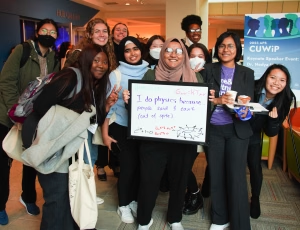
For Iman Shaikh, a junior physics major at Widener University, belonging is closely tied to recognition and ownership of her work. As the only woman in her lab, she often felt isolated and at times questioned whether she truly belonged, despite her significant contributions. Inspired by the story of Dr. Jocelyn Bell Burnell, who discovered the pulsar, Shaikh began to rethink her doubts: “I realized that I should not undersell my place in physics, no matter how small it is,” she asserts. Her experience highlights a key finding from Dr. Singh’s research: Perceived recognition is one of the strongest predictors of physics identity. A professor’s praise, a mentor’s support, or acknowledgment of a student’s contribution can strengthen a student’s sense of belonging and reinforce their identity as a “physics person.”
A Message to Future Physicists
Dr. Singh offers advice to young women who sometimes feel like outsiders in the profession. She emphasizes that struggle and mistakes, rather than signs of weakness, are essential parts of learning. “If you are challenging yourself, it means you are growing,” she says. She encourages students to ask questions, embrace mistakes, and remember the impact of physics, from medical breakthroughs like the MRI to advances in quantum computing. “Every student, regardless of background or experience, should learn by asking questions, exploring, and working through difficult problems,” Dr. Singh adds.
Her message is clear: Do not let self-doubt define your place in physics. Your questions and contributions matter. As Shaikh came to realize, you do not need permission to belong. When women are willing to work hard and take on challenges, they already have a place in physics.
 Shruti Shrestha, PhD, is an Assistant Teaching Professor of Physics at Penn State Brandywine. As a particle physicist, she has worked on the High Voltage Monolithic Active Pixel sensor for the Mu3e Experiment. She also conducts free workshops in the Philadelphia area to motivate and empower girls to pursue STEM degrees. The author acknowledges Chole Muller, an undergraduate student and AWIS member, for her contributions to developing interview questions for this article.
This article was originally published in AWIS Magazine. Join AWIS to access the full issue of AWIS Magazine and more member benefits.