
Scientific research careers can be very rewarding but also demanding and filled with uncertainty, especially for scientists who are faced with the challenges of starting a family while juggling demanding careers. For those who are pursuing academic faculty roles, a career path towards a tenure-track Assistant Professor position which allows someone to lead an independent lab as Principal Investigator requires lengthy doctoral and postdoctoral training, oftentimes a combined 10+ years of training after an undergraduate degree, while receiving a stipend as “trainee”. Openings for faculty positions in biomedical sciences are limited, fueling pressures to publish impactful research and obtain competitive research funding to demonstrate potential for success. Once an individual secures an Assistant Professor role, the tenure clock begins, adding the need to hire, train, mentor and retain lab personnel and serve on committees to achieve promotion and tenure in addition to the ongoing requirements to write manuscripts and apply for grants. Furthermore, training in scientific research careers often requires relocation to geographical areas with high-density research environments, which uproots individuals from their family support system when trying to raise a family. These among many other challenges faced by parenting scientists-in-training catalyzed the Harvard Cancer Consortium’s (HCC) education and training office, Pathfinder, to create and host their first Parenting and Science Careers Panel on September 30, 2026.
Beyond professional challenges, there are many financial considerations to take into account when starting a family— the need for funds to pay for larger living space and to cover the costs of healthcare and childcare, to name a few. The National Institutes of Health (NIH) minimum postdoctoral stipend for fiscal year 2026 is $63,480 for 0 years of postdoctoral experience, with the pay scale sliding up to $77,076 for 7+ years of postdoc experience; all institutions receiving NIH training grants or fellowships are mandated to follow these minimum salary guidelines. However, many research institutions are clustered in high cost of living (HCOL) geographical areas, where rising rent and daycare costs cannot be covered with the income of a postdoctoral fellow.
The inaugural Parenting and Science Careers session included three panelists, representing diverse scientific careers in industry and academia: Sam Linder, PhD, Associate Principal Scientist of Discovery at AstraZeneca; Christopher Ott, PhD, Assistant Professor at Harvard Medical School and Massachusetts General Hospital; and Chadene Tremaglio, PhD, Associate Professor of Biology at the University of St. Joseph. The series is a natural extension of the role of Pathfinder in supporting the training and career development of early-career investigators, including PhD, MD, and MD-PhD-trained postdoctoral and clinical fellows and instructors, at HCC-affiliated institutions. Liz Salomon, Senior Program Manager of Pathfinder, says, “As we’ve spoken with cancer-focused postdocs, clinical fellows and instructors across the HCC community, we’ve heard a lot about both the joys and the challenges of juggling parenthood with the demands of developing research careers. We created this series to provide a forum for cross-sharing and community-building.”
For many, becoming a parent requires re-examining time allocation and life priorities, inevitably transforming their relationship with work and how they think about their future. Parenting changes career decisions and which jobs one chooses to pursue. It involves making compromises and choices to fit raising a family with your and your partner’s or other support peoples’ careers.
Dr. Tremaglio had her first child during her PhD training at Boston University School of Medicine, and her second child during postdoctoral training at Dana-Farber Cancer Institute. She quickly realized that Boston was an expensive place to raise a family, especially while a postdoc and with two children in daycare. Following her husband’s medical residency, Dr. Tremaglio completed her postdoctoral research project, and they moved to Connecticut to be closer to family. Dr. Tremaglio shifted her attention to raising her children full-time while researching other career options. During this time, she explored different avenues utilizing her scientific knowledge, including serving as a freelance science writer, illustrator, and co-host of an immunology podcast. Two years later, thanks to a “chance encounter” with a parent from her son’s T-ball team, she had the opportunity to take on an Adjunct Faculty position at the University of St. Joseph, where she discovered her passion for education and teaching. This experience positioned her for a tenure-track faculty position when the opportunity arose, and she is happily still serving in this role today.
For Dr. Linder, the birth of her son toward the end of her PhD at Harvard Medical School forced her out of the “tunnel vision of PhD training” to priorities that come with raising a family, including financial stability. Following her PhD, Dr. Linder joined Chroma Medicine as its founding scientist, balancing having an infant with building a company. She next transitioned to AstraZeneca and from being a bench scientist to a managerial role, which allowed more work flexibility. Due to the demanding nature of biotech startups, Dr. Linder notes the importance of having “read the room” when interviewing to choose the right work environment and supportive supervisor who would be understanding with unexpected childcare demands. Dr. Linder and her wife also decided to move closer to family for childcare support and emphasized the importance of being creative to find solutions that will best align with family financial situations and childcare needs.
 Dr. Ott was a postdoctoral fellow at Dana-Farber Cancer Institute prior to becoming Assistant Professor at Harvard Medical School and leading a lab as Principal Investigator at Massachusetts General Hospital. His first child was born during the first year that he began his independent lab and he and his wife now have a second child as well. In Dr. Ott’s experience, leading a lab as Principal Investigator inherently provides a lot of schedule flexibility to fit with childcare needs. In addition, it has provided the financial resources to choose a daycare of choice. He notes that the nature of the job has been extremely supportive for building a family. However, this might not have been the case had he and his wife decided to have children earlier “I don’t know that had I, my wife and I, decided to start a family during my postdoc years when she was still a graduate student, we would have [had] to make very different choices.” That said, Dr. Ott shared, “There have been challenges, but tons of joys. And I think navigating the postdoc to faculty transition at the same time as navigating the not being a dad to being a dad transition – it’s a unique experience and one that I’m still living.”
The Parenting and Science Careers panelists shared that the biggest challenge they face as a parent with a scientific career is time. The exploratory nature of scientific research often means that work hours extend outside the typical 9-to-5, 40-hour work week. Dr. Ott explained that in the lab research culture, there is a mindset that the more time you spend in the lab, the more data you generate, the more likely you are to find something that you can publish which will give you the best chance at the next job or the next grant. His fellow panelists commented that they used to spend all their time in the lab but have had to adjust their work hours to fit with daycare schedules and children’s extracurricular activities. Furthermore, when their children get sick, taking the time off from work to take them to the doctor and care for them until they can return to daycare or school can upend carefully planned days of work. Dr. Linder shared that finding the time to do all the things you have to do at work and to raise a child requires a lot of self-regulation and making decisions based on necessity. It becomes critical to be efficient and able to identify the essential tasks that must be completed at work each day versus the tasks that can wait in order to leave the required time to be a parent and partner (if applicable) alongside their careers.
The panelists recommended three key “best practices” for parents in science careers:
- Raising a family takes a village. Don’t be a hero trying to do this all by yourself and don’t be afraid to ask for help. Establish a network of friends, neighbors, mentors, and coworkers to rely on and to make navigating the demands of work and parenting manageable. Cultivate mentors in your life who serve as positive role models of what parenting in the workplace can look like. Seek workplaces where you feel supported and not alone. As Dr. Tremaglio shared, “[one other major challenge] is making sure that my needs in the workplace are being respected and understood…. And some of that comes down to having colleagues who are in the same boat. Where I currently work, a lot of us are parents, it is just sort of the culture here, and so I don’t have to explain myself when I need to run out the door and take care of kids for some reason or another, but I have worked in places where that was not the norm.”
- Communicate with your manager, partner and others in your network. Set a Sunday night meeting with your partner or others who support you in your parenting role to look over your calendars and discuss work schedules, travel to conferences, extracurricular activities, and any childcare duties that need to be coordinated. Be clear about your work schedule and needs, while remaining flexible and open to compromise. In the workplace, set boundaries and do not wait for permission to prioritize your family.
- Self-calibrate periodically (every 6-12 months) and check-in with the family unit to evaluate both career and family goals. Dr. Linder explained, “Your family is like a small business. If you care so much about the way your day-to-day works, why aren’t you putting that same level of effort into your family unit?” Parenting challenges evolve as children age, and thus, systems to coordinate work and parenting need to change as well.
Many STEM students and professionals may not be aware of the parenting supports available through their institution, especially if they do not see peers or supervisors tapping into these resources. Dr. Ott did not take parental leave when he and his wife had their first child, but when his second child was born, he took advantage of the time off that was given and noted that the lab did not lose momentum. Trainees may also not feel empowered to take full advantage of the resources available to them. In a lab culture that praises and rewards scientists who put in extra work hours to make the breakthrough, publish, get funding, or meet quarterly milestones, many may feel that taking full parental leave, for example, might be perceived as lacking commitment. Organizations should provide resources and, as supervisors, Principal Investigators should encourage their graduate students and postdoctoral fellows, including non-birthing parents, to use them.
While there are difficulties in parenting alongside a scientific career, there are also joys. Panelists agreed that having children makes their lives more full, from the expanded network of friends when meeting parents of their children’s friends, picking up hobbies that got left behind during the busy graduate school years, and sharing them with their children, and importantly, being in the moment spending time with their children and providing fun experiences for them is a reminder that there is life outside of a career.
Panelists reminded the audience to prioritize their family’s needs, and that it is possible to be a very ambitious scientist and be present for your family—it just requires a lot of organization and thoughtfulness. For Dr. Ott, carving dedicated time for the family by not working on evenings and weekends, and making that the norm, has worked to create balance between family and career. In the end, there is no “one-size-fits-all” solution for raising a family while navigating a career in science.
This is why HCC created this series. “We hope that these panels will create a space where trainees can hear from more senior researchers about how they balance their careers, child-rearing and their own well-being, learn about resources and strategies, and feel less alone in their own journeys,” said Ms. Salomon. The more support that parents have will enable them to remain productive at work, avoid burnout, and succeed in their career of choice.
Harvard Cancer Consortium (HCC) is one of the largest cancer research consortia in the country, is National Cancer Institute (NCI)-designated as a comprehensive cancer center funded through a Cancer Center Support Grant awarded by the NCI and is composed of more than 1,100 cancer researchers across five Boston academic medical institutions and two Harvard Schools.
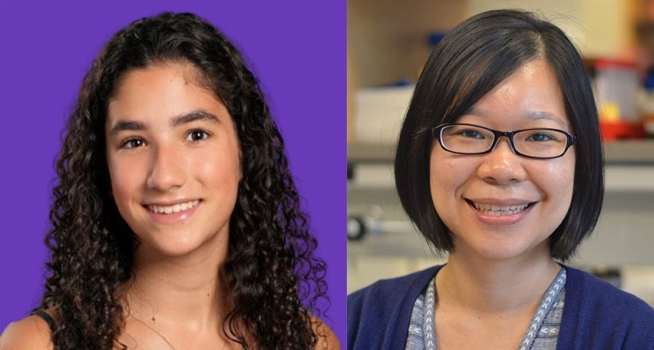
 Gillian Katz is a senior at Lane Tech High School in Chicago. Next fall she is planning to major in biology and ultimately pursue a career in genetics research. She loves running and has two dogs.
 Isabel Lam, PhD, is a Program Administrator at Dana-Farber Cancer Institute and the Harvard Cancer Consortium involved in training and career development of early-career investigators. She holds a PhD in Biomedical Sciences from Gerstner Sloan Kettering Graduate School of Biomedical Sciences and was a Postdoctoral Research Fellow at Brigham and Women’s Hospital and Harvard Medical School.