

We can learn some of the most important lessons about sustainable food systems by venturing far outside the laboratory. My time in the Kimaut community in Kenya offered one such opportunity.
During an Engineers Without Borders-USA implementation and monitoring trip, I spent time visiting households, engaging with farmers, and observing daily food preparation practices within the community. Although we primarily focused on water infrastructure, we quickly observed how deeply water access connects to food safety, to food preservation, and, ultimately, to food security. The trip gave me the chance to view each interaction through both a scientific and a deeply human lens.
Throughout my academic and research journey, I have focused on sustainability, food safety, and the extension of food’s shelf life to reduce loss and waste. My academic path began with a bachelor’s degree in food engineering in my home country of Türkiye and continued through my master’s and PhD studies at Texas A&M University, followed by postdoctoral research at Massachusetts Institute of Technology. Across these years, I have studied how food preservation systems, packaging technologies, and safetyfocused innovations can strengthen sustainability and improve food security. I have committed myself to translating scientific innovation into sustainable solutions that improve food safety, extend shelf life, and reduce preventable losses across food systems.
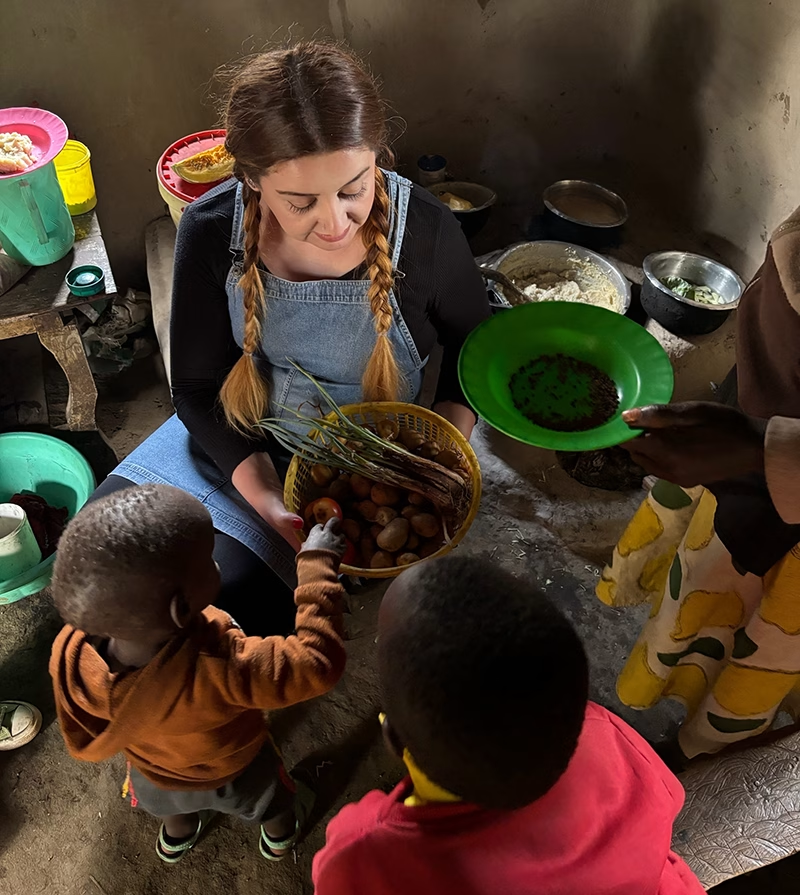
One of the most memorable parts of the Kenya trip involved spending time with families during household visits, where I learned how to prepare ugali, a staple maizebased dish cooked over an open fire and shared as part of daily meals across much of East Africa. Cooking alongside Kenyans in their traditional kitchens and sharing meals together offered much more than cultural immersion. Sharing that experience with families offered meaningful insight into the daily realities that shape food preparation, preservation, and food safety within their households.
What stood out most during these visits was how strongly food safety depends on both infrastructure and knowledge. Access to clean water is essential not only for safe drinking but also for washing ingredients, cleaning cooking utensils, and maintaining proper hygiene during food preparation. At the same time, awareness of contamination risks, handwashing practices, and safe food-handling techniques plays a critical role in ensuring that people can consume available food safely.
Another observation that has stayed with me relates to the impact of limited cold storage. Without refrigeration or practical preservation options, households often have to prepare fresh food and in smaller portions because they can rarely store cooked meals safely for later use. This means families must engage in food preparation daily, increasing the time and labor they commit to this chore and facing a greater risk of spoilage, all of which contribute to household-level food waste. Seeing this up close gave me a powerful reminder that food waste does not always result from overconsumption or poor planning. In many communities, infrastructure limitations create the problems
Another observation that has stayed with me relates to the impact of limited cold storage. Without refrigeration or practical preservation options, households often have to prepare fresh food and in smaller portions because they can rarely store cooked meals safely for later use. This means families must engage in food preparation daily, increasing the time and labor they commit to this chore and facing a greater risk of spoilage, all of which contribute to household-level food waste. Seeing this up close gave me a powerful reminder that food waste does not always result from overconsumption or poor planning. In many communities, infrastructure limitations create the problems
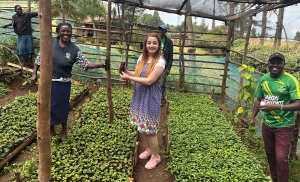
This same systems-level challenge became even more apparent during conversations with farmers in the Kimaut community. Agriculture is central to livelihoods there, yet many farmers described significant postharvest losses of perishable produce due to limited cold storage, lack of local food processing opportunities, and insufficient preservation methods. They often lost crops before consumers could buy or consume them, food that required only a modest extension in shelf life to reach markets or households.
These discussions resonated strongly with my scientific background because they reflected many of the challenges I have spent years studying. We design such tools as shelf-life extension, food processing technologies, packaging innovations, and preservation systems to address exactly these kinds of losses. Yet the experience in the Kimaut community reinforced for me that people need more than scientific knowledge alone. The challenge rarely results from absent technical solutions; rather, it results from the lack of systems that allow practical, accessible, and sustainable implementation of those solutions within local contexts.
I took particular inspiration from talking with farmers and community members about their great interest in solutions that could help preserve crops longer, reduce losses, and create stronger economic resilience. These conversations highlighted how reducing food loss is about far more than preserving produce. Mitigating such loss protects livelihoods, strengthens household stability, and improves food security for entire communities.
The trip tangibly reinforced something my years of academic research had already taught me: We cannot approach food systems in isolation. Water access, sanitation, hygiene education, food safety knowledge, preservation technologies, and agricultural infrastructure all interconnect. If the system lacks one of these parts, the effects ripple across every stage of the food chain, from production to preparation to consumption.
As a woman in STEM working at the intersection of sustainability, engineering, and applied food systems research, this experience deepened my understanding of how scientific knowledge creates a meaningful impact when it extends beyond the laboratory and engages directly with real-world challenges. We cannot build sustainable solutions solely through technical innovation; we can only build them through listening, collaborating, and designing systems that reflect the realities of the communities they are intended to serve.
My time with families and farmers in the Kimaut community reminded me that food loss and food waste are not inevitable outcomes. Instead, they spotlight systems that have opportunities for improvement. Addressing them requires not only scientific expertise but also systems thinking, interdisciplinary collaboration, and a commitment to creating solutions that prove both technically sound and locally meaningful.
Ensuring that food fulfills its purpose— nourishing people rather than degrading before reaching them—is not only a scientific challenge, but one of the clearest pathways toward a more sustainable and resilient future.
 Dr. Yagmur Yegin is a scientist and engineer who earned an MS and PhD from Texas A&M University and completed postdoctoral research at MIT. Dr. Yegin’s work centers on formulation science, antimicrobial technologies, and environmentally friendly material systems, with applications in consumer products, food safety, and sustainable packaging. She has contributed to interdisciplinary research across academia and industry, including in the development of biodegradable packaging, antimicrobial systems, and nano- and microparticle technologies aimed at replacing intentionally added microplastics in consumer formulations. Throughout Dr. Yegin’s career, she has authored over 30 peer-reviewed publications, book chapters, and patents and has received numerous awards recognizing her contributions to science and engineering. Outside of her professional work, Dr. Yegin enjoys cooking, road trips, spending time with family, and volunteering for charitable causes.
This article was originally published in AWIS Magazine. Join AWIS to access the full issue of AWIS Magazine and more member benefits.