
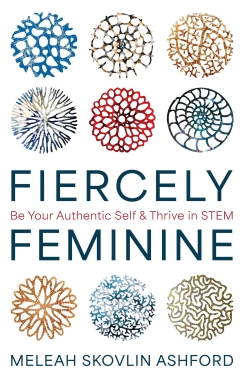
When Meleah Skovlin Ashford told friends that it had taken four years to write her new book, another woman engineer gently corrected her: The book had taken her entire life. After 30 years as a water resources engineer, Ashford had accumulated experiences she did not fully recognize until she stepped away from the profession. “When I was working, I didn’t see the inequities or challenges; I accepted them,” she says.
Published in August, Fiercely Feminine: Be Your Authentic Self & Thrive in STEM, grew out of Ashford’s reexamination of the adaptations that helped her build a successful career. She had learned to remain guarded, work independently, and enter meetings prepared to defend a predetermined answer. Those habits could resemble confidence, but they also made asking for help or listening to colleagues harder.
Ashford, now a life coach and the founder of both an engineering firm and a coaching practice, wants women to imagine success more expansively. Her book asks what women could accomplish if their success in STEM didn’t depend on adapting to its existing culture.
Recognizing the Armor
Ashford describes the version of herself who succeeded in engineering as “highly armored.” That armor did not make her appear tough. It shaped how she worked, related to colleagues, and responded to uncertainty. “I built a wall around myself,” she says. Behind it, she became isolated, reluctant to seek support, and convinced that she should have every answer.

Ashford clung to this armor most tightly in meetings. She arrived with a solution already in mind and felt responsible for defending it. “Say we (went) into a meeting; I felt like I had to know the answer before we even started, and then I had to defend that answer, so I wasn’t open,” she insists. Control offered protection, but it also limited the possibility that a perspective might lead to a better result.
She did not recognize these habits as protective adaptations while she was immersed in her career. “After some therapy, yoga, and mindfulness work, I began to see that I always guarded myself,” Ashford says. Lowering her guard did not require abandoning competence or rigor. Instead, it allowed her to ask questions, seek help, and work more collaboratively.
Redefining Feminine
In reexamining the word feminine, Ashford invites us to join her in a reframe: “I like to think of it as feminine energy, and that takes away a little of the [word’s stereotypical] charge,” she explains. She associates that energy with empathy, intuition, creativity, and community: the very qualities that workplaces often dismiss as soft but which actually represent vital professional strengths. The fierceness in her book title comes from protecting those strengths, establishing boundaries, and refusing to confuse authenticity with weakness.
“I’d love to see the connotation of feminine change to strength, the same way I’d love to see the stereotypical picture of a doctor, lawyer, or scientist change to be [either] a woman or a man,” Ashford says. She does not prescribe how women should look or behave, nor does she decide whether these qualities arise from biology or socialization.
Ashford emphasizes flexibility. “We all have feminine and masculine energy, and the key is to find a good balance, not necessarily to be one or the other.” She deliberately pairs fierce and feminine. Fierceness can mean defending a boundary, pursuing an opportunity, or protecting the empathy and creativity a professional culture might discourage. As Ashford observes, “Newer leadership styles use intuition, creativity, and collaboration, which I believe are traits of feminine energy.” Ashford argues that those qualities belong in the workplace.
Who Gets to Look Like an Engineer?
Throughout her career, people told Ashford that she did not look like a typical engineer. The comment may have seemed casual to the person making it, but Ashford heard a more consequential message. “It tells a woman, ‘You don’t belong here,’ and you begin to question your identity,” she says. Instead of concentrating on the work, she had to spend energy reconsidering whether she truly had a place in the profession.
If you hear such comments repeatedly, they can diminish your confidence. “By itself, this comment isn’t a big deal, but when you hear it over and over, on top of the other gender challenges you are facing, it eats away at your confidence,” she notes. The issue wasn’t Ashford’s ability; the comment implied that technical expertise should come from someone who looked different from her.
Changing who belongs in STEM requires more than opening the door to women. It also means expanding the image people carry of an engineer, scientist, doctor, or leader. When women see themselves treated as exceptions, these minor interactions can accumulate into doubt. “Each one of those little incidents in itself is small, but they build,” Ashford points out. Over time, she had to learn to separate other people’s expectations of her from her own ability.
The Freedom to Do Better Work
When Ashford began working primarily with women, she stopped questioning whether she belonged and noticed a sense of ease. “I felt safe working with these women,” she says. “Everyone was supportive and creative.”
Feeling safe changed how Ashford worked. It quieted the self-monitoring that had consumed her attention. She explains, “All that emotional energy that was always buzzing around me about ‘Am I doing it right?’ just slipped away.” By letting go of the part of herself devoted to expectations, she could focus fully on the work itself.
Ashford became less attached to trying to control outcomes. Feeling supported allowed her to listen, experiment, and consider solutions beyond approaches she had previously prepared herself to defend. She believes the more collaborative attitude produces better work: “I think the solutions that we came up with in those scenarios were better solutions rather than just rinse and repeat, rinse and repeat.”
For Ashford, belonging had practical consequences. A supportive team does more than make employees feel welcome. In that environment, she could ask questions, entertain unfamiliar ideas, and find better answers with her colleagues.
Leadership Without Leaving Yourself Behind
Throughout her corporate career, Ashford did not see leadership as something she could claim. “I never wanted to be a leader because I didn’t think I could be one,” she says. She assumed others, mostly men, possessed an understanding that she lacked, rather than recognizing leadership as an array of skills she could learn.
Looking back, Ashford would urge herself to pursue training. “I would tell myself to seek opportunities to learn how to be a leader.” As she set out to build her own business, Ashford found the chance she was seeking. “Owning my own firm gave me freedom that I didn’t feel in my corporate jobs,” she explains. She could set a schedule, invest in opportunities, compensate employees well, and build relationships with clients. “I was much closer to my clients and got to know them better so we could collaborate more.”
Today, Ashford admires women leaders who feel confident in their abilities, support other women, and work to change the system. Their example has expanded her understanding of who can lead and helps her to pay it forward, creating conditions for others to succeed.
Boundaries as Authentic Strength
Ashford does not promote a passive or endlessly accommodating leadership model. She asks women to stay aware of limitations and boundaries and to clearly define and defend what matters. “For instance, sometimes we need to use our masculine energy to defend our boundaries,” she says.
Women who learn to be agreeable and adaptable can feel that setting limits is uncomfortable, and that tension is not foreign to Ashford. She asserts, “I think boundaries are really important. [With our good girl side], we’re taught to have very flexible boundaries and just adapt to everything, but there’s a balance between being adaptable and being a doormat.” Adaptability matters, but it should not require someone to surrender time, energy, opportunities, or self-respect.
Ashford does not reject encouraging women to negotiate or speak assertively. “I think this advice has a place,” she says. For Ashford, the difference lies in acting from a secure sense of identity rather than imitating someone else’s aggressive approach. Instead of copying a masculine model of authority, women can advocate for themselves in ways that remain consistent with their values. “We can be nicely assertive and get the same thing, just holding those boundaries tight.”
In this framework, Ashford distinguishes fierceness from both overaggressiveness and passiveness by recognizing when adaptability has turned into self-erasure, and she needs to hold onto the boundary.
Authenticity Is Not a Substitute for Equity
Ashford does not suggest that confidence alone can repair an inequitable workplace. “I mean, for sure, institutions need to change,” she says. Women should not bear responsibility alone for dismantling the barriers they encounter.
While her book does not primarily focus on institutional reform, Ashford identifies opportunities for employers. “Though it’s not the focus of my book, some things institutions can do include training all staff to recognize microaggressions and inequalities; providing more transparent salaries and promotion guidelines; offering better parental leave policies; and openly recognizing health issues that women deal with during menstruation and menopause.” These policies would give institutional support to the changes Ashford asks individual women to make.
She avoids presenting inequality as a problem women must solve by changing themselves. “I don’t want to say that it’s a woman’s problem and I don’t want my book to be about fixing the woman.”
Ashford sees a role for both women and their employers in addressing workplace inequity. Women who trust their strengths may be positioned to question inequitable practices and to lead differently. Organizations, in turn, must create conditions where authenticity does not prove costly to women.
What Research Reveals About Gender and Leadership
Employers often still associate leadership with masculine qualities. This assumption creates a perceived mismatch between being a woman and being a leader, a problem psychologists refer to as role incongruity. Women may consequently be viewed as less suitable for authority or judged more harshly when they exercise it. Ashford captures the dilemma simply when she says: “It’s a really tough tightrope.”
Research, however, challenges the assumption that if you focus on relationships, you cannot be an effective leader. A meta-analysis found that women leaders demonstrate slightly more transformational leadership, on average, than men do. Transformational practices (including encouraging, developing, and engaging others) are actually associated with leadership effectiveness.
Psychological safety offers another connection to strong leadership, and research echoes Ashford’s experience. Safety supports team-learning behaviors such as asking questions, discussing errors, seeking feedback, and experimenting.
Importantly, research does not establish empathy or collaboration as biologically feminine. That being said, when women face conflicting leadership expectations, their willingness to use relationship skills can improve how teams learn and work.
More Ways to Thrive
Ashford now sees community as a professional resource. “I would tell my younger self to engage with other women for support and to join women’s affinity groups like the Society of Women Engineers,” she says. Connection might have helped her recognize that experiences she treated as shortcomings reflected patterns other women also faced and that taking off her armor could be an opportunity, rather than a vulnerability.
She would definitely encourage that younger engineer to imagine herself as a leader. “I would tell her not to give up on being a leader and to seek leadership training,” she emphasizes. Leadership isn’t something people instinctively know how to do, but they can learn it while staying grounded in their values.
Through Fiercely Feminine, Ashford wants women entering STEM today to recognize possibilities she could not yet see at the beginning of her career. To become successful, they do not have to become better at suppressing themselves. They can seek support, preserve their valued strengths, and widen the field of who belongs and leads in STEM.
 Frances Tietje-Wang is a brewing chemist, researcher, writer, educator, speaker, and stand-up comic with a BS in biochemistry from Le Moyne College in Syracuse, New York. In 2018, they founded Fermly, a data and quality platform for craft beverage producers, and became a TTB-certified brewing chemist. They have contributed to organizations including AFDO, MBAA, ASBC, and the Brewers Association and currently serve as President of the MBAA Rocky Mountain District. Tietje-Wang has spoken internationally on brewing science, quality, and product stability, often finding room for a little comedy along the way. Their writing ranges from technical science to history and pop culture, with a focus on making complex subjects, and the human stories behind them, accessible, engaging, and enjoyable.
This article was originally published in AWIS Magazine. Join AWIS to access the full issue of AWIS Magazine and more member benefits.