

Gender inequality remains a persistent challenge in STEM. Women continue to face systemic barriers, including unconscious biases and unequal access to opportunities, that limit their representation and advancement. However, artificial intelligence has emerged as a transformative tool to address these disparities. By uncovering hidden biases, enabling data-driven interventions, and fostering inclusive practices, Al not only revolutionizes technology but also opens new paths toward gender equity in STEM.

One standout figure in the conversation about Al is Dr. Siobahn Grady. Her current research exposes both the potential for Al to drive equity in STEM and also the dangers involved in not addressing existing biases.
Dr. Grady works as an assistant professor at North Carolina Central University and serves as the Program Director of Information Science at NCCU’s School of Library and Information Sciences. She also recently became the Director of the Laboratory for Artificial Intelligence and Equity Research (LAIER), co-directs the Center for Data Equity, and has earned the role of Office e-Learning Faculty Fellow at NCCU. In 2018, she became the first woman to earn a PhD in computer science from NC Agricultural and Technical State University, and she has gone on to establish six STEM-centered endowed scholarships at all of the historically black colleges/universities within the University of North Carolina system. She continues to blaze an inspirational and lasting legacy for all women in STEM.
It goes without saying that the future of technology is bright with incredible women like Dr. Grady at the helm. Nonetheless, with the excitement of progress comes the complicated questions that Dr. Grady strives to answer: How can we trust Al to make the right choices? How can we find errors or faults before they cause irreversible mental, emotional, and/or physical harm? Could Al exacerbate existing inequities?
Dr. Grady’s research explores a variety of topics, including misinformation on social media and fault detection in autonomous vehicles. Her 2024 publication in the Journal of Nursing Scholarship outlines a comprehensive framework for nurses to use in mitigating bias and preventing discrimination, with help from a clinical algorithm called Bias Elimination for Fair Al in Healthcare (BE FAIR). Her study explains that “if missing data and measurement errors are more prevalent in some patient groups than in others … the model may not adequately represent all patients,” which “plac[es] vulnerable populations at risk for inadequate or inappropriate care.” After examining the three prominent frameworks for addressing bias in Al systems used in health care, her research team presents an original framework that aims to address the six most common types of bias: societal, label, aggregation, representation, evaluation, and human use.

Other articles by Dr. Grady explore misinformation and the urgent need for transparency, such as her 2021 paper on “consumers’ desire for information transparency in self-driving vehicles.” As autonomous cars become a mainstream topic, this research becomes increasingly crucial. She finds, for example, that young adults worry more than middle-aged adults do about automated vehicles providing information that is intentionally difficult to understand or only partially accurate. Full transparency emerges as a clear desire of all the consumers she surveyed, which reflects the larger question that underlies all of Dr. Grady’s work: Can we really trust AI?
Whether you’re enthusiastically embracing artificial intelligence or slightly wary, you can’t deny that AI has an increasing impact on every field of STEM. Seventy-seven percent of companies “either use or explor[e] the use of AI in their businesses,” and eighty-three percent assert that AI is a “top priority in their business plans.” Researchers project that AI will contribute “$15.7 trillion to the global economy by 2030, … eliminate 85 million jobs, [and] create 97 million new ones.” Furthermore, AI has driven innovation in “STEM learning prediction, content delivery, assessment, behavior detection … [and] personalization and adaptive learning,” all crucial considerations for expanding access to STEM education for people whom the current system may not be built to support.

Many STEM environments remain antagonistic to women, ranging from subtly unfriendly to outrightly hostile, and the mere existence of AI will not change that. For minoritized students and employees, stereotypes, sexism, and exclusionary behaviors from their colleagues erode their sense of belonging and self-efficacy. Research shows that in self-reported evaluations, for example, women in mixed-gender teams receive more negative evaluations. However, AI can combat these inequities. Natural language processing (NLP) techniques can capture and analyze the verbal and nonverbal behaviors that reveal team dynamics and offer a more precise and impartial assessment of the team’s collaboration. A 2019 study by Nixon, Lin, and Snow titled “Catalyzing Equity in STEM Teams: Harnessing Generative AI for Inclusion and Diversity” did just that and found that when assessed with objective metrics like “overall responsivity,” “social impact,” and “internal cohesion,” women’s conversations show higher marks in all three areas, dispelling the fear-inducing stereotype that other team members overshadow them. Researchers also view generative AI as a potential tool for constructing inclusive awareness training or curricula for students to address unequal participation and microaggressions, and even for helping teammates to “adaptively respond to the dynamics and needs” of a team, and in this way, promoting inclusivity and equity.
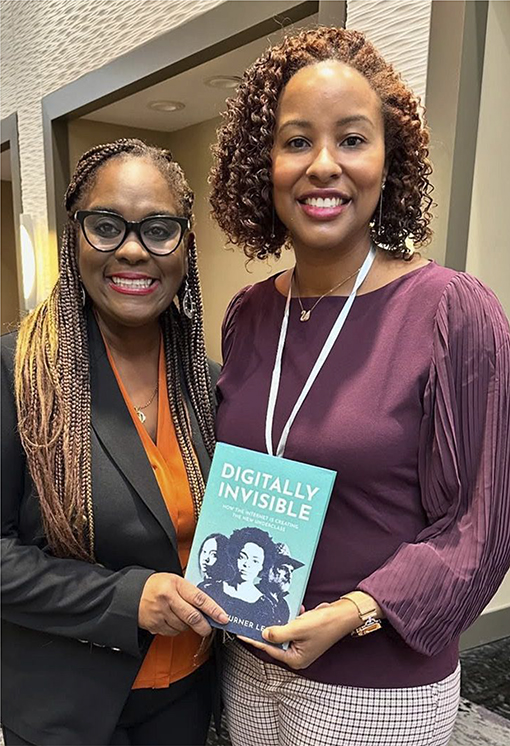
Other AI tools in development focus on identifying and reducing biases in recruitment processes to ensure fairer hiring practices. For instance, companies like HiredScore utilize AI to assist recruiters in making unbiased decisions, which promotes diversity in the workplace. Also, programs like AI4All aim to increase diversity in AI by educating underrepresented groups, including women, and by providing mentorship programs that empower women to pursue careers in AI and related fields. In the media, projects such as SMEEQ employ AI to ensure equal media coverage for female athletes, to challenge stereotypes, and to promote gender equality in sports. Initiatives like On Her Care utilize AI to reduce gender inequalities in healthcare systems by improving diagnostic accuracy for women, which addresses disparities in medical treatment. Dr. Grady herself has presented research on these very topics, such as her poster “Bridging the Digital Divide: Enhancing Literacy and Inclusivity through DELP” through LAIER at the 87th Annual Meeting of the Association for Information Science and Technology in Calgary, Canada. She said in an October 2024 interview that she “wants to understand how I can better serve my students, and also use these tools and technologies so that I can give more personalized experiences for my students.”
Dr. Grady’s impressive work in AI has cemented her prominence as an important contributor to this evolving conversation. She also stands as a role model and trailblazer for all women in STEM. “Our lived intersectional experiences are valid,” Dr. Grady writes in a 2021 article, “[and] it is not easy to express to others who cannot directly relate or identify … [but] the world needs to hear from you. Your story, experiences, tips, strategies, successes and failures are all relevant and necessary.” We must embrace this message as the future of AI unfolds, and we must look to women like Dr. Grady for leadership as we strive to integrate AI in a way that enhances inclusivity, community, and self-efficacy for people of all identities.
 Aynsley Szczesniak is a sophomore at UNC at Chapel Hill studying Biology, Mathematics, and Entrepreneurship on the premedical track. She is also the former Student STEM Programs Chair of AWIS North Carolina Chapter and the Founder and CEO of Speak Out Sisterhood, a global nonprofit for young professional women in STEM.
This article was originally published in AWIS Magazine. Join AWIS to access the full issue of AWIS Magazine and more member benefits.