
In recent years, political scientists and historians have given a lot of consideration to the integral roles that race, gender, and nativism play in shaping US politics. However, this was not always the case.
For decades, scholars like Dr. Gwendolyn Mink examined how patterns of subordination based on race, gender, and economic status influenced and impacted policy and politics. Dr. Mink’s early efforts often faced skepticism, but they eventually helped pave the way for a more robust examination of race and gender in contemporary political science.
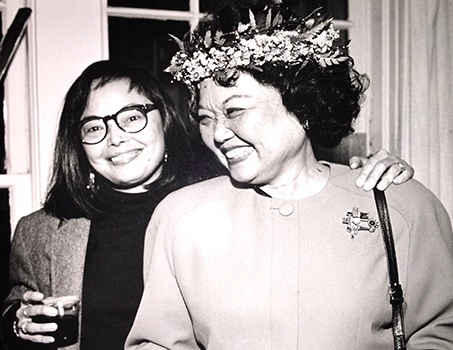
What does the life of an advocate and political scientist look like? Dr. Mink (who currently works as an independent scholar) claims both Japanese immigrant relatives who settled in Hawaii and Eastern European ones who settled in Pennsylvania’s coal country. Born in Chicago and raised in both Honolulu and Washington, DC, she is the daughter of the late Patsy Takemoto Mink, who was not only the first woman of color elected to the US Congress but also the coauthor and champion of the antidiscrimination policy known as Title IX.
Gwendolyn Mink graduated in 1974 from the University of California, Berkeley, with a BA in East Asian History and Politics, which she felt compelled to study in response to racist stereotyping of Asian people and ignorance of their histories, which suffused much discourse during the Vietnam War. Then she obtained a PhD in government from Cornell University, where her dissertation became her first book, Old Labor and New Immigrants in American Political Development: Union, Party, and State, 1875–1920. In this work, she discusses the role of nativism in pitting the labor movement against radicalized immigrant workers and the political consequences of a fractured working class during the late-19th and early 20th centuries. Dr. Mink’s exploration of the political sources and ramifications of divisions within the industrial-era working class laid the foundation for questions of inequality and discrimination that would shape her scholarship throughout her career.
The knowledge and perspectives she obtained during her education evolved into a rich teaching and research career. As a professor at the University of California, Santa Cruz, she taught classes on American politics, women and the law, as well as specialized seminars on US gender policy, from 1980 to 2001. From 2001 to 2008, she served as Professor of Women and Gender studies at Smith College, where she taught classes on the public policy debates affecting security and equity for women of all races, as well as courses on poverty policy. Since 2008, she has worked independently.
Coming into her own as a doctoral student in the late 1970s and as a junior professor during the early 1980s, Dr. Mink brought a perspective to the table that bloomed from her own experiences and in solidarity with the experiences of other women, especially women of color. She was one of only two women in her first-year cohort in graduate school and the only woman remaining after the first year. As she challenged real time sexism and racial misogyny, including sexual harassment, she also fended off dismissive attitudes toward her historical research, due to its emphasis on political dynamics affecting people of color, immigrants, and women.
Across her career, Dr. Mink has written six books and edited several anthologies. She has won two prestigious prizes, one related to scholarship on women and politics from the American Political Science Association (1996) and a more recent one related to research on women’s history from the Organization of American Historians (2023).
Her mother’s role as an avid equality advocate in Congress significantly influenced her intellectual path. Patsy Takemoto Mink worked as a political activist all her life, and her daughter grew up steeped in that work. She worked on her mother’s campaigns and was one of her interlocutors on topics of peace and social justice. In the 1990s, mother and daughter collaborated with allies to resist neoliberal welfare reform that they believed would adversely affect low-income mothers. They mobilized legislatively to challenge mainstream prescriptions for the conditional participation of low-income mothers in the social safety net.
Together, they developed a policy alternative to neoliberal welfare reform, one that centered on the needs of low-income mothers and opened a conversation about how racial and gender inequalities perpetuate poverty. Gwendolyn Mink also actively contributed as a campus advocate for the implementation of Title IX , which her mother co-authored and helped pass in Congress in 1972. Their shared commitment to economic equity for low-income mothers is immortalized in several books, including Welfare’s End (2001, by Gwendolyn Mink), Ensuring Poverty (2018, by Felicia Kornbluh and Gwendolyn Mink), and the political biography Fierce and Fearless (2022, by Gwendolyn Mink and Judy Tzu-Chun Wu), which shares the empowering story of Patsy Takemoto Mink’s resilience as she climbed the ladder of American politics.
In 1995, Dr. Mink also published The Wages of Motherhood: Inequality in the Welfare State, 1917–1942, which traces how crucial social welfare policies emerged from a framework built by racial and nativist biases. Her book illuminates how ethnocentric blinders and goals prolong inequality and economic insecurity for low-income mothers. She also describes the gender hierarchy that interacts with racism, nativism and poverty. For example, describing sex-based employment discrimination, Dr. Mink writes:
“Labor regulations impeded women’s movement into certain industries and confined women to low positions in others. Night work laws banished women from the newspaper industry, for example, while assigning women to less remunerative day shifts in the restaurant industry. Labor regulations thus capped opportunities and rewards for wage-earning women, even as they safeguarded women’s terms of employment. But they did not promote domestic motherhood among wageearning women, except by indirection.”
Her book Welfare’s End meaningfully questions assumptions about single mothers who need social welfare support and reveals the racialized gender project that dismantled economic security guarantees for lowincome mothers in the 1996 Personal Responsibility and Work Opportunity Reconciliation Act. She built her critique of existing policy and a prescription for equality-enhancing alternatives around recognition and support for caregiving as a productive form of labor that is essential for society to flourish. Dr. Mink concludes Welfare’s End by stating:
“The end of welfare, then, includes ‘making work pay’ not only by remunerating caregiving work, but also by making participation in the labor market equitable and rewarding. We can begin to make work pay with a caregiver’s income that solo parents can use to offset the caregiving costs of wage-earning…. To make work pay, we must enact policy that will also improve women’s position in the labor market: a minimum wage that provides an income at least at the poverty threshold; comparable worth policies that correct the low economic value assigned to women’s jobs; unemployment insurance reforms covering women’s gendered reasons for losing or leaving jobs; paid family leave; guaranteed childcare…. This end to welfare will take us down many paths, all leading to gender justice.”
In a distinguished career that spans several decades, Dr. Mink has followed a very particular trajectory. “There’s a through-line in my work, which is the foundational roles of racism, nativism, sexism, and racial misogyny in the late, constrained, and contested emergence of the US welfare state,” she notes. “For a long time, it was quite a struggle to get people to take seriously that racism/nativism and sexism/racial misogyny have been causal factors in the way the US developed politically.”
Although Dr. Mink’s scholarship has been informed by her own personal experiences and values, the emergence of a generation of scholars who ask questions similar to hers and whose cognate writings enrich her own thinking have enabled her perseverance. She especially credits the work of legal scholar Kimberle Crenshaw, who has contributed to the development of critical race theory and who coined the term intersectionality; and research by historians Dana Frank and Eileen Boris, whose scholarship on labor history highlights how economic systems impact the lives of marginalized workers.
Through her journey of scholarship and advocacy, Dr. Mink has asked important questions about how race, gender, and national origin influence public policy in the United States, as well as questions about the impact of public policy on marginalized communities. She also found common ground with her mother’s advocacy interests, a joint passion through which they uplifted each other. Ultimately Dr. Mink has left a lasting impact in the field of political science. Importantly, the questions that she has never stopped asking have now become more mainstream, although controversial in some political circles. Her work shows us that we must continue to ask these questions to confront the equity gaps that currently exist in American society and politics.
 Erika Minetti, MS, is a medical student at Boston University Chobanian & Avedisian School of Medicine, and a researcher investigating the impact of cardiometabolic disease on vascular endothelial health. Her interests lie at the intersection of medicine, public policy, and health equity, with a particular focus on how structural factors shape the lives of marginalized individuals.
This article was originally published in AWIS Magazine. Join AWIS to access the full issue of AWIS Magazine and more member benefits.