
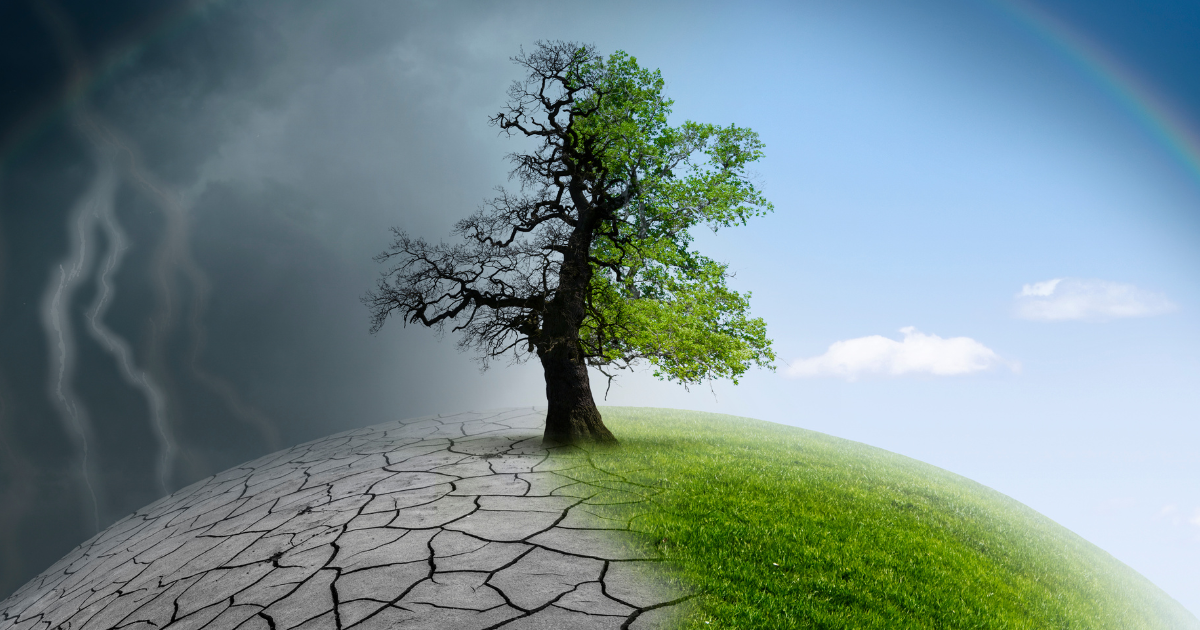
In the past several months, devastating and deadly heat waves have swept across the globe. The dangerous heat has not only led to a high number of heat-related deaths, but it has also put extra pressure on the environment and infrastructure. In Spain and Portugal alone, there were over 1000 heat-related deaths during a single week in July. In the past two months, nearly 80 square miles of forests have been destroyed by devastating wildfires in France, and 37,000 people have been forced to evacuate. And in the United Kingdom, transportation infrastructure has been affected by the high temperatures: railroad tracks have begun to warp and buckle; aircraft tires have sunk into the pavement of melting runways, due to the abnormal heat.
Since the 18th century, the average global temperature has increased 1.1–1.2° Celsius, due to greenhouse gas pollution, particularly CO2 emissions from the energy and industry sectors that have increased by 60% in the last 30 years. To help solve this global emergency, 196 countries adopted the Paris Agreement in 2015, with the goal of limiting global warming to below 2° Celsius, preferably to 1.5° Celsius, compared to preindustrial levels. In order to reach this target, the agreement stipulated that global energy-related carbon dioxide emissions must reach net zero by 2050. Unfortunately, due to an insufficient reduction of greenhouse gas emissions in the past decade, we likely cannot meet the 2050 target date without also proactively removing carbon from the atmosphere.
Carbon dioxide removal (CDR) solutions can be divided into natural and technological approaches. Natural mitigation strategies are relatively low cost, easier to deploy, and beneficial to the ecosystem, compared with technological approaches. A major type of natural CDR strategy is terrestrial carbon removal and sequestration, which involves using land and management practices within forests and agricultural lands to enhance the total storage of carbon in trees and soil.
Forests have historically been considered great resources for absorbing carbon from the atmosphere and for helping with climate mitigation. However, setting aside land for carbon removal and sequestration via trees and soil is not that simple because of competition from the expansion of food production; food producers also require land, which they need for agriculture and pasturage. In this article, we will discuss some critical challenges in terrestrial carbon practices and what scientists are working on to solve them.
Education Is Fundamental

One major obstacle to implementing science-based forest and soil carbon practices is a gap between the scientific knowledge that already exists and the dissemination of that knowledge to practitioners, such as policymakers, landowners, and forest managers. Michigan State University’s Department of Forestry has established the Forest Carbon and Climate Program (FCCP) to help close this gap. The program’s Director, Dr. Lauren Cooper, recognizes the need for systematic learning in this field and believes that FCCP provides many more opportunities and more potential outcomes than the chance to earn a graduate certificate and to take three graduate courses. “We want to engage and create responsive and creative learning experiences for professionals, to meet them where they are in realistic time components that match their professional needs,” Dr. Cooper said.
Since 2014, Dr. Cooper has been expanding the program to include more educational resources. As the first program of its kind, the FCCP now offers three tiers of learning experiences that range from graduate-level courses to shorter professional courses suitable for natural-resource professionals, extension agents, and landowners. The FCCP also collaborates with governments and private companies, which either sponsor employees to participate in the program or create sponsorships for external applicants interested in taking part. The goal is to allow more professionals to become comfortable with engaging in conversations and advocating for actions and decisionmaking in their own spheres of influence.
In addition to fostering educational opportunities, Dr. Cooper also focuses on creating a variety of partnerships between the diverse team of the FCCP and other universities, nonprofit organizations, and the forest industry. “We all are bringing something unique to the table, and we are able to do way more when we are working together,” Dr. Cooper said. “We try to be strategic about where we can jump in and enhance each other’s work.”
Forest Carbon Modeling

Policy making that relates to nature-based solutions relies heavily on anticipated outcomes of forest and land-management practices. However, scientists can find it challenging to accurately characterize a system as complex as a forest or similar ecosystem. Fortunately, researchers have taken detailed forest measurements over time and have gradually developed a variety of forest carbon models that enable them to reliably connect forest-associated climate-mitigation strategies with carbon-cycle dynamics on different scales. One such tool, the Carbon Budget Model of the Canadian Forest Sector, is a forest carbon model used by American Forests (AF), a nonprofit conservation organization, to examine the carbon impact of forest management practices at a landscape scale. AF’s current study consists of four projects spanning seven states in the United States and is led by Kendall DeLyser, Director of Climate Science.
For each region, DeLyser and her team compile a baseline level of carbon fluctuations using historical-management and natural-disturbance information. A range of potential forest-management and wood-utilization scenarios are then applied in the model to generate outputs that reflect future carbon changes in the landscape. “With each of those different management practices and scenarios, we want to understand which ones can help us capture the most carbon,” says DeLyser. “The results can then help forest managers confirm that their current practices are good or decide what they should be doing next. Policy makers can also use the results to support climate-action goals with programs to incentivize climate-smart practices.”
To distribute the findings of the study broadly, DeLyser and the team work closely with direct state partnerships and the U.S. Climate Alliance. “There are a lot of other states with a lot of forest lands that either don’t know we are doing this [research] or don’t know that they can ask us to do this [work]. Our next step is to figure out how to expand this project to other parts of the country with forests, so we can better manage all our forests as a climate solution,” DeLyser said.
Unique Carbon Dynamics in Urban Forestry

Another innovator in this field, Dr. Lucy Hutyra, is a biogeochemist and ecologist at Boston University who is specifically interested in carbon dynamics in urban areas. “Historically, cities are just viewed as the source. They are just where CO2 comes out, and that is a problematic view,” explained Dr. Hutyra. To many people’s surprise, urban trees also play an important role in promoting climate mitigation and in shaping the bigger picture of climate change.
Over the last decade, Dr. Hutyra’s team has discovered that urban vegetation behaves differently than vegetation in other environments. Specifically, in the northeastern United States, urban trees grow more productively and cycle carbon dioxide more rapidly than trees growing in rural areas. These findings point to a critical need for scientists to reevaluate their methods of monitoring, reporting, and verifying carbon dynamics in cities, so that they can accurately assess whether or not climate-mitigation policies are working.
While policy makers’ efforts to conserve fragmented forests in cities and to implement urban afforestation can be extremely valuable, they need to carefully plan and manage this work. “We need to think very thoughtfully, in a way that we haven’t been, about which trees to plant,” Dr. Hutyra said. She pointed out that different trees can achieve different environmental goals, and that we also need to take climate, pest tolerance, human preferences, and other human impacts on trees into account.
Agroforestry in Africa

Another potential challenge in implementing naturalbased CDR solutions lies in interactions with local communities: scientists must recognize the needs of these communities while making plans to meet climate goals. This is especially important in low-income communities and in developing countries, which are more vulnerable to climate risks and whose needs do not always align with the needs of climate-change policy makers.
In recent years, some scientists and policy makers have developed road maps for how to address this particular challenge. A perfect example of an organization working to balance communities’ needs with climate-change objectives is the Regreening Africa program once led by Dr. Susan Chomba, who is now the Director of Vital Landscapes for Africa at the World Resources Institute. Speaking at a recent seminar, Dr. Chomba noted, “When you are working with small-holder farmers, it is not just focusing on land health. What we realized is that you have to focus on the economic aspects because you are working with farmers, who are looking at what that means for their children to be able to go to school and what that means for them to feed their children in the evening.”
Regreening Africa focuses on giving farmers across eight African countries access to locally appropriate knowledge and technologies to bring trees back onto farms and to sustainably manage landscapes. The major approach of the project—agroforestry—incorporates a deliberate and systematic integration of trees with crops and livestock.
The benefits of agroforestry include increasing carbon storage, enhancing crop and grass yields, and boosting income and food security. Using these strategies, the project has helped 500,000 households reverse land degradation across one million hectares in eight countries in sub-Saharan Africa. The program is also estimated to have decreased soil erosion by 5% while increasing both tree cover and average household income by 10%.

Summary
Climate change is a global emergency that requires global attention and cooperation. Even though they face many obstacles in their efforts to reach net zero by 2050, scientists, policy makers, landowners, and other stakeholders are all working together to come up with solutions to halt the crisis and to save our planet. Nature-based solutions are only the tip of the iceberg. As technology evolves, we can look forward to additional cost-effective and scalable approaches to both control carbon emissions and to remove carbon from the atmosphere.
 Ruonan Zhao is a PhD student in the Anatomy and Cell Biology program at the University of Kansas Medical Center. She is a science writer who is passionate about research, human health, and medicine. After completing her degree, she would like to pursue a career in clinical research development, where she can apply her scientific skills to make advances in human health.