

Artificial intelligence (AI) used to be a chat box to the standard consumer, but now it’s everywhere. AI is used in your phone, car, workplace software, doctor’s office, grocery stores… and the list goes on, with no limit to its capabilities.
In a recent interview with Devex, Helene Moliner, the UN Women’s Advisor on Digital Gender Equality Cooperation shared, “Right now, there is no mechanism to constrain developers from releasing AI systems before they are ready and safe. There’s a need for a global multistakeholder governance model that prevents and redresses when AI systems exhibit gender or racial bias, reinforce harmful stereotypes, or does not meet privacy and security standards.”
AI is marketed as a tool to make quicker, more accurate decisions, but unfortunately research has shown that these machine learning models succumb to the same biases as humans.
Bias Is a Data Problem
Every machine learning model is fundamentally a reflection of the data it is trained on, along with the assumptions made by humans during development. When datasets contain historical inequities or underrepresent populations, AI systems can systematically create technical failures that become societal problems.
This phenomenon has already been documented across multiple domains:
Credit scoring algorithms have learned historical lending patterns that resulted in women receiving lower credit limits than men, reinforcing existing financial disparities.
AI-assisted recruiting platforms have ranked female candidates lower than equally qualified male applicants because historical hiring data reflected biased employment practices.
Researchers at the Berkeley Haas Center for Equity, Gender and Leadership found that among 133 publicly documented biased AI systems, 44.2% demonstrated gender bias, while 25.7% exhibited both gender and racial bias. They track publicly available instances of bias in AI systems here.
These outcomes illustrate a fundamental principle of data science: models cannot generalize fairly if the underlying data are not correctly represented.
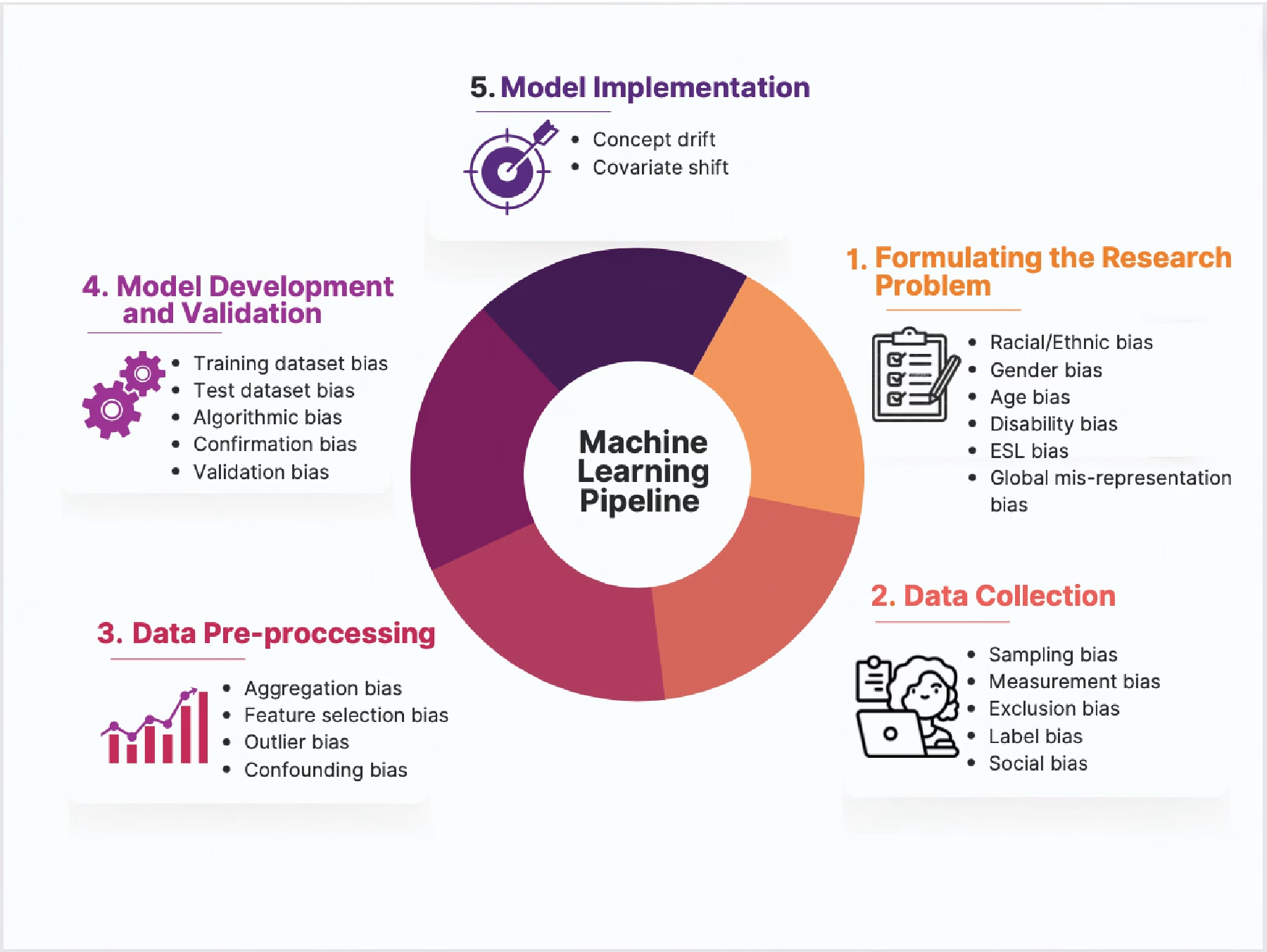
Nazer LH, Zatarah R, Waldrip S, Ke JXC, Moukheiber M, Khanna AK, et al. (2023) Bias in artificial intelligence algorithms and recommendations for mitigation. PLOS Digit Health 2(6): e0000278. https://doi.org/10.1371/journal.pdig.0000278
Representation Improves Model Performance
One of the most effective ways to improve AI systems is by increasing diversity throughout the development lifecycle.
As of 2021, women represented only 22% of professionals working in AI and data science. This lack of representation affects everything from research priorities to feature engineering, model validation, and deployment decisions.
Diverse research teams bring broader perspectives that help identify hidden assumptions, question biased training data, and recognize failures that homogeneous teams may overlook. From a STEM perspective, this leads to more robust algorithms, stronger external validity, and improved generalizability across populations.
A Global AI Governance Framework
AI has a global reach, so governance efforts should reflect the diverse populations that it is designed to serve. While many countries are developing their own AI policies, international frameworks can provide a common foundation for building transparent, equitable, and accountable systems.
An example of this is the United Nations’ Global Digital Compact (GDC), which positions gender equality as a core component of digital governance rather than an afterthought. Instead of treating gender bias as a separate issue to be addressed after deployment, the GDC proposes a dual-track approach that integrates equity throughout the AI lifecycle.
First, the framework recommends establishing a stand-alone goal on gender equality, prioritizing three fundamental objectives:
- Freedom from technology-facilitated gender-based violence and discrimination, ensuring AI systems do not perpetuate harmful stereotypes or discriminatory outcomes
- Equitable educational and economic opportunities, promoting equal access to AI-driven innovation, workforce development, and digital resources
- Equal voice, leadership, and participation, increasing the representation of women and underrepresented communities in AI research, development, and governance
Second, the GDC advocates for the mainstreaming of gender considerations across every area of digital governance. From a STEM perspective, this means incorporating inclusive practices rather than relying on bias mitigation after a system has already been released.
Let’s Start at Home
As AI adoption accelerates, states across the U.S. have begun to introduce legislation focused on algorithmic accountability, transparency, and consumer protection. While these efforts are an important step forward, a coordinated approach could establish consistent standards for responsible AI development.
One potential solution is the creation of an independent AI regulatory body, modeled after the FDA or FTC, to evaluate systems before widespread deployment. This agency could assess dataset diversity, intended use, privacy protections, and safeguards against algorithmic bias, with oversight provided by a multidisciplinary board that includes experts in STEM, healthcare, cybersecurity, finance, and representatives from historically underrepresented communities.
Additional policies could further strengthen responsible AI innovation by requiring users to select privacy and data-sharing preferences during account creation and expanding NSF and NIH opportunities that increase participation of women and BIPOC researchers in AI. These investments would improve both the diversity of the AI workforce and the quality of the technologies being developed.
Together with international frameworks like the UN Women Global Digital Compact, these initiatives recognize that inclusive governance is not only a policy objective but also a STEM imperative for building AI systems that are robust, transparent, and representative of the populations they serve.
The Future of AI Is Better Science
As AI becomes part of the foundational infrastructure for industries such as healthcare, finance, education, and scientific research, responsible governance should be viewed as an extension of good engineering practice. Models that are transparent, reproducible, privacy-preserving, and rigorously validated across diverse populations will promote equity and be more accurate, robust, and scientifically sound.
By ensuring that women and historically underrepresented groups are included from the earliest stages of AI design and development, we can build technologies that better reflect the populations they serve and drive innovation that is both responsible and transformative.
 Eposi Elonge is a member of the AWIS Advocacy Committee which works to ensure that all women in science and STEM related fields can achieve their full potential. Our advocacy work focuses on achieving positive system transformation, equitable workplaces, and recognition of women’s scientific and leadership achievements.