
Americans’ willingness to talk about mental illness has grown in recent years. Throughout much of our history, we hid our mental and emotional problems in the shadows because of shame and fear and lack of knowledge. These days, we often freely share information about anxiety medications, talk about therapy, and discuss mental health challenges with greater openness.
Unfortunately, these advances have not yet made their way to some parts of the world. Current research shows that nearly 197 million Indians suffer from mental disorders, including about 44.9 million affected by anxiety and 44.7 million by depression. Many of these sufferers go undiagnosed due to barriers and low access to care. In addition, rural citizens can interpret mental illnesses as spiritual in origin, thus delaying diagnosis and treatment. In particular, children experience emotional neglect and pathology due to an environment of constant economic pressures, low access to health care, and unstable education.
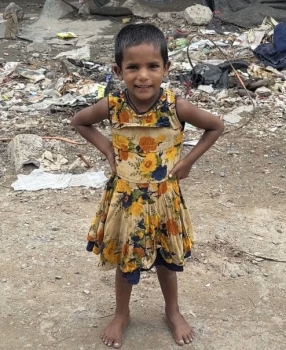
 I developed Project Muskan as an attempt to alleviate the systematic cruelties these children endure. I visited an impoverished slum under a highway in Delhi and saw an NGO working to improve children’s education. While laudable, this effort to introduce structure and to educate the community overlooks the lack of emotional well-being and the pathology or illness that such a lifestyle can breed. I saw roads lined with mountains of trash, small makeshift shelters, and an inconceivable amount of dirt. Life in such an area revolves around surviving from one day to another, forcing children to grow up with the need for constant resistance and resilience.
India’s development framework assumes that access to education leads to mobility, but it fails to address the gaps that prevent children from staying engaged. NGOs and local initiatives work to increase enrollment; however, they rarely account for the psychological conditions that influence a child’s ability to participate. Many children struggle despite these opportunities because they deal with depression, trauma, learning disabilities and social anxiety, all of which affect concentration, attendance, and interaction. Without integrated mental health support, these challenges remain invisible within systems that measure success through attendance and performance alone. As a result, children gain access to education but lack the capacity to sustain their mental and emotional focus, and many eventually disengage.
India’s mental health system reveals a clear gap between policy and access. National frameworks exist, but limited funding and weak implementation restrict their reach. The District Mental Health Programme (DMHP), designed to decentralize care, receives less than 1% of the national health budget, which limits its ability to operate at scale. Within this system, children receive minimal focused attention, and the DMHP has not developed a strong or consistent school-based mental health framework. As a result, the treatment gap remains as high as 84.5%, leaving most individuals without adequate care. Children grow up without early identification or sustained support, allowing distress to persist until it disrupts their development in visible ways.
I developed Project Muskan’s intervention model in response to a challenge I encountered while working in the field. Existing psychological tools did not translate into the environments I was working in, and even well-validated measures failed to gauge the realities of children with limited exposure to formal assessment or emotional vocabulary. To address these challenges, I designed a screening approach that prioritizes accessibility and cultural relevance under the guidance of professional clinical psychologists in India. Under their supervision, I adapted established frameworks into formats children could engage with intuitively, using simplified constructs and semantic differential scales, such as “happy–sad” or “safe–unsafe,” to reduce cognitive load and misinterpretation.
 I built the model so that trained nonspecialists could administer it under supervision without crossing ethical boundaries and while still generating reliable, populationlevel insights into emotional wellbeing. My effort required careful attention to question design, verbal explanations, and observational context. I focused on replicability from the start, ensuring that the model could function across regions with different languages and educational exposures. By keeping the structure consistent and the delivery flexible, I aimed to create a system that could scale without losing clarity or validity.
This approach rooted Project Muskan within a crucial gap in India’s mental health ecosystem. While initiatives such as SMART Mental Health, the MITHRA app, Tele-MANAS, and Delhi’s Aam Aadmi School Clinics have expanded access, they remain limited in their reach to children in rural and peri-rural settings. As I developed the project, I focused on children who fall outside these systems, including those not consistently enrolled in school, those living in informal settlements, and those unable to access phone-based or clinic-based services. This led me to design a model that combines active, school-based screening with passive community-level observation, enabling continuous identification of distress across institutional and noninstitutional settings.
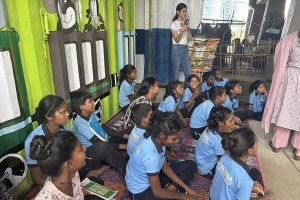
My team and I have applied this model across multiple sites, reaching over 300 children through mental health literacy workshops and structured screenings, all conducted under the supervision of psychologists who ensure ethical and clinically informed practice. In these settings, we identify emotional distress, learning difficulties, conductrelated concerns, and dysregulation that traditional systems frequently overlook. We share these cases with host schools and partner NGOs to support appropriate accommodation or referral.
Our work includes collaborations with Laksh, Utpal Valley School, Lumina CAS Conclave, Riviera Public School, Lakshyam Foundation, and Kuthumb, where we have conducted emotional regulation workshops, exam stress interventions, interactive well-being sessions, emotional literacy programs, and supervised screenings. Throughout this process, we have maintained clear, ethical boundaries: We do not diagnose or label children. We design and administer screening tools to identify those who may need support and refer them to qualified professionals for clinical assessment or treatment. This approach reflects a commitment to responsible and ethically grounded practice.
We must remember that we cannot separate mental health from basic challenges to survival because a child’s ability to learn and progress depends on their psychological state. Efforts to create opportunity remain incomplete if they ignore the emotional conditions that determine whether a child can truly access it.
 Mahika Tampi is a psychology student at Drexel University whose work spans research and field-based mental health initiatives. She has designed a community-based, mental health support program called Project Muskan, developed under the guidance of mental health professionals in India. Her interests lie in clinical and neuropsychology, research exploring behavior and cognitive functioning, and analytical writing on psychology in real-world contexts.
This article was originally published in AWIS Magazine. Join AWIS to access the full issue of AWIS Magazine and more member benefits.