Quantum computers don’t work alone. Much of the work surrounding a quantum calculation still relies on classical computers, and that connection is central to Smriti Bajaj’s research at Dell Technologies. As a Research Scientist in the Office of the CTO, she uses machine learning to tackle quantum problems and studies how high-performance computing can support quantum systems. Her work is helping answer a practical question for a rapidly developing field: how can we make quantum computing useful in the real world?
A Day in the Life of a Quantum Computing Researcher
What does a typical day in your role look like?
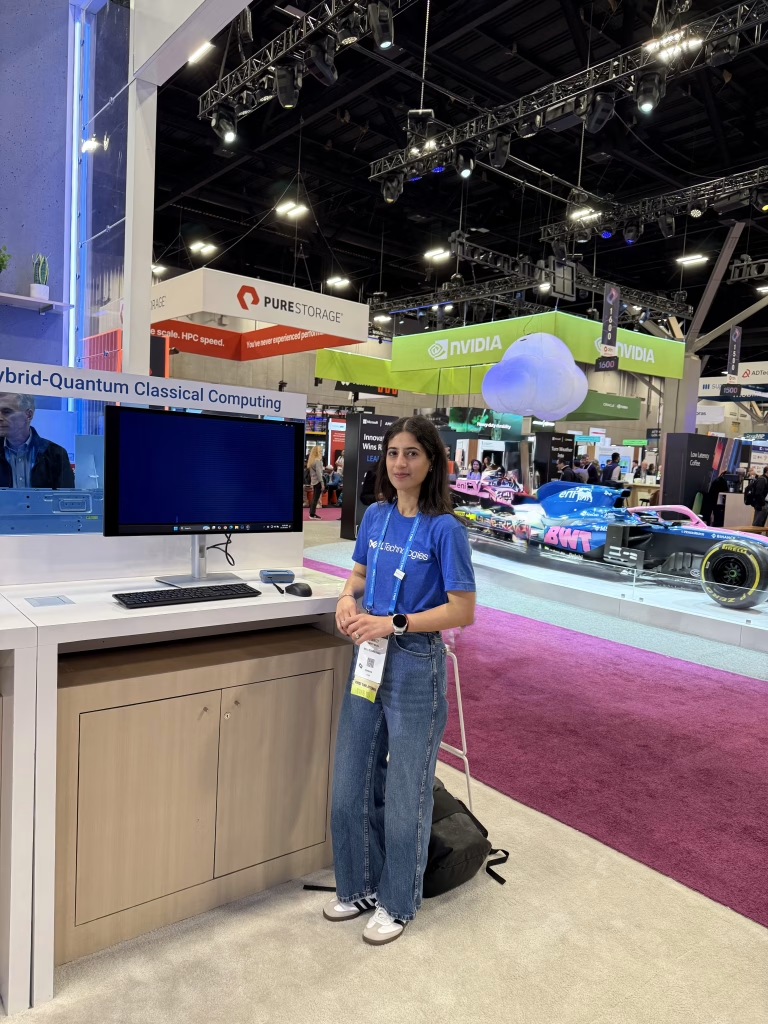
I work at Dell as an applied researcher in Quantum Computing in the Office of the CTO. My work is at the intersection of AI, HPC, and quantum computing. I love the fact that no two days look the same. My time is split between deep technical execution like using classical machine learning to solve unique quantum problems and collaborative research, where I’m writing papers, or speaking at quantum events. I also spend a lot of time consulting with enterprises and university professors. When people wonder how Dell fits into quantum computing, I remind them that 99% of any quantum workflow is actually classical. My research group focuses on strengthening Dell’s position as the classical enabler that these quantum systems need to function.
How would you explain your field of work to a kindergarten class?
You know how when you lose a toy, you have to look under one cushion, then behind the couch, then under the bed until you find it? That takes a long time. Now imagine you had a magical helper. Instead of looking in every spot one by one, they snap their fingers and the whole house instantly disappears except for your lost toy, which lights up like a star. That’s kind of what quantum computers do. They don’t guess answers one by one but instead make the wrong answers disappear so the right one stands out. My job is figuring out which puzzles are worth giving to these magical helpers. They’re amazing at finding hidden things but not great at regular chores. So, I help pick the right puzzles for them.

The Path to Quantum Computing
I did my undergrad in computer science in India. Then I went to Northeastern University in Boston for my master’s where I studied machine learning. I learned about basically every ML specialization except NLP, which is funny because my job before starting grad school was building chatbots when AI didn’t really exist yet. While in grad school, I interned at Amazon and Motorola in computer vision. Honestly what prepared me most wasn’t any single class but the breadth knowledge of data science, computer vision, software engineering systems and classical ML. When I joined Dell after grad school and quantum showed up in my career, I didn’t need to start from zero. I already had the connecting pieces like Linear algebra, ML, Python, software design and more.
Curiosity, honestly. During my internship at Oracle, I got fascinated by how data changes decisions. Then at my first job while building chatbots, I kept wondering how the conversations actually worked underneath. I’ve always been the person who asks “but how does that work?” and then goes down the rabbit hole. What keeps me excited about quantum is that nobody has all the answers yet and this is my ultimate playground. It feels incredible to work on a true frontier where the rules are still being written, and I get to show up every day to chase that curiosity.
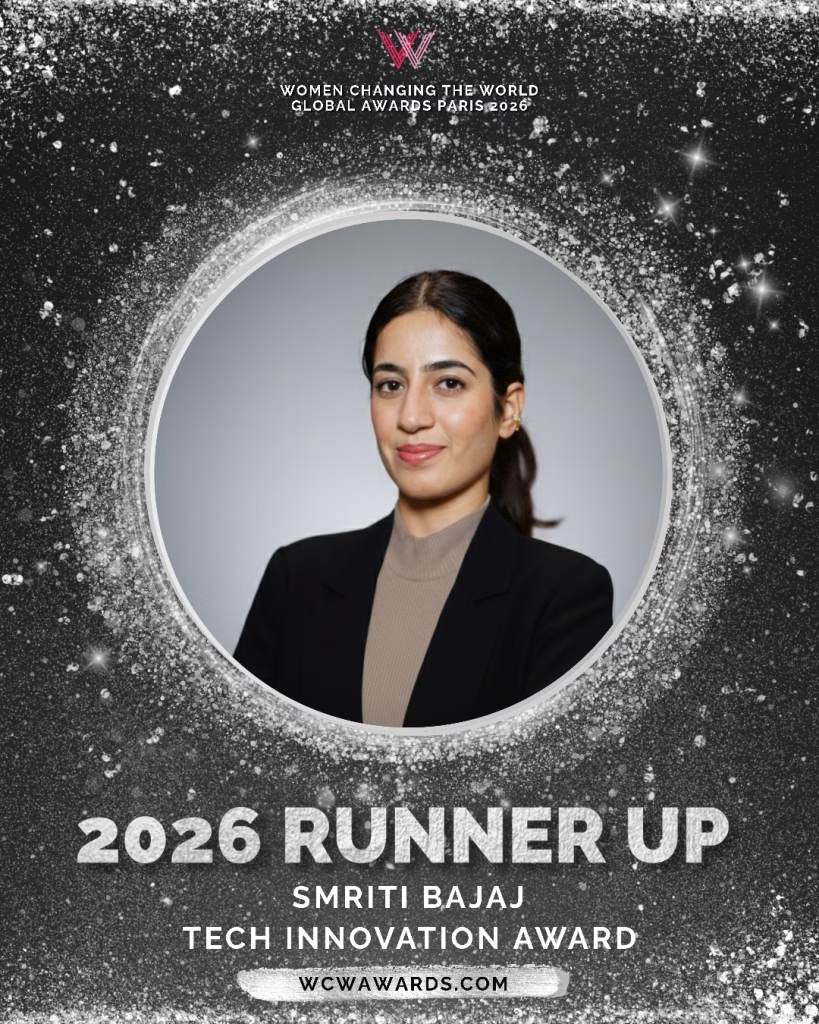
Through my research work and 20+ filed patents, I shifted from writing code to building reproducible, novel tech. Being named runner-up for Tech Innovation at Women Changing the World (out of 1,500 global entries) validated that this work truly matters far beyond my own team and company.
The Science That Moves Us Forward
How has your work/research helped drive discovery, innovation, or impact?
At Dell, I came across quantum project data sitting untouched in a database. I cleaned it, ran feature analysis, modeled it and built a dashboard that made it visible and useful to leadership. Then I formulated an optimization problem as a QUBO for benchmarking on a quantum annealer. That was my first quantum-native contribution. Since then I’ve been writing whitepapers, filing patents and contributing to research.
Where do you see your work heading next?
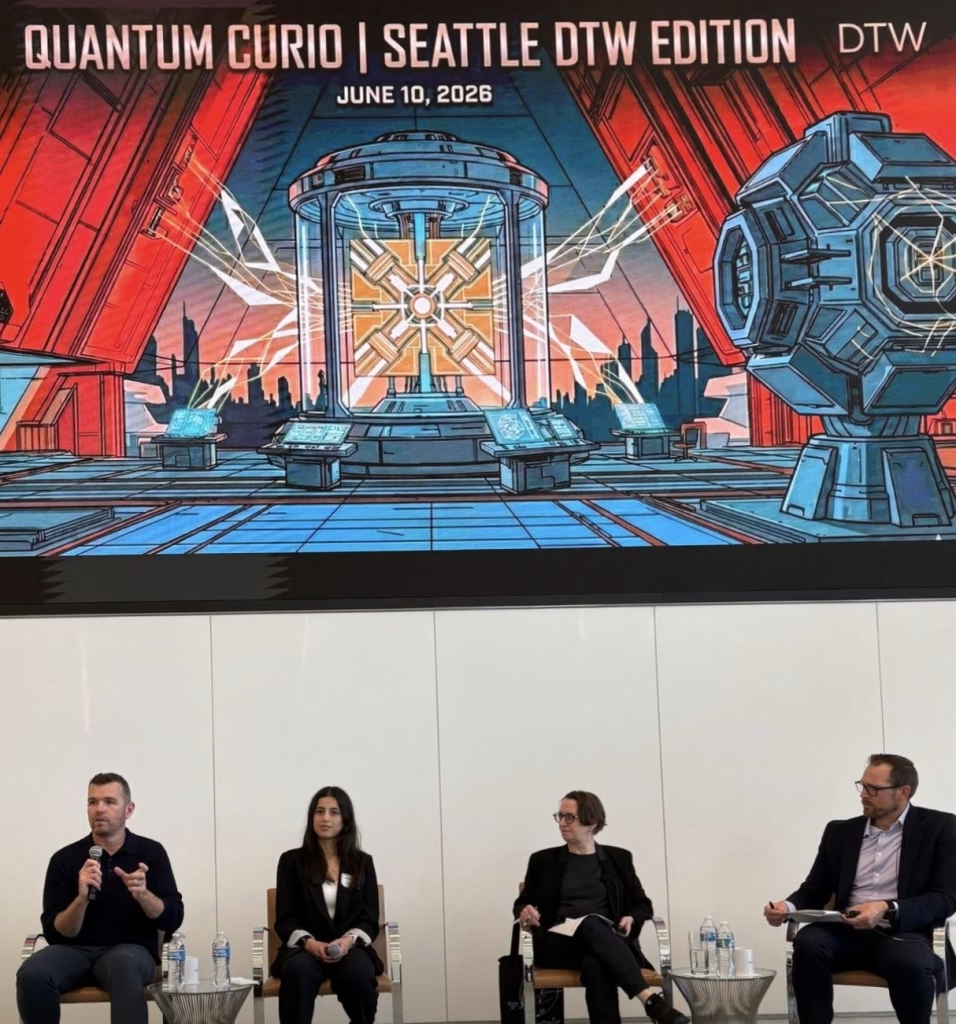
Hybrid quantum-classical workflows are going to become standard in enterprise within the next few years. I want to be one of the people building that bridge and which is why I am a part of ORNL’s openQSE initiative that focusses on standardizing Quantum HPC. On the research side, I want to keep publishing and filing patents to contribute in this field. I also lead Dell’s Women in Tech chapter for the Seattle region with a goal to encourage more women to explore emerging tech and connect with one another. I’m also drawn to workforce development. Quantum needs so many more people and most of them don’t know this field exists yet. I want to help change that through writing, speaking, mentoring or just showing up in rooms like AWIS.
How do you see your work helping shape the future of STEM?
I’m a woman, an immigrant, someone who went from proctoring dorm rooms to filing quantum computing patents. That path isn’t in any career brochure but it’s real. When someone who chooses to come out of their comfort zone sees that trajectory, it expands what they think is possible for themselves. That is why I try to create spaces where women feel encouraged to experiment and grow. Beyond visibility, my research directly contributes to how businesses will use quantum technology. The whitepapers I write, the benchmarks I run, the problems I formulate. That work becomes part of the foundation other people build on and how STEM moves forward.
To a Future Scientist Just Starting Out
What advice would you give to your younger self / someone just starting out in your field?
Every major move in my career came from initiative, not invitation. I’ve always been adapting myself in tech by learning from the lives of the notable people in the industry and research. I spent years feeling guilty about not being the deepest expert in one thing. Turns out the person who can connect ML to quantum to software to business strategy is rarer and more valuable than a single-lane specialist. My other advice is you can’t do this alone. There’s a famous saying. If you want to go fast, go alone. If you want to go far, go together. Choose the right tribe and that makes all the difference.
What are some strategies you use to maintain resilience and persistence in the face of obstacles?
Whenever a technical setback feels overwhelming, I remind myself of where I started. I left a comfortable career in India to proctor dorm rooms at an American university just to cover rent. Facing student loans in a completely new country with no family nearby was incredibly difficult but if I survived that, I can survive a tough day at work. I don’t do it alone, though. I lean heavily on my community; my cousins are effectively my siblings, and we anchor each other through everything. And above all, I stay curious. When a problem gets hard, I try to get interested in the challenge instead of letting frustration take over. Seeking out mentorship and staying curious has proven to be the ultimate antidote to discouragement.