
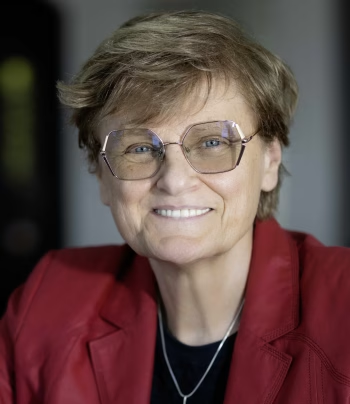
Seeing is believing, and Dr. Katalin Karikó, the Hungarian biochemist who laid the foundation for the Covid-19 mRNA vaccine, reminds us how women in STEM can aspire to become what they see.
Her diligent work on the mRNA vaccine, which BioNTech/Pfizer and Moderna developed, earned her global recognition. In fact, Dr. Karikó received several prestigious awards, including the Lasker-DeBakey Clinical Medical Research Award in 2021, the Breakthrough Prize in Life Sciences in 2022, and the 2023 Nobel Prize in Physiology or Medicine.
Dr. Karikó’s journey as a scientist began when she received her doctorate in biochemistry from the University of Szeged in Hungary. Currently, she serves as a professor at the University of Szeged and as an adjunct professor at the University of Pennsylvania. She served as a senior vice president at BioNTech in Germany and worked there between 2013 and 2022. Prior to her time at BioNTech, she worked at the University of Pennsylvania for 24 years.
Dr. Karikó openly shares the challenges she has faced in the workplace. After serving as a Research Assistant Professor, she was demoted to Senior Research Investigator, but she never gave up her dedication to science. Her journey shows young women in STEM what persistence means. By staying committed to her curiosity and her work, she has become the kind of scientist future generations can see and believe they can become.
I interviewed Dr. Karikó about her path in biochemistry, her advice for women in STEM, and her reflections about her memoir Breaking Through: My Life in Science. Her book focuses not just on her career but also on the benefits of collaboration and a “shared journey life” in science.
In your memoir, you mentioned becoming the top biology student in your town and later in Hungary, even though you didn’t come from a scientific family. Why did you choose biology?
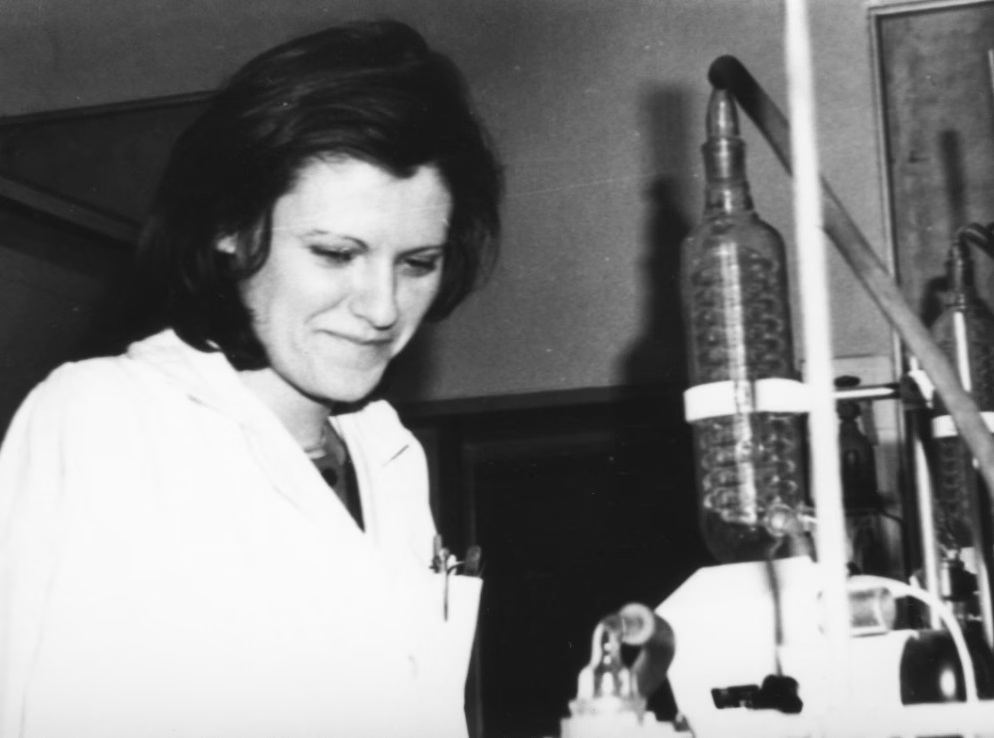
My high school biology teacher, Mr. Albert Tóth, told me that I can be a scientist. At that time, I had no idea what scientists do, but he believed in me and that inspired me to work hard in biology. I dedicated this book to teachers because of the impact they had on my life. Looking back, I believe it is important for underprivileged children to have teachers who open doors of encouragement and curiosity. In my time, many students went into medicine or research, and I would say a good teacher can inspire a whole generation of young scientists.
You have said that real success comes from learning and helping others, not in winning awards. In a field that values publications, grants, and titles, how can women in STEM today redefine success?
For me, success means understanding how nature works. When you design your own experiments, real success is learning from what happens, especially when results are unexpected. It is about adjusting and persisting after setbacks. Trying out new tools or reagents (compounds added to activate chemical reactions) often means facing the unknown. You cannot always predict how reagents will react in different experimental conditions, so you test carefully, observe closely, and repeat until you are sure of the results. Whenever I had made a new reagent, I tested it thoroughly, fixed any mistakes, and repeated the process until I was confident. That kind of persistence and curiosity, even when things are unexpected, is a real part of success in science. Even understanding a section of a scientific paper and thinking of a new idea from it counts as success. Big awards like the Nobel Prize are out of our hands, but the effort we put in and the joy we find in our work belong to us. Success isn’t only about big achievements; it is also about enjoying your journey and feeling empowered by what you do.
Looking back, what was the most difficult challenge you faced in developing the mRNA vaccine?
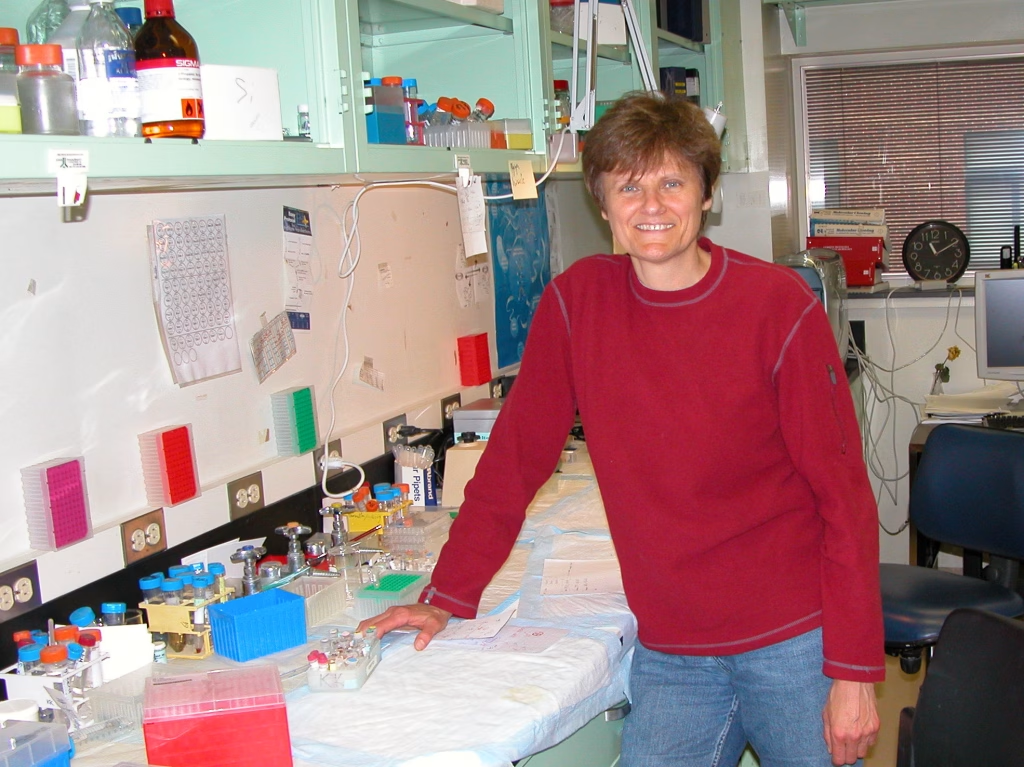
The lack of funding was the most difficult challenge. I had to do everything myself, from picking up radioactive materials, culturing cells, and isolating plasmids, because I did not have a technician. Even at 58 years old, I was still preparing chemical samples on my own. In situations like this, many people might give up, but I persevered. This challenge taught me that if you don’t receive grants or funding, you can try to collaborate with colleagues. For example, I was able to convince Dr. Elliot Barnathan, a cardiologist, about my idea to use mRNA to make urokinase receptors. This approach allows scientists to instruct cells to produce a specific protein without altering DNA. Due to working with Dr. Barnathan and his grant, I was able to continue my research. My advice to women in STEM is: If you cannot convince a committee to fund your project, you may be able to convince a colleague with research funding to collaborate with you. Don’t give up; find another path.
The fast development of mRNA vaccines saved many lives, but it led to public controversy. What do you wish people better understood about how these vaccines were developed?
I wish the public understood is how the mRNA vaccine is not new. Traditional vaccine often uses weakened or inactivated viruses to trigger an immune response. The mRNA vaccine uses a messenger RNA molecule, created in the laboratory, to instruct our cells to produce a specific protein (or even just a part of a protein) that prompts the immune system to respond. The immune system then produces antibodies, which help protect us from infections.
During the pandemic, I realized how wide the gap still is between scientific understanding and public perception. As scientists, we often discuss our work within our own communities and overlook the importance of communicating with the public. This can leave the public confused about the biological process. For example, when the typhoid vaccine was introduced a century ago, it was observed to disrupt the menstrual cycle. This was studied and documented at the time and communicated clearly. When people notice temporary changes after vaccination, they may blame the vaccine and not appreciate that it is protecting them from serious disease.
Scientists need to do a better job of reaching out and explaining the complexities of biology in simple terms. I have given talks at public libraries in my neighborhood here and also in Hungary and answered every question people had. By doing this, we can build trust, inspire the next generation, and help people appreciate the value of scientific discovery.
In your memoir, you mention that being both a mother and a scientist comes with unique challenges. What experience from your early life in Hungary most influenced your curiosity and dedication?
I learned from my parents that hard work was simply a way of living. They taught my sister and me if you want to achieve something, you will find a way; otherwise, you will just find excuses. When we faced setbacks, they reminded us never to blame others. Instead, we should respond to misfortune by learning more, working harder, and being more creative.
As a scientist and a mother, my parents’ lessons helped me to stay resilient. My daughter sometimes accompanied me at work during school breaks, and I came to believe that children are inspired the most by seeing what their parents do. I have, at times, felt guilty about missing her sports events, but I reminded myself that the work I do as a scientist is also important. Balancing work and family life are challenging for women in STEM. The grit that I learned from my parents helped shape who I am today.
What advice would you give to women in STEM starting out in their careers?
My advice to women starting out in STEM is to choose work that feels very important and meaningful enough to keep you curious. Currently, I work in human clinical trials. I am very curious and hopeful to see if the treatment that we are developing is effective. There are so many diseases about which we still don’t understand the causes and so many problems we still need to solve. So, your work may be about one of these. Find the questions that are important to the world, and if you have natural curiosity, that is one of the powerful tools that you can have in STEM.
After all the challenges and breakthroughs, what keeps you curious and passionate about science today?
My curiosity makes me feel that a new chapter in science always opens. I have spent more than 40 years reading about diseases while trying to understand how they can be treated. When a critical trial fails, I see it as an opportunity to better understand the disease rather than seeing it as a setback.
What motivates me most is the belief that I can help someone who is suffering from disease. Some people may call it as obsession, but for me, it is a commitment to seek answers that remain unexplained.
 Shruti Shrestha, PhD, is an Assistant Teaching Professor of Physics at Penn State Brandywine. As a particle physicist, she has worked on the High Voltage Monolithic Active Pixel sensor for the Mu3e Experiment. She also conducts free workshops in the Philadelphia area to motivate and empower girls to pursue STEM degrees.
This article was originally published in AWIS Magazine. Join AWIS to access the full issue of AWIS Magazine and more member benefits.