

Dr. Emily Bick runs one of the most innovative labs, the Original Digital Entomology Lab, at the University of Wisconsin-Madison. The Bick Lab focuses on practical agricultural ecology where they use technology to study insects and their movement patterns. Their research includes tracking insect populations, understanding their behavior in fields, and applying digital tools for better pest management. The Digital Entomology Lab specifically works on developing data-driven methods and technology-based solutions to improve pest control strategies, making management effective, precise, and sustainable. Their lab is developing advanced technology to help farmers predict and detect pests in their fields, facilitating proactive and precise pest management.
Dr. Bick earned her bachelor’s degree from Cornell University and pursued graduate studies at the University of California, Davis, building a strong academic foundation. Then, she completed a three-year Innovation Postdoctoral Fellowship at the University of Copenhagen before joining the University of Wisconsin as an assistant professor. I had an opportunity to interview her to learn more about her pioneering and foundation work on innovative solutions for pest management.
How do you envision automation and technology transforming the field of entomology in the future?
In entomology, we have typically sampled manually, which is time-consuming and laborious. This consumes valuable time that skilled labor could use for more productive and sophisticated tasks. During my postdoctoral research, I began exploring the idea of applying sensors to monitoring insects. At that time, I was collaborating with Danish startup FaunaPhotonics (now closed). We were using a $30,000 LiDAR-based system that would count and identify flying insects. However, the device’s cost made it cost prohibitive to stakeholders. This raised the issue for me of automating insect monitoring and detection and making it digital. My laboratory at the University of Wisconsin-Madison, along with other labs around the world, are now working to make this happen.
How do you employ digital technology and automation in entomology? Can you share some of your current projects?

We have been working on a device called the Insect Eavesdropper. Alexander Arovas designed the software for the Eavesdroper project and Laurence Still leads the analysis. It is a clip-on, contact microphone that lets us listen to insects while they interact with plants and identify them hopefully reducing the need to go into the field. As the insect world buzzes with noise, this device effectively filters that noise, facilitating clearer recognition of insects. We hope that this project will develop into an independent business or start-up.
In addition to this, we are working on open science tools. Lauren Glynn, one of my graduate students, has succeeded remarkably well in developing our ‘StickySonic’ device. This device provides a way to cross-validate what an air microphone or audio sensor can hear. This camera captures an image every time something lands on a sticky card in the field, a process that captures both the physical specimen and a digital copy of that specimen. Along with this, the sticky sonic device also captures the sound of the insect as it approaches the sticky card.
We have tested these devices in the field and have gotten promising results. However, these trials are in the preliminary stage currently.
What first motivated you to incorporate automation into entomology, especially considering that this technology was still in its infancy when you began?
In short, a challenge inspired me to act.
I have three degrees in entomology from Cornell University and the University of California, Davis. I was very enthusiastic about utilizing models to add data to decision-making processes and spent my entire PhD working on a modeling project. In my final year, I realized that the collected data was fed into an incorrect model, resulting in no meaningful or useful outputs. Following that, I delved more deeply into the topic and found that several scientists were working to solve the issue of data inaccuracy. I saw automation as one of the ways to obtain better-quality data which also ensures data integrity. It could also aid in understanding migration patterns and population levels of insects in the field. I came to entomology to refine these strategies and to develop accurate models to help farmers worldwide.
How will these technologies help in sustainably controlling pest populations?

At present, we are working to refine the models for applicability in farmers’ fields. We hope these models will prove useful in two separate ways: in spacing and timing.
Now, timing is always more important than spacing.
If we can have a network of sensors that autonomously detect pests as they fly through the country while migrating, we will have continuous monitoring. Through this, we can empower farmers to act at the most effective time and to track the movement of insect populations. This idea presents itself as a potential sustainable solution.
Spacing is comparatively trickier. We can mount sensors on tractors or drones to check pest populations across the f ield and to identify the areas where the control measures are most effective. Some researchers now focus on this aspect, but my work is less centered on it.
How do you envision the use of these tools in the field as practical solutions?
As a state government employee in Wisconsin, my role involves research, teaching, and extension work to support agricultural decision-making. It would be great if we could work on creating a network of insect sensors, similar to weather stations. This would be extremely useful in tracking insects and their migration patterns. Aside from this, such a network could help us in scouting by identifying which insects cluster in specific regions.
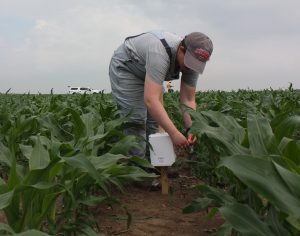
When we think about farmers, crop consultants, or other stakeholders visiting their fields, we think of them typically splitting shoots to diagnose stem-boring insects. Instead, in the future, they could attach a microphone to detect pests without physically damaging the plants. More work needs to be done to test this approach, though.
Given that temperature serves as a crucial factor in plant growth and as a major element in modeling systems, what do you think the outlook for digital entomology is in a changing climate?
We currently use insect population models that we base on old data collected in controlled environments like growth chambers, rather than on current data collected from actual fields. Unarguably, degree-day models (which predict the development and life cycle of insects based on accumulated heat over time) are useful. However, researchers use them based on the assumption that insects behave the same way that they did decades ago.
To improve predictions in insect development, we need real-time digital tools that can collect and combine live data into our developing models.
Climate change alerts us to the fact that current conditions are more favorable for insects than plants, but, importantly, we are also breeding crops to be more resistant to insects. With continuous digital data feeding our models, we can accurately understand and respond to these environmental changes.
My PhD student, Fletcher Robbins, is working on how to make updatable degree-day models that incorporate new, year-after-year trapping data or automated information. Our initial continuous data work focuses on automated information Wisconsin. However, the results should be widely applicable and widely useful.
What are the major challenges or setbacks you and your research group have encountered while working on this?
Like any other field, we also encounter several challenges
First, there is minimal overlap between the skill sets of conventional entomologists and the skill sets of digital experts whose tools we need to work on these projects. Even our programming skills do not necessarily translate to embedded system engineering. Hence, we collaborate closely with engineers. My lab has more engineering students than entomologists. You always face challenges in merging two fields because of a serious domain knowledge gap.
Another major challenge is that we are the first ones to use certain novel machine-learning approaches to work on and analyze data. This means that we cannot follow standardized data analysis protocols, and we must invent the tools as we move forward. On the bright side, because we must innovate, our projects are extremely collaborative. We currently work with 25 labs on the Insect Eavesdropper project and with three labs on the StickySonic project.
The third challenge is the insects. They seldom cooperate!
What are the major funding sources for your projects?
We have a major USDA National Institute of Food and Agriculture grant and other USDA funding. We also have two grants, one from the Missouri Soybean Board and the other one from the Wisconsin Soybean Board, that total about $170,000. I have a fair amount of start-up funds to support these projects too. The other major funding source, the Wisconsin Alumni Research Foundation, is external. It’s a nonprofit associated with the University of Wisconsin-Madison, and they’ve been incredible at trying to support my work in terms of bringing the sensor closer to product form.
What is the public perception, both from scientists and from stakeholders, about automation and entomology?
We have received a positive response from everybody. At this point, a third of my invited extension talks are about my automated tools. I did a National Public Radio Shortwave interview, which was well received on Wisconsin Public Radio.
What makes me excited is that other scientists are also enthusiastic about potentially using these tools to answer their specific questions.
Esha Kaler is a graduate student at the University of Nebraska-Lincoln in Entomology. She researches perennial sorghum’s interactions with aphids. An avid reader, she has now ventured into writing. She has been a member of AWIS since 2024.
This article was originally published in AWIS Magazine. Join AWIS to access the full issue of AWIS Magazine and more member benefits.