

Dr. Ayanna Howard is singular, in so many ways. As an African American woman leader in AI and robotics, she has often been among the “first”: she led the team that designed the first SmartNav Mars rover for future NASA exploration missions; was the first director of Georgia Tech’s Human-Automation Systems Lab; and is the first woman dean of engineering at The Ohio State University.
She is also proficient in other roles and sectors, including as founding director of Zyrobotics, a nonprofit that designed assistive technologies for children with disabilities; as an appointed member of the National Artificial Intelligence Advisory Committee; and as one of two scientists featured in the new movie Superhuman Body: World of Medical Marvels.
A Dual Existence: Humans and Robots
When we read about AI and robots, technology almost always leads the story. For Dr. Howard, however, AI and robotics exist in a mutually beneficial duality that aims to better humankind. This philosophy is reflected in her work, which seamlessly combines research in and public advocacy for the benefits, and also warns against the harms, of AI. She attributes her human-centered philosophy to her parents, who nurtured her talents while imbuing her with an ethos centered in the belief that one’s purpose, regardless of one’s path, is always to leave the world a better place than when one entered it.

Her love affair with human-robot interaction began in her childhood, when her favorite TV show was The Bionic Woman. It led her to imagine her future as a prosthetist—until she did a dissection in her first-year, high school biology class. It was such a cringeworthy experience for her that she decided she was more interested in developing the prosthesis to fit the human than in adapting the human to fit the prosthesis.
Dr. Howard attended Brown University in Rhode Island, where she did her first robotics project and earned a degree in computer engineering. She then returned to her home state of California to attend graduate school at the University of Southern California, where she earned her MS and PhD in electrical engineering. Her doctoral thesis was on designing a robot with vision and deformation controls to sort out hospital waste —a project that was spurred by the AIDS epidemic, then the leading cause of death for Americans 25–44 years of age.
During graduate school, Dr. Howard worked part-time at NASA’s Jet Propulsion Lab (JPL), which cemented her interest in AI and her fascination both with neural networks and with human-robot interaction. After completing her PhD, she accepted a position as a robotics researcher at JPL, where she continued work she had been carrying out on robotic terrain exploration.
Leaning into Diversity
A key to Dr. Howard’s persistence in a field where she is almost always singular is her father, an engineer, who was a major role model in his fearlessness toward ungendered learning. She remembers that he taught her to solder when she was just in second grade and encouraged her to enter a soapbox derby, where she was the only girl. She won third prize. When she complained that no one in a given activity looked like her, he would redirect her focus to how much she enjoyed the activity itself. With her father’s support, she learned that she could be in spaces where no one else looked like her and could fulfill her own standards of excellence. She says, “There have been many rooms I’ve gone into where I’ve been the youngest, or the only woman, or the only person of color. Even now I can still go into rooms like that.”
An event in her early training made her lean further into her difference. Upon completing her doctorate, her supervisor at JPL, Dr. Homayoun Seraji, asked her to lead the design of an AI navigation system for the next generation Mars rover. Years later she asked him why he had selected her to lead the SmartNav design, bearing in mind that she was the only woman and the youngest on his team. He responded that it was because she was always the first one to challenge his team’s approach with a “but…” way of thinking, a characteristic that he realized would be critical to designing a system de novo. That revelation led Dr. Howard to not only embrace but to celebrate her difference. “I realized then that that was my superpower, being different. I always had the ‘but’ [approach] because I had different experiences from and didn’t see the world the same way as everyone else. I am who I am because of how I grew up and the spaces that I lived in that were different from those on the team,” she explains. As a result, when she’s in a conversation with her team, she always asks herself, “What’s my ‘but’?”
An Epiphany and a Calling
After her tenure at NASA, Dr. Howard pivoted toward academe because she wanted more freedom to pursue different research directions. She accepted a position at Georgia Tech, where she continued along the lines of her research at NASA, but she switched from working on exploration of Mars’s terrain to investigation of Earth’s glaciers.
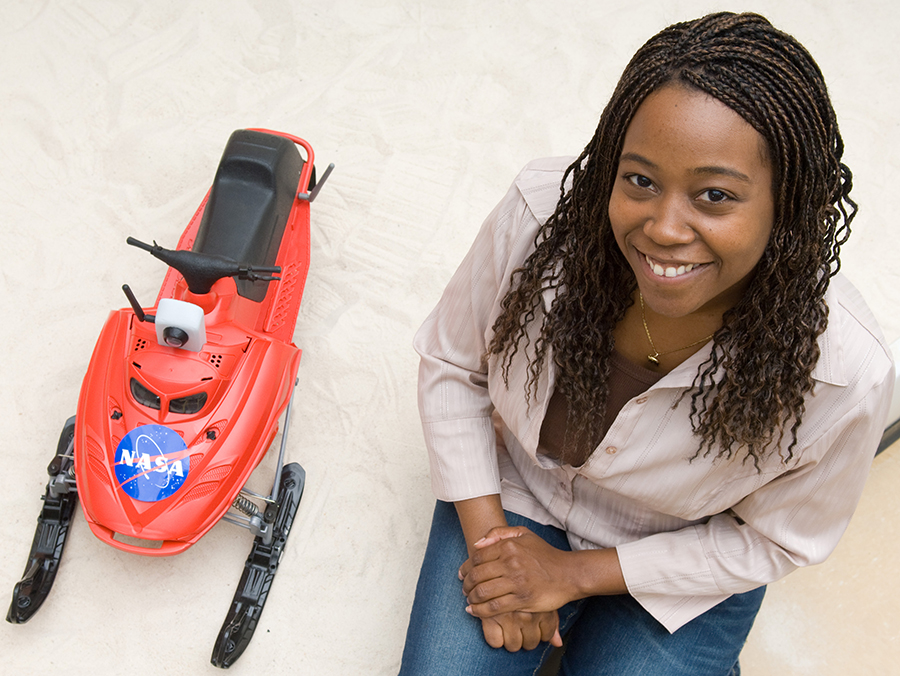
In 2008, while running an outreach camp on coding a robot to navigate a maze, she had an experience that altered the path of her research away from terrain exploration and toward more directly helping people. During one of the early camp exercises, a student, who she didn’t realize was visually impaired, asked her for help because she couldn’t see the program interface. Although Dr. Howard had always engaged in outreach with underserved communities, she was now starkly confronted with the disempowerment of people with different abilities, a population she had not previously encountered in her outreach experiences. Her curiosity awakened, she did some market research, discovering the existence of assistive technologies, but she was appalled by their great cost, for example, $2,000 for a pen adapted for people with tremors. These pivotal experiences set her on the path toward developing assistive technologies.
Her current research focuses on a wide range of adaptive technologies to improve the quality of life and publication topics including perceptions of stroke survivors in the adoption of rehabilitation technology and an examination of strategies to repair trust between humans and robots after deliberately programmed robot deception. Her patents include methods and systems for facilitating human-robot interaction and a toy controller to provide input into a computer.
Developing Humans While Creating Robots
Dr. Howard has learned valuable lessons about human development, including her own, from her many roles, research areas, and sectors. She says that the fuels that drive her are curiosity and lifelong learning. When she senses she has learned 90% of what is needed for her job, she feels ready to be challenged anew.
Reflecting on how she has learned to work with others, she says that she has come to understand that people fundamentally want to work together if they can identify a common cause. When she is putting a diverse team together, she sees her primary role as figuring out how to get people of different mindsets, values, communication styles, and disciplines to see the one place that they all want to get to. As she led the team to design SmartNav she sought the perspective of scientists so that she could design the programming to navigate the terrain in ways that they would find interesting. She adds, “Wherever I go and whatever I do, my job is to figure out the common thread that can bring people together. What are the barriers I have to break down? What is it that we want to achieve ultimately even if we take different approaches to getting there?”
This multitalented roboticist believes that her chief leadership role is to encourage future trailblazers. “I build leaders so that one day I’ll be out of a job. By this I mean I give my team lots of autonomy. I focus them on their decision-making process, including considering possible unintended consequences. When mistakes happen, we talk about what could’ve been done to have a different outcome. While others question the level of autonomy I give my team because of their greenness or field expertise, I focus on their spirit of curiosity, skill, and raw talent.” In addition to fostering autonomy, she calls on her team to be good communicators of science and to be of service to the community. She requires all her mentees to engage in outreach.
Developing AI Responsibly
Dr. Howard’s vision of the primarily beneficial duality of human-robot interaction doesn’t blind her to the potential ill effects of the technology. She acknowledges that AI robotics will do some socioeconomic harm but reflects on the history of all technology—from the discovery of gunpowder to the invention of automobiles—with the awareness that society has had to discover ways to mitigate the losses while enjoying the benefits. An example she offers about such harm mitigation is the invention of the seatbelt to reduce injuries from car collisions. In her own contemporary work in health-care AI robotics, Dr. Howard is working to represent all populations in clinical trial data to ensure treatment accuracy.
She reflects on how AI will affect the lives of women, especially those in science careers, by summoning AI’s potential to level the playing field. She believes that since women are still the primary caregivers in the United States, they can avail themselves of AI to take care of repetitive tasks and to free up time for more purposeful ones. For example, she has found ChatGPT to be a time saver by using it to compose email responses in her own communication style.
In her book Sex, Race, and Robots: How to Be Human in the Age of AI, Dr. Howard honestly confronts the potential for AI to exacerbate society’s social ills by perpetuating artefactual racist and sexist biases in programming and erasing civil liberties. However, she also addresses ways to mitigate the potential harm by embracing diversity as a key strength to humanity as we work to develop and improve AI.
In addition, Dr. Howard describes her work in cofounding Blacks in Robotics, with coauthor roboticist Monroe Kennedy III, in a 2020 Science Robotics article, “Robots Are Not Immune to Bias and Injustice.” Blacks in Robotics is a global network of Black roboticists, their allies, and organizational sponsors that offers opportunities in mentoring, jobs, education, and outreach with the goal of enhancing the diversity of Black scientists and other underrepresented groups in robotics.
Although Dr. Howard is optimistic about the potential for AI to make fundamental discoveries, for example, in drug development, and to enhance the quality of life through such tools as personalized medicine, she is aware that if scientists don’t develop and deploy it responsibly, it could exacerbate the divide between the haves and have nots. It is one of the reasons why she constantly asks herself as a leader in AI robotics, “What is my responsibility?”
Read more from Patricia Soochan about the role of AI in robotics, research, and its influence on existing inequities.
Editor’s Note: The contents of this article are not affiliated with the Howard Hughes Medical Institute (HHMI).
 Patricia Soochan is a senior program strategist in Data Science, Research, and Analysis in the Center for the Advancement of Science Leadership & Culture at HHMI. In her role, she collaborates with the Center’s programs to capture, analyze, synthesize, and communicate program-level data to promote organizational effectiveness and evaluation. Previously she shared lead responsibility for the development and execution of the Inclusive Excellence (IE1&2) initiative and had lead responsibility for science education grants provided primarily to undergraduate institutions, a precursor of IE. She is a member of the Change Leaders Working Group in the Accelerating Systemic Change Network and is a contributing writer for AWIS Magazine and The Nucleus. Prior to joining HHMI, she was a science assistant at the National Science Foundation, a science writer for a consultant to the National Cancer Institute, and a research and development scientist at Life Technologies. She received her BS and MS degrees in biology from George Washington University.
This article was originally published in AWIS Magazine. Join AWIS to access the full issue of AWIS Magazine and more member benefits.