
When I finished my PhD, I believed the hardest part was behind me. Years of experiments, clinical data analysis, troubleshooting assays, and navigating the uncertainty of research had prepared me for the next step. Industry, I was told, values rigor, resilience, and translational thinking. I had all three. Yet months into applying for biotech roles, I found myself refreshing my inbox more often than revising experimental protocols. Applications disappeared into silence. Interviews, when they came, felt encouraging—yet rarely led to offers.
Like many scientists with clinical research and molecular biology experience, I began asking a quiet but persistent question: What am I missing?
At first, I assumed it was my résumé or how I pitched my profile. I rewrote it repeatedly, replacing academic language with industry keywords. I sought feedback from mentors and colleagues who had successfully transitioned. I learned to quantify impact and foreground collaboration. Still, the rejections continued. That’s when I started to wonder whether the issue was larger than formatting.
The biotech job market has shifted dramatically in recent years. Layoffs, restructuring, and cautious funding have tightened hiring pipelines. Roles are posted, but sometimes they are paused mid-search. Others appear highly specific, almost tailored to someone already inside the organization. In conversations with peers, I hear similar experiences. Positions are frequently filled through internal mobility or referrals. From a company perspective, this makes sense: Internal hires reduce onboarding time and perceived risk. But for external candidates—even well-qualified ones—it can feel like you are proving fit before you have the chance to prove impact.
There is also a more subtle tension facing scientists at this stage. We are no longer trainees, but we are not yet senior leaders. With years of specialized experience, we may be perceived as more costly than early-career hires. At the same time, leadership roles require prior industry track records that many of us are still building. The result is an uncomfortable in-between space—overqualified for some roles, under-positioned for others.
Many of us are ready to contribute—to design better clinical trials, build stronger functional assays, interpret signals in complex datasets, and move therapies closer to patients. We trained for this work and have gained a set of transferable skills including:
- Problem-solving under uncertainty like debugging assays and narrowing hypotheses
- Decision-making like deciding what evidence is “good enough” to move forward
- Conflict resolution and consensus building with collaborators who disagree on interpretation, timelines, or risk so that the team can move forward
- Strong communication skills to clarify expectations and translate technical constraints for non-technical partners
- Delegating work across students, cores, clinicians, and vendors, and keeping complex workflows on track
- Data analysis and handling sensitive information, such as working with patient data, bridging the gap be.
- Navigating complex regulatory environments by aligning study design with Good Laboratory Practice and Good Clinical Practice to ensure compliance and translational readiness.
Those are not “soft skills” bolted onto science; they are how rigorous science gets finished—especially when projects are ambiguous, cross-functional, and time-bound, which is exactly the texture of much industry work.
Doctoral training prepares us deeply for discovery, but less explicitly for navigating constrained labor markets. Perhaps industry and academia alike need clearer pathways for mid-career scientific mobility. I do not believe the solution is simply “try harder” or “network more.” Nor do I think the system is irreparably flawed.
When teams bring in an external candidate, the organization benefits from new perspectives. An outsider often carries different methodological habits, exposure to adjacent disease biology, and experience navigating distinct regulatory or data environments. That diversity of practice does not replace institutional knowledge; it complements it—stress-testing plans earlier, spotting blind spots in study design or data interpretation, and translating insights across functions in ways that can reduce rework later. In other words, outside hiring is not just “fairness;” it can be a practical way to keep innovation from becoming too insular.
But I do believe that intentional inclusion of scientists from outside established networks would strengthen—not weaken—the biotech ecosystem: fresher questions, fewer blind spots, and teams that are better prepared to turn complex science into durable progress. I remain optimistic about where this path leads. The goal is to carry forward the kind of thinking that rigorous science demands—careful, collaborative, and grounded in real-world impact. In my current role and beyond, I hope to contribute in ways that reflect that training.
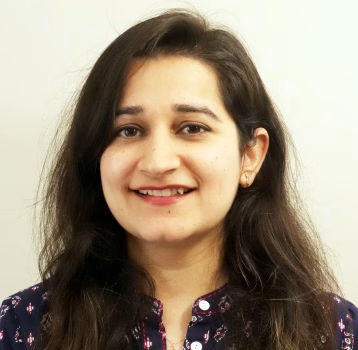
 Deepali Luthra, PhD, is a research scientist at Stanford Medicine, studying inhibitor development and immune tolerance in hemophilia and bleeding disorders, as well as immune modulation and host-pathogen interactions in cystic fibrosis. She has contributed to projects like a patented food testing kit used in rural India. Passionate about mentorship and women in STEM, she combines grit and consistency to drive translational, patient-centered research.