

As the president of the Purdue University Chapter of NORD Students for Rare, as well as a patient living with multiple rare disorders, I have developed a deep personal and professional passion for advancing the rare disease community. My unique perspective as a patient and also as a researcher drive my commitment to designing impactful projects focused on orphan products and diagnostic tools for rare disorders. This intersection of lived experience and scientific pursuit fuels my desire to contribute meaningfully to the development of innovative solutions that can improve the lives of those affected by rare conditions.
Rare diseases impact people across all age groups, yet the development of drugs and medical devices to prevent, diagnose, and treat these conditions remains a significant challenge. Clinicians often recall the saying, “When you hear hoofbeats, think of horses, not zebras,” meaning that common diseases generally prove to be the most likely diagnosis. However, an estimated 7,000 to 10,000 rare diseases collectively impact over 30 million Americans. Many of these diseases are life-threatening and do not have treatments because companies traditionally develop drugs for more common afflictions, drugs that serve larger markets and reap more profits.
In an effort to address this gap, the U.S. Congress passed the Orphan Drug Act (ODA) in 1983 to provide incentives for companies to develop products, drugs, and therapies specifically designed to treat rare disorders. Drug developers can apply for an “orphan drug” designation from the Federal Drug Administration (FDA). If the drug wins approval, the sponsor receives tax credits and market exclusivity for up to seven years after approval. In addition, the ODA established the Orphan Product Grants Program to provide funding for developing products for rare diseases or conditions.
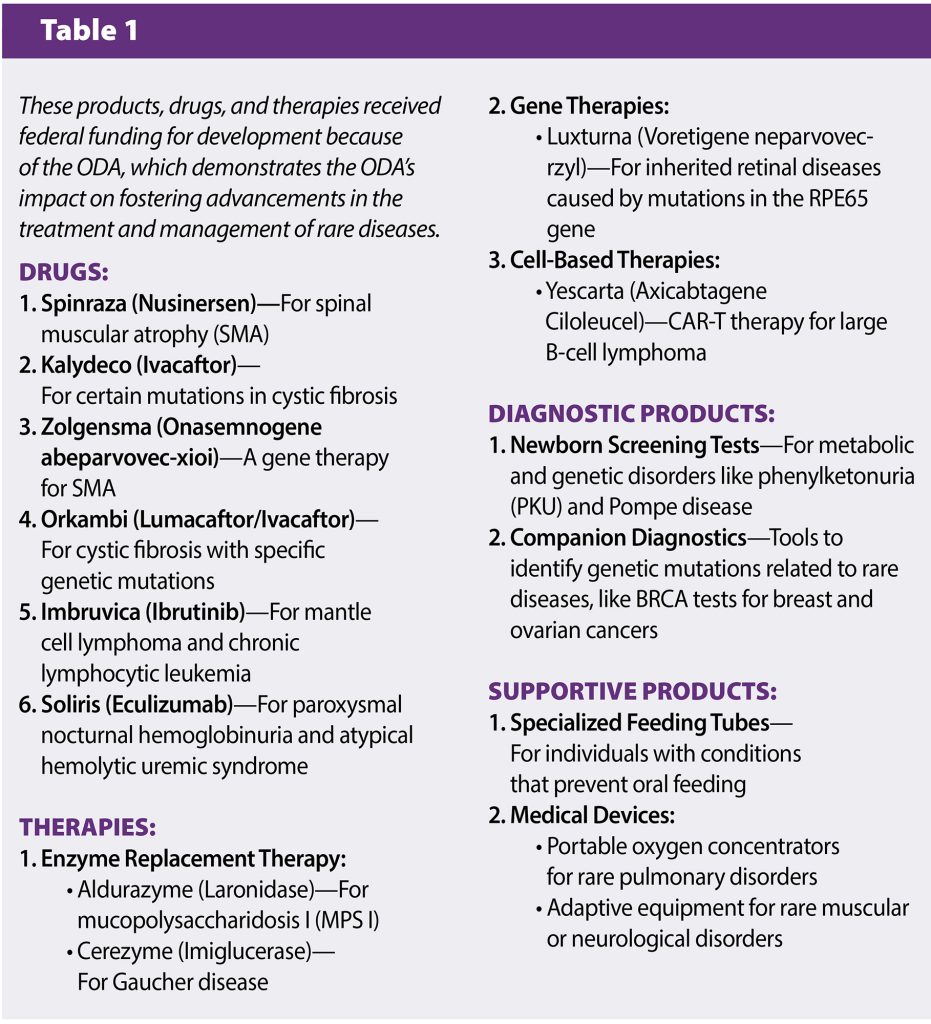 HIV serves as a prominent example of a disease that doctors and patients no longer view as a terminal diagnosis, due to groundbreaking antiviral treatments developed during the 1980s and 1990s—some of which received financial incentives from the ODA (see Table 1 for other examples). The FDA’s medical product centers, including the Center for Drug Evaluation and Research, the Center for Biologics Evaluation and Research, and the Center for Devices and Radiological Health, also play a crucial role in supporting the development and approval of safe and effective drugs, biologics, and medical devices for rare diseases.
Benefits of Orphan Drugs
Orphan drugs significantly improve the lives of patients with rare diseases. For example, gene and enzyme replacement therapies dramatically improve outcomes for disorders like spinal muscular atrophy a genetic condition that causes muscle weakness or lysosomal storage diseases that are caused by enzyme shortage in the lysosomes, the microscopic organelles breaking down and recycling large molecules. Therapies for pulmonary arterial hypertension condition that causes high blood pressure in the arteries of the lungs and lead to heart failure, enable patients to perform daily activities with greater ease.
Many rare diseases are life-threatening, but orphan drugs have extended the life expectancy of patients. Advancements in therapies for Duchenne muscular dystrophy, a genetic disorder marked by progressive muscle degeneration and weakness caused by mutations in the dystrophin protein to maintain the integrity of muscle cells, have improved survival rates and delayed disease progression. These treatments such as corticosteroid medicine (steroids) and Ataluren, a newer medicine for children alleviate symptoms, improve physical and cognitive functions, and allow patients to lead more independent lives.
In addition, the availability of treatments brings hope to patients and their families, reducing the psychological burden associated with living with a rare disease. Recent approvals, such as gene therapies like PTC Therapeutics’ KEBILDI, a gene replacement therapy for aromatic l-amino acid decarboxylase (AADC) deficiency, provide new hope for patients. This condition impacts brain function and disrupts nerve cell communication by reducing neurotransmitter production, previously leaving patients with limited treatment options. The success of orphan products has fueled awareness, advocacy, and funding within rare disease communities, encouraging more patient engagement in research and policymaking.
Orphan products also benefit society as a whole. Drug research tailors many orphan products to specific genetic or molecular profiles, paving the way for precision medicine. This personalized approach increases treatment effectiveness and minimizes side effects. In addition, technologies and research methodologies developed for orphan products often benefit other areas of medicine, leading to breakthroughs in more common conditions.
Lastly, orphan products reduce the longterm health-care costs associated with managing rare diseases by decreasing hospitalizations and complications. They enable patients to contribute more actively to society, improving social and economic outcomes.
Growing Market
In 2023, the FDA designated over half its approvals to novel drugs for rare diseases, reflecting a growing focus on orphan drug development. This progress, ironically, raises concerns that industry research and development resources increasingly target rare diseases at the expense of addressing more common conditions, such as Alzheimer’s disease, coronary artery disease, and systemic lupus erythematosus, whose sufferers continue to have vast unmet medical needs.
However, looking at the big picture, only 15% of rare diseases have received orphan designation, and a mere 5% have an approved orphan drug, many of which neither cure nor modify the given disease. We actually require a substantial expansion in drug development efforts, rather than a decrease, to meet the needs of all patients with rare diseases.
Despite challenges such as high costs and limited accessibility, the development of orphan products continues to progress. Observers expect the global market for rare disease diagnostics to grow from $21.6 billion in 2024 to $34.7 billion by 2029, at a compound annual growth rate (CAGR) of 9.9%; the diagnostics market for rare cancers to expand from $11.2 billion to $18.2 billion at a CAGR of 10.2%; and the market for metabolic and endocrine disorders to grow from $1.5 billion to $2.4 billion, also at a CAGR of 9.9%. The ongoing investment in these products reshapes the landscape of rare disease care and promises improved outcomes and renewed hope for a better future to millions of people worldwide.
If you are interested in learning more about how you can support or contribute to this critical area, I would be delighted to connect. Whether through collaboration, advocacy, or simply sharing ideas, every effort counts toward advancing care and resources for the rare disease community. Please feel free to reach out to me for more information or to discuss ways to make a meaningful impact together through my Purdue University Chapter of NORD Students for Rare.
 Behnaz Akbari received her BS in chemistry & MSc in analytical chemistry in Iran. In 2019, she joined the University of Nebraska-Lincoln and obtained a second MSc in chemistry (2021). To advance her career in medicine, she pursued her interests at Boston University School of Medicine and received her third MSc in 2022 in bioimaging (e.g., MRI). She is continuing her PhD studies at Purdue University, Department of Chemistry. She received several awards and educational grants. She is also the President of the Purdue University Chapter of the National Organization for Rare Disorders.
This article was originally published in AWIS Magazine. Join AWIS to access the full issue of AWIS Magazine and more member benefits.