

Numbers often dominate a conversation about the impact of research. Total funding obtained. Total patents filed, total papers published, total labs built. But the lasting impact of research truly lies in the personal and professional growth that it ignites in the young scientists who train to become our next generation of leaders. As a young woman myself at a research university, I found myself wondering how young college women’s growth into their adult identities plays into their simultaneous growth as scientists. So, I reached out to a few undergraduate women I know who are making waves with their scientific pursuits: Sofia Jackson, Sara Kaufman, Mila McNeal and Zena Komrokji.
Sofia Jackson (she/her), a second year chemical engineering major at the University of Maryland, College Park, who works in Dr. Peter Kofinas’s lab on airbrushed polymer fibers for postoperative intrauterine adhesion prevention.
Sara Kaufman (she/her), a third year biomedical engineering major at Johns Hopkins University, who investigates ways to create a microphysiological system for drug development and for modeling hypertrophic cardiomyopathy (HCM) by using cardiac organoids at the Johns Hopkins School of Medicine.
Mila McNeal (she/her), a third year double major in neuroscience and psychology at the University of North Carolina at Chapel Hill, who works as an undergraduate research assistant in the UNC School of Medicine on the PEEPs study, examining hormones and mood during the perimenopause transition.
Zena Komrokji (she/her), who graduated from the University of South Florida with a BS in biomedical sciences, and currently works in Tampa as a research assistant in a clinical sciences laboratory at Moffitt Cancer Center, focusing on malignant hematology.
Why Research Matters
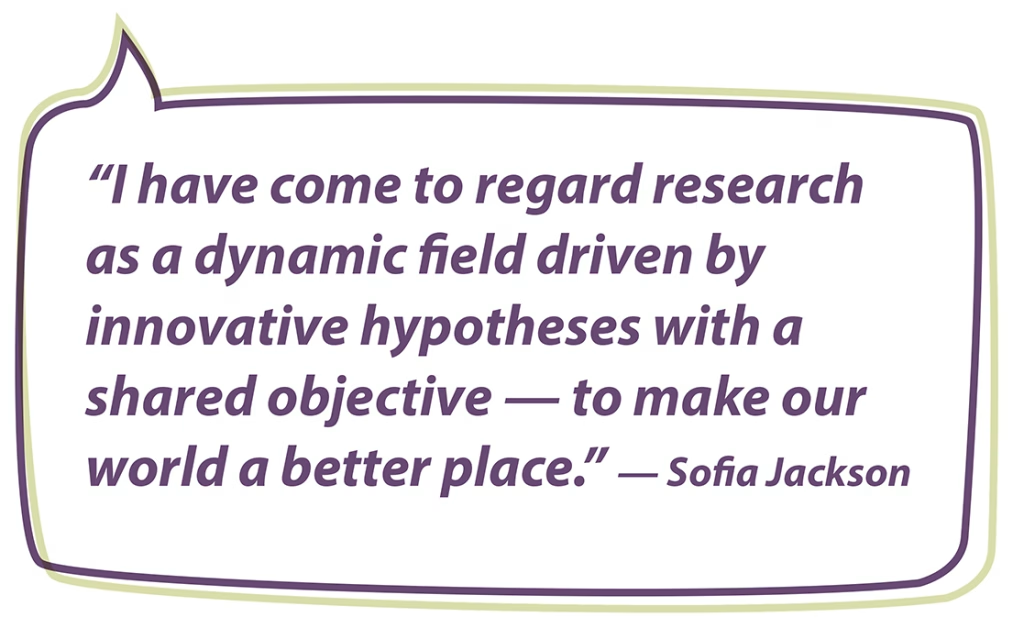
To start, we explored how a formal role in research has changed their perspectives on what their work truly means. Jackson notes that she has “come to regard research as a dynamic field driven by innovative hypotheses with a shared objective — to make our world a better place.” She explains that while “the frustration that comes with continuous experimental failure can be difficult to overcome and serves as a common fear among researchers…, the most profound challenge lies in the seemingly limitless nature of inquiry itself, where each discovery opens the door to even more unknowns and uncertainties.”
 McNeal says, “research can take many forms depending on what your strengths and interests are…, [but] what matters most is curiosity and the desire to make a difference.” Kaufman echoes this belief, stating that “research is about analyzing problems and troubleshooting to discern a solution, but this critical thinking can be taught.”
“A good researcher,” she continues, “has received good mentorship and has learned how to make the most of the resources they have to benefit the public good. Research doesn’t have to be this magical thing ‘smart people’ do in windowless labs. It can be accessible, and it can be understood by the public, and it can be a fun, community-wide effort to improve upon issues.”
Even after spending four years working in labs, Kaufman continues to feel a deep gratitude for the opportunity to engage her scientific investigations: “I am fortunate to be working on solutions to global problems; I am fortunate to receive training in how to help people; I am fortunate to be in a lab.” I heard a similar sentiment from McNeal, who notes that “contributing to a relatively new field like women’s neuroscience feels both exciting and empowering, especially knowing that it has the potential to improve countless lives with the application of new knowledge.”
Komrokji offers a unique perspective to close out this inquiry: “I’ve realized that research is essentially storytelling — seeking to answer a question with successes and occasional obstacles along the way. It can be a culmination of months and even years of experiments aimed toward paving a clearer understanding of certain phenomena. There’s a methodical approach that requires thoughtful determination of an end goal, particularly one that’s impactful within the research community.”
Unexpected Benefit of Research: Self-Growth
Given that each woman has a unique yet overlapping perspective on how to define research, I then asked them if they see themselves developing new strengths through their engagement with science. They all acknowledged shared areas of growth: finding a community, learning how to take constructive feedback, and gaining increased confidence, self-worth, patience, and optimism. For example, Kaufman says, “Scientists lift each other up…and that strength of research has really stuck with me. I’ve seen a lot more researchers supporting each other — sharing grant opportunities, taking care of each other’s’ cells, etc.”
Both Komrokji and McNeal reflect on overcoming challenges. Komrokji asserts “I have accepted mistakes and so-called failures as opportunities for learning and growth. When experiments didn’t go as expected, I was [at first] quick to try to find fault in what went wrong (and even to blame myself), when in reality, that’s what research is.” McNeal shares this sentiment and says, “While I’ve always understood [the value of constructive feedback] and have implemented and learned from what I have been told, it hasn’t always been easy to hear it and not to feel discouraged about myself and my skills…Research has shown me how disciplined and dedicated I am, especially in my commitment to helping others.”
Jackson also credits research with building her self-confidence: “During the initial phase of my research experience, I encountered repeated errors in my experiments that challenged my…sense of self-worth. It was quite frustrating and overwhelming to invest so much effort into experiments with results that would not meet my supervisor’s expectations.” However, she eventually realized that growth “stems from the lessons learned along the way that shape us into stronger individuals, or in my case, a more capable and determined researcher.”
Bringing Your Whole Self into Research
To conclude our conversation, I brought us back to the reason I had initially reached out: to learn about the intersection of identity with the experience of research, particularly for young women entering their scientific careers as college students.
 McNeal reflects, “Growing up, I felt sad and anxious when learning about health issues that affect only women, and it stressed me out thinking about how little we understand about hormones and their role in so many health conditions. Being involved in women’s health research feels so empowering because I’m helping address the fears I had as a young girl.”
Jackson also engages in women’s health research, although she focuses on the “highly understudied topic of intrauterine adhesion[s]…[which are] fibrous tissue bands that form between tissue surfaces within the uterus and/or cervix after the disruption of the endometrium from trauma related to pregnancy and childbirth.” She describes becoming instilled with a “sense of responsibility to advocate for women’s health through scientific discovery” after starting this project.
She also notes, “The idea that my research could create a future where adhesions of any kind do not pose a threat to the livelihood of humans, especially women, serves as my daily motivation to never give up.” McNeal echoes this feeling, saying, “It’s a privilege to contribute to this work, and I feel proud to be part of something that supports and uplifts other women.” Similarly, Komrokji states that she is “immensely grateful to engage in research at an institution that’s diverse and encourages confidence in our identity.”
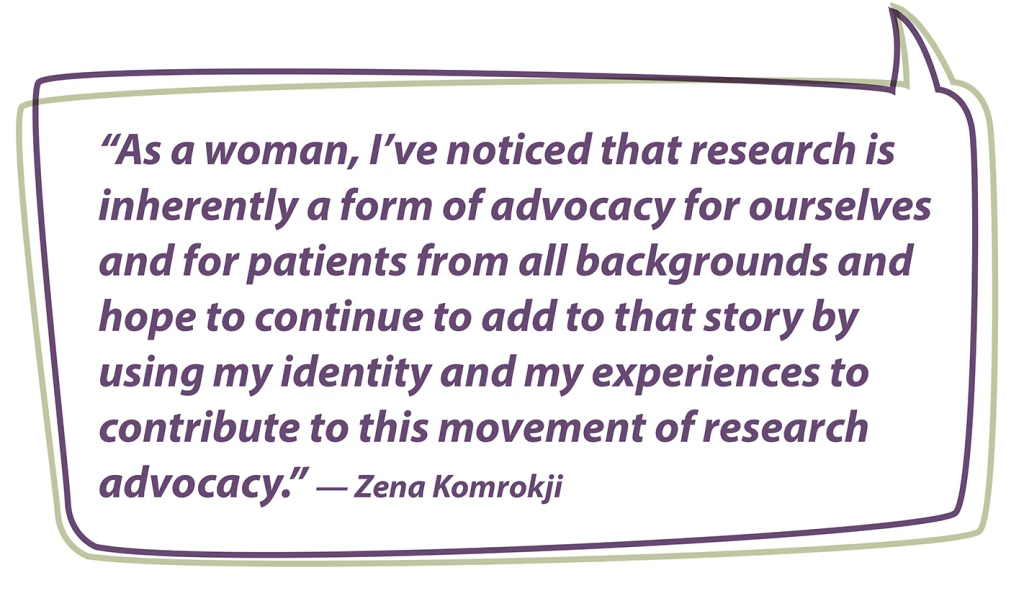
She continues, “As a woman, I’ve noticed that research is inherently a form of advocacy for ourselves and for patients from all backgrounds and hope to continue to add to that story by using my identity and my experiences to contribute to this movement of research advocacy.”
Finally, Kaufman sums their joint perspective up beautifully: “Research has empowered me to be my full self. It has given me a space to push the bounds of my knowledge (and the world’s) in a safe environment, often surrounded by amazing [women] role models.”
Talking to these remarkable young scientists affirms for me that the strength of the research community lies in the curiosity and courage of its members. For young women in particular, the foray into research serves both as an open door to a world that challenges and changes them in unexpected but inextinguishable ways, and as a starting place to inquire more deeply into questions related to women’s experiences. We must continue to actively invite young women into the scientific community and to ensure that the STEM fields become increasingly accessible to them, regardless of background and identity. The new information gathered from research publications undoubtedly furthers societal progress, but perhaps even more powerfully, the process of gathering and publishing this information instills determination, curiosity, self-awareness, and a comfort with discomfort that prove invaluable for young women as they enter scientific fields.
 Aynsley Szczesniak studies biology, chemistry, and entrepreneurship on the premedical track at the University of North Carolina at Chapel Hill. She also serves as the Executive Director of the Student Success in STEM Task Force in the UNC Undergraduate Student Government and as the Founder and CEO of Speak Out Sisterhood, a 501(c)(3) nonprofit for young professional women in STEM.
This article was originally published in AWIS Magazine. Join AWIS to access the full issue of AWIS Magazine and more member benefits.