
Grit. Perseverance. Resilience.
Those three words have shaped who I am and who I am becoming.
Many years ago, I told my father that I wanted to study science, and I provided him with a simple reason: Science felt mentally challenging, and that was exactly what I wanted to experience.
In university, I found myself in the biochemistry bachelor’s degree program. Not the medical school I once dreamed of, but still a biomedical science degree. By my third year, I fell in love with the subject. I excelled in my courses and felt captivated by lectures on cancer and other diseases. Combined with my childhood exposure to medicines—I had recurrent illnesses as a child, which got me familiar with some drugs—this education stirred an interest in drug discovery.
Yet passion alone was not enough. The pathway seemed out of reach as I contemplated pursuing graduate school. I learned a hard truth, that I needed to pair my intelligence and ambition with something more: mentorship.
Like many science graduates in Nigeria, I faced a complex reality. Opportunities in biomedical sciences there are scarce, often accessible only to those with the right connections. For most of us, a degree in biochemistry or microbiology does not lead to a laboratory career. Instead, many of us pivot to unrelated fields, working as bankers, entrepreneurs, or in telecommunications.
Like many of my peers, I accepted such a job, first as a network surveillance specialist at a telecommunications company. Later, I moved into the financial sector, serving as a group-life insurance underwriter at one of Nigeria’s top insurance firms. It was a good job, but not my dream.
Despite my full-time professional responsibilities, I refused to let go of my scientific aspirations. I spent countless hours searching for scholarships and opportunities to study abroad. Unfortunately, while I had the passion, I lacked the know-how. That changed when I met Oluwafemi Akolade, a colleague at my telecom job, and Ayoola Fasawe, who I met on a social media platform. These two people became my first unofficial mentors. Each offered a peer-to-peer kind of mentorship, and their help transformed my path. With their guidance, I earned a fully funded spot for a PhD in Applied Chemistry at the University of Arkansas, Little Rock despite holding only a bachelor’s degree and having five years of work experience unrelated to science.
Moving thousands of miles away to begin a PhD was exhilarating but also daunting. The cultural transition, academic expectations, and the loneliness of being far from home weighed heavily on me. Once again, mentorship made the difference. The right people appeared at critical moments, helping me navigate research challenges and personal struggles, especially transitioning into the Pharmaceutical Sciences program at St. John’s University in New York.
One of my most rewarding experiences came from joining the American Chemical Society’s pilot mentorship program in 2024. I matched with Ashley Nomland, a senior chemist at Merck. Her mentorship has been invaluable—not only scientifically, but also in connecting me with her professional network.
My research focuses on developing a novel class of selective chemical probes for Poly (ADP-ribose) polymerase 2 (PARP2) inhibition. PARP2, a member of the PARP family of enzymes, is a DNA repair enzyme with growing importance in prostate cancer. Most existing PARP inhibitors (PARPi) target PARP1, its better-known relative, but PARP2 plays distinct roles in DNA repair and cancer cell growth that remain poorly understood.
To address this gap, I am synthesizing small molecules using a scaffold new to the PARP field to create highly selective PARP2 probes. The probe will help validate PARP2’s role in prostate cancer biology, provide new insights into DNA repair, and potentially serve as a foundation for more targeted therapies. Unlike genetic editing methods that reduce PARP2 expression, chemical probes allow for precise modulation without any change to protein levels. The optimized probes can be shared with cancer biologists for more insights into the functional role of PARP2 in the biological system.
Having benefited so much from mentorship, I started paying it forward. I volunteer with organizations that empower young people, especially women, in STEM and education. From 2021 to 2023, I was a Global Youth Ambassador with Theirworld, where I participated in global campaigns such as #LetMeLearn, a program that advocates for education access. This role sharpened my networking and advocacy skills, leading me to co-found a nonprofit in Nigeria: Shaping African Women in STEM (SWIS Africa), with Samuel Olarewaju.
At SWIS Africa, we harness the power of storytelling to celebrate, promote, and encourage young African women aged 18–35 to pursue and persist in STEM careers. We highlight the journeys of trailblazing women across diverse STEM fields, while also equipping young women with essential skills for success—such as academic writing, mentorship, and networking—through both virtual and in-person trainings. In addition, we provide scholarships to support female high school students in Nigeria as they transition to college. In just two years, our efforts have gained recognition locally and internationally. We have collaborated with the International Fertilizer Development Center’s HortiNigeria program to celebrate women in agriculture and established partnerships with other organizations to further advance our mission.
In 2023, I also volunteered as a mentor with the Working to Advance Science and Technology Education for African Women (WAAW) Foundation, which guides young women as they explore STEM careers.
Joining the Association for Women in Science (AWIS) has been an enriching part of my academic and professional journey. Through AWIS, I have gained access to valuable professional development resources, inspiring events (including those unforgettable science-themed summer movie nights), and meaningful volunteer opportunities. I served on the Education Award Committee and, more recently, was elected as the graduate student representative on the local section’s Women in Natural Sciences (WINS) steering committee.
Grit and perseverance carried me through difficult times, and mentorship gave those qualities direction. As I move forward, I remain committed to being a scientist, mentor, and advocate who helps others achieve what once felt unreachable to them.
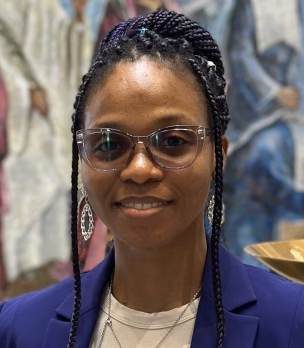
 Abosede Salami is a fourth-year PhD candidate in Pharmaceutical Sciences (Medicinal Chemistry) at St. John’s University. Her passion for drug discovery led her to join Dr. Tanaji Talele’s lab at St. John’s, where she works on developing small-molecule inhibitors of PARP1 and chemical probes for PARP2, both of which have links to cancer progression. Salami also strongly advocates for STEM education and empowerment, especially for young women.
This article was originally published in AWIS Magazine. Join AWIS to access the full issue of AWIS Magazine and more member benefits.