
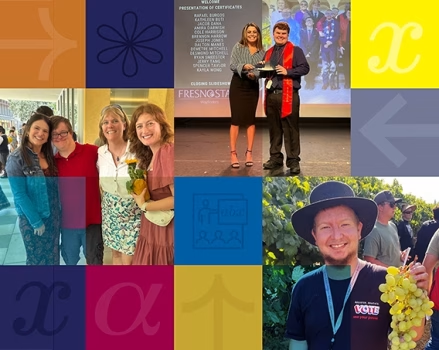
Innovative university programs for students with intellectual disabilities remind us that the best solutions often emerge from thoughtful inclusion. In fact, when universities build such programs, they not only help these young adults, but they also become more robust and secure financially and institutionally.
Amid the daily bustle of campus life, faculty, staff, and students at universities juggle grant proposals, research and education, and engagement with and service to the world around them. Across departments, burnout spreads as stagnant funding, threats to academic autonomy, and declining morale limit innovation, erode confidence, and undermine meaningful collaboration. This mounting pressure negatively affects the well-being of university communities and jeopardizes the very mission of higher education.
Faced with an unsustainable system, institutions must seek out new pathways for renewal and impact. One powerful emerging solution: comprehensive, non-degree programs eligible for extramural funding. Comprehensive Transition Postsecondary (CTP) programs, including those funded by Transition Programs for Students with Disabilities into Higher Education (TPSID) grants, support university communities in real-world, mission-aligned work that gets support from outside funding sources and state agencies, strengthening the higher education ecosystem.
An Unconventional Solution
A close look at current CTP programs shows the many benefits that universities can gain. CTP programs support students with intellectual and developmental disabilities, helping them access meaningful postsecondary educational experiences aligned with independent living and job-entry support. The US Department of Education provides primary funding for CTP. Additional funding sources include the federal Office of Special Education and Rehabilitative Services (OSERS), state-level developmental disability council grants, state-level departments of rehabilitation, and foundations, including the John P. Kennedy, Jr. Foundation. Medicaid can also support postsecondary transition programs for students with intellectual disabilities, for instance, by funding Home and Community-Based Services waivers and programs that provide career assessment, vocational training, and independent living support.

CTP programs innovate by developing customized, holistic learning approaches and implementing adaptive teaching methodologies. Think College, a national coordinating center dedicated to expanding and improving inclusive higher education options for students with intellectual disabilities, maintains the Think College Directory of all postsecondary education programs that provide services to these students throughout the country.
Beth Foraker, an inclusive college pioneering educator and advocate for inclusive higher education, has worked to transform opportunities for students with intellectual disabilities. Early on in her decades-long work in the classroom, Foraker recognized that neurodivergent students face systemic limitations. Further inspired by her personal experience as a mother of a child with Down syndrome, she became a champion for full academic inclusion.
At UC Davis, Foraker was instrumental in developing the trailblazing, four-year inclusive Redwood SEED Scholars Program, securing a collaboration with the MIND Institute and $2.1 million in federal funding. Her approach goes beyond traditional expectations: she advocates for comprehensive academic access, independent living, and meaningful career pathways for students with intellectual disabilities. Through her work, she challenges the “soft bigotry of low expectations” and demonstrates that higher education can and should be accessible to all.
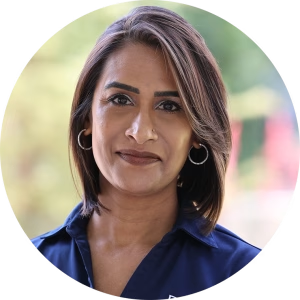
Shail Lopez-Ortiz, a disability rights advocate born and raised in Zimbabwe, began her professional journey by assisting her father in pioneering work. He led an effort by the Lion’s Club to meet a critical need for services that support people with intellectual disabilities. This early exposure inspired Lopez-Ortiz to pursue rehabilitation counseling in the United States and eventually to become the director of Wayfinders, a groundbreaking, inclusive postsecondary program at Fresno State University. Through Wayfinders, she has not only expanded educational opportunities but has also been a vocal advocate for systemic changes in how institutions support and integrate neurodivergent students.
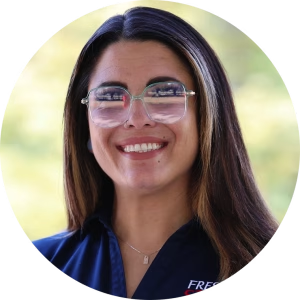
Another pioneer, Mariah Ramos, PhD, MS, CRC, has dedicated her professional career to the field of inclusive postsecondary education, bringing a unique background that bridges anthropology, neuroscience, and mental health rehabilitation to her work. As a case manager and key team member at Wayfinders, she has spent nearly six years developing innovative support strategies for students with intellectual disabilities. With an MS in Mental Health and Rehabilitation Counseling and a recently completed PhD in psychology, public policy, and law, Ramos grounds her efforts with both academic rigor and profound personal commitment to expanding educational opportunities for neurodivergent students.
Inclusion in Action
These professionals identify key components for successfully integrating students with intellectual disabilities into STEM-focused courses, labs, or internships:
- Peer mentorship and support: Wayfinders partners with undergraduate STEM students who serve as peer mentors. These mentors help students with intellectual disabilities gain confidence, navigate social situations, and participate in labs and campus events—providing trusted, supportive companions. UC Davis has over 170 peer mentors who support their scholars. These mentors are undergraduates, grad students and even include two medical school students.
- Student-centered approach: Each student’s interests and strengths become the foundation for their learning plan, which they build in close collaboration with professors and program staff. Students and faculty create person-centered plans that guide the student’s college experience.
- Collaborative academic planning: The university’s inclusion coordinator and staff communicate directly with STEM faculty to ensure that professors make appropriate accommodations, such as implementing Universal Design for Learning strategies to break down complex concepts and to make content more accessible and using plain language and multiple methods of communication—such as charts, graphics, and visual aids—to help convey scientific ideas. At UC Davis, the Academic Director creates an academic plan for every course, including STEM courses, and the Redwood SEED Scholars receive academic credit for their work.
- Encouragement of self-advocacy: Students receive support for expressing what accommodations will help them thrive.
- Focus on confidence in real-world exposure: Students get encouragement and support to participate in all aspects of college life—from attending special events like AgTech Day to engaging in practical work through campus partnerships.
- Professional development: Faculty receive training to better recognize the potential of students with intellectual disabilities and to better understand their needs and how to adapt teaching techniques accordingly.
Success Stories
Celebrating and sharing stories of these students’ achievements can help build awareness and inspire others who may benefit from similar programs.
Ramos said, “I’d love to highlight a student I am currently working with and share some of her incredible accomplishments. She initially struggled with significant anxiety and found the transition to independence and navigating a college campus very challenging. Through the use of innovative technology and her strong interest in horticulture, she has made remarkable progress. She began working with the Horticulture Department on campus, joined a Plant Science Club where she actively volunteers, and has even encouraged other Wayfinders students to get involved. She plans to continue her science journey by enrolling in Plant Science 40, further building on her passion for horticulture. She intends to graduate from the Wayfinders Program and Fresno State, then continue her education at Fresno City College to earn a certificate in horticulture and pursue employment at a nursery. This semester, she will be working at Gazebo Gardens. I am incredibly proud of her resilience and determination. By utilizing campus accommodations— such as transportation support, Read & Write Gold, and generative AI tools to create study guides—she has been able to manage her anxiety, succeed academically, and work toward a future that allows her to give back to the community doing something she truly loves.”
Lopez-Ortiz shared another Wayfinders success story: “A student came from a farming background, and he was really interested in ag science and working with cattle. So, he joined the Fresno State program through us. He learned skills for artificial insemination and delivering calves. He was able to gain hands-on experience with everything the department had to offer. This student now has gotten a small piece of property on his parent’s farm and is doing cattle ranching. He raises the grass-fed beef and sells it. And he met his wife in our program. She was learning to work with preschool students.”
The Ripple Effect
The support structures and collaborative relationships that characterize these inclusive programs may indirectly ease faculty workload and potentially help mitigate burnout. Describing this benefit of the Wayfinders program, Ramos said: “We also have the university inclusion coordinator, who works with the professors on campus. And the professors are really great. They work with us to provide that support for our students, to guide them.” Foraker noted that with inclusivity, “your education, for typical students, gets better. The professors get better, the workplaces get better, the living and the dorm opportunities, everybody improves because it’s accessible to everybody.”
She added, “Our students do work in science labs. We have students who works in plant pathology, entomology, and ag sciences. One student who’s working in an education lab was named on a paper that they published. So that was really cool, and the first time we’d ever seen that in our program.”
A Call to the Scientific Community
By embracing inclusive college programs like Wayfinders at Fresno State and the Redwood SEED Scholars at UC Davis, higher education institutions leverage a new strategic tool for building a more resilient, innovative, and fulfilling academic environment, thereby revitalizing their communities.
Professional organizations like AWIS or STEM-focused companies can best support the work of inclusive college programs in two main ways. First, they can spread the message that students with intellectual disabilities are capable. Second, they can open employment pathways. Ramos noted that many students come to Wayfinders seeking work in STEM. Companies could “provide an open door for them to find work sites and opportunities and to use the skills they do have and refine them.” Foraker expressed a similar message: “Build jobs. We’re now in a contracting economy, and so the first people to lose jobs are people with intellectual disabilities. I’d love to see science companies, think tanks, and nonprofits really welcome people with intellectual disabilities into their spaces, because they are virtually nonexistent in all those spaces.”
Beth Foraker, Shail Lopez, and Mariah Ramos have ambitious visions for postsecondary education for neurodivergent students, ranging from more of a college track for these students in high school to competitive, integrated employment. “We want it all,” Foraker says. “Four-year inclusive college programs in every university. We want it to be a best practice in universities with inclusive living. Two-year inclusive college programs at every community college in our state with inclusive living. How do we get there? It’s really about building understanding at the state legislative level of the impact of these programs on people with intellectual disabilities and their communities, and then helping the state legislature set aside some funding and also braiding the funding with these other big funding pots, like Medicaid and Department of Rehab. There’s so much work we can do.”
 Georgina To’a Salazar, PhD, works to create innovative solutions in science communication, research, and policy. With a BS in chemical engineering from Stanford University and a PhD in biomedical engineering from the University of California, Irvine, Dr. Salazar has fulfilled her dream of exploring the world, having taken research positions in Singapore and Japan before returning to the United States to focus on science communication. She currently works as a freelance scientific writer through her small business, Redwood Scientific Communications, LLC.
This article was originally published in AWIS Magazine. Join AWIS to access the full issue of AWIS Magazine and more member benefits.