
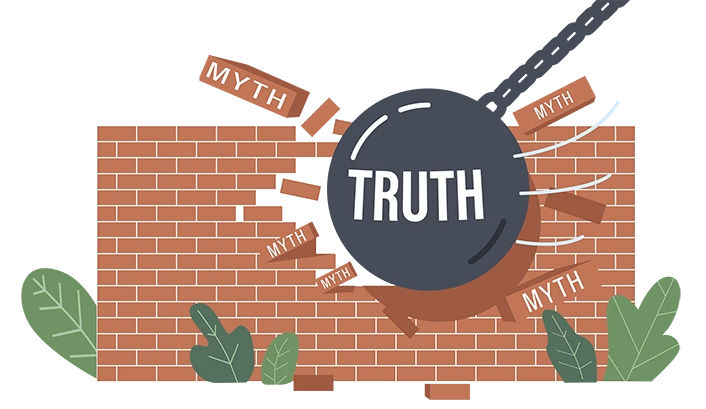
Many people mistakenly believe that teaching colleges exist solely as teaching institutions: They assume that instructors and students at these schools don’t engage in any meaningful or serious research. However, the myth that only research universities produce quality work overlooks some ground-breaking work at community colleges and teaching-focused four-year institutions.
I reached out to several professors to help me explore this myth. They helped me see that people who buy into this fallacy believe that the greater output of research at universities always equates to better-quality work; that teaching-focused institutions focus solely on curriculum-based research rather than on so-called “real” research and do not provide the tools, infrastructure, or mentorship for serious scientific work; and that significant breakthroughs cannot come from them. Now is the time to dispel this widespread set of misconceptions.
The truth is, students and teachers from these institutions have published papers, won national awards, and contributed to cutting-edge research and discoveries worldwide.
 These days, students at teaching colleges have the chance to contribute meaningful research across a wide range of disciplines. At institutions such as Finger Lakes Community College in New York, Bluegrass Community and Technical College in Kentucky, and Del Mar College in Texas, they demonstrate that rigorous, high-quality research does not just come from major universities. Their achievements have received support through a growing network of programs designed to expand undergraduate research opportunities.
Initiatives such as the Community College Undergraduate Research Initiative, the Summer Undergraduate Research Fellowship in Earth and Environmental Sciences, and the National Science Foundation’s Research Experiences for Undergraduates provide structured pathways for students to engage in advanced projects. At the same time, collaborative programs like Chemical Research at Texas, a partnership between Austin Community College and the University of Texas at Austin, foster direct connections between community colleges and research-intensive universities. Together, these opportunities highlight both the potential and the of commitment of community teaching-focused college students as active contributors to the broader research enterprise.
Despite their often-overlooked status, these hidden-gem colleges have provided launching pads for impressive future researchers. Eileen Collins, the first woman to pilot and command a NASA space shuttle mission, started her academic journey at Corning Community College in New York. Adriana Ocampo, a planetary geologist and science program manager at NASA, discovered her passion for science at Pasadena City College in California. The world of academia offers many such examples if we look closely.
Undeniably, teaching-focused institutions cannot devote the same amount of time to research that universities can. Moreover, research and teaching expectations differ in these institutions. Some colleges, although certainly not all, do not consider professors’ research as part of tenure and promotion decisions. Additionally, community and four-year college instructors often carry full teaching loads, leaving them with limited time. Such a tight schedule does not allow them to design experiments, write papers, and mentor students in such projects.
Another significant barrier lies in more limited funds and resources, compared with those at R1 institutions. Grant reviewers often underestimate the capabilities of teaching-focused institutions, leading them to hesitate to fund deserving projects, despite their potential impact. A possible way for scholars at teaching focused colleges to address this challenge consists in collaborating with researchers at R1 institutions to share resources, ideas, and work toward common project goals.
Despite these roadblocks, researchers at non-research institutes have continued to make their mark. A 2022 study found that community college faculty researchers participation in biology education publications increased from 3.2% (approximately 15.2 papers/year) to 5.9% (approximately 29.4 papers/ year), nearly doubling the publication volume per year in this field over a span of five years. Roughly 33% of the community colleges in a 100-college sample offer undergraduate research opportunities, while others now work to implement such programs. “What we’ve found — and what we recently published — is that there’s more undergrad research going on at community colleges than we’d thought because, frankly, we didn’t think there would be any. But it’s still not a lot,” says Nancy Hensel, former executive officer of the Washington, D.C.-based Council on Undergraduate Research (CUR). “When it does occur, it’s typically in the areas of computer science and STEM.” The U.S. National Science Foundation (NSF) awarded a $530k grant to LaGuardia Community College for professional development in STEM degree programs. NSF Director Sethuraman Panchanathan said, “Community colleges play a critical role in training people from all parts of the country for a variety of STEM careers, including future scientists, engineers, and technicians.” Similarly, NASA awarded grants to teaching-focused institutions, including Whittier College, Jackson State University, and California State University to support STEM student research. Contrary to popular belief, teaching institutions are increasingly becoming hubs of meaningful research, innovation, and scholarly contribution, recognized even in the discourse of policymakers and education leaders.
The faculty at teaching-focused institutions can have less of a niche focus than those at R1 institutions, and their wider interests can lead to innovative cross-disciplinary approaches, which in turn, can give their students more exposure to multiple disciplines. Moreover, personalized mentorship is more prevalent in undergraduate-specific colleges, which foster close mentor-mentee relationships and tailored guidance. In this way, teaching-focused institutions may provide more supportive environments for women and underrepresented groups. As the students work with multiple people and limited resources, they become better prepared to navigate similar challenges in graduate university programs and industry.
Further enhancements, such as increased financial support, initiatives that encourage partnerships between research and teaching institutions, and fellowship programs for graduate students, could improve the quality and impact of research within community and four-year colleges. These fellowship opportunities can foster collaborative research, access to exclusive networks and mentorship, and provide space for professional development. Such efforts would help these colleges get some of the recognition routinely extended to research-focused universities. It is essential to acknowledge and value the commitment and work of both faculty and undergraduate researchers. These institutions may operate under the radar, but they can set skilled students and researchers on a path that enables them to make significant contributions to our communities.
I want to extend my sincere gratitude to Dr. Davida Smyth, Professor of Natural Sciences at Texas A&M University–San Antonio; Dr. Holly Basta, Associate Professor of Biology at Rocky Mountain College; Dr. Joey Becker, Associate Professor of Mathematics at Wartburg College; and Dr. Sean Coleman, Associate Professor of Biology at Wartburg College, for their invaluable guidance and support in shaping this article.
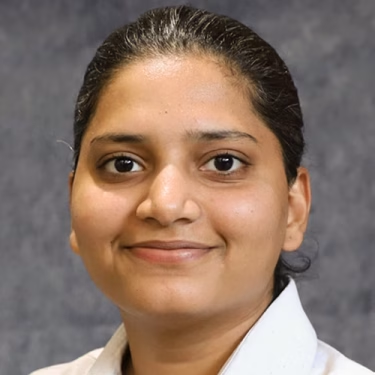
 Esha Kaler is a graduate student at the University of Nebraska-Lincoln in Entomology. Her research focuses on understanding the sorghum-sugarcane aphid and sorghum-fall army-worm interaction system using molecular and bioinformatic tools. She has been a member of AWIS since 2024.
This article was originally published in AWIS Magazine. Join AWIS to access the full issue of AWIS Magazine and more member benefits.