

STEM fields have historically faced limits imposed by geography, resources, and social barriers. Classrooms and labs can provide structure, mentorship, and guidance yet inadvertently exclude many curious minds who lack access to educational institutions or to financial resources. Today, virtual learning, adaptive platforms, and massive open online courses (MOOCs) quietly work to transform STEM education. They break barriers, provide flexible access, and give worldwide learners the tools to explore science, technology, engineering, and mathematics on their own terms—on their own time and at their own pace.
For me, this evolution feels deeply personal. During the COVID-19 pandemic, I navigated the final chapter of my PhD at Texas A&M University. After graduating, I successfully interviewed for a postdoctoral position at MIT entirely online and then began my postdoctoral research. I still remember my first virtual interaction with students and colleagues during this period. Our screens filled up with muted microphones and indicated switched-off cameras, yet a shared curiosity connected us all. That moment crystallized a truth I carry to this day: STEM education is not bound by lecture halls or lab benches; it can provide access and opportunity to anyone, anywhere.
Throughout my journey, I have guided undergraduate research projects online, co-facilitated MIT classes, supervised lab sessions, and explored online courses myself. I’ve witnessed firsthand how technology bridges gaps, empowers learners, and ignites curiosity. Every such virtual interaction—whether mentoring on research ethics, troubleshooting an experiment, or discussing career pathways—reinforces the fact that learning is lifelong and ever-evolving.
Virtual Learning
Virtual learning has advanced far beyond emergency remote instruction. Platforms such as MITx, Stanford Online, Coursera, and edX now provide students worldwide access to world-class lectures, interactive exercises, and virtual labs. For disciplines that rely on hands-on experimentation, simulations and interactive modules replicate essential lab experiences, enabling learners to experiment and learn safely.
At MIT, I delivered lectures, co-facilitated classes, and guided students virtually in University Research Opportunities Program projects. These online experiences taught me that learning consists of far more than just absorbing information—it involves mentorship and confidence building. Students who revisit lecture materials, explore concepts at their own pace, and engage in guided problem-solving become not only competent but independent, empowered learners.
In my postdoctoral work, I found that even small moments—helping a student troubleshoot an experiment or discussing research design during office hours—often sparked curiosity and confidence that extended far beyond the classroom. Beyond classroom teaching, I personally explored virtual courses in sustainability, process engineering, and emerging STEM technologies. Strengthening knowledge in areas outside my expertise helped me personally understand the importance of lifelong learning.
With in-person learning restricted during the pandemic, virtual classes became essential—not only for students but also for educators and professionals. Remote instruction, online labs, and interactive simulations allowed education to continue uninterrupted. The experience showed that education transcends physical boundaries and that curiosity and knowledge thrive in any setting.
Adaptive Learning
Adaptive learning platforms take virtual learning a step further, personalizing the educational journey. They track progress and tailor content to each learner, providing support where needed and introducing challenges at the right time. In STEM, this is transformative: Students who struggle with foundational concepts gain targeted help, while advanced learners can dive into complex topics at their own pace.
Adaptive platforms also encourage self-reflection, which I have found to be especially impactful. Students visualize which concepts they understand and which require more attention, a process that helps them take ownership of their education while still receiving guidance.
For historically underrepresented STEM learners, adaptive platforms serve as game changers. They ensure that they leave no student behind and foster mastery and self-assurance. Equity in STEM begins when each student can progress according to their ability, curiosity, and potential. Students once overlooked in traditional classrooms can now unlock their full potential.
MOOCs
MOOCs have democratized access to top-tier STEM education. Platforms such as Coursera, edX, and FutureLearn allow learners worldwide to access universitylevel courses, often free of charge. I have explored MOOCs to expand beyond my research focus, from sustainable practices to advanced engineering concepts.
Students in rural areas, at under-resourced schools, or on nontraditional pathways can engage with material once confined to elite campuses. Online discussions, peer feedback, and virtual labs foster a sense of community, even for learners scattered across continents.
Challenges remain. High dropout rates, limited lab experiences, and uneven credential recognition can hinder MOOCs’ effectiveness. Yet platforms continue to evolve. Peer collaboration, virtual labs, and micro-credentials enhance engagement and legitimacy, allowing learners to gain meaningful STEM experience from home.
Outreach and Continuing Education
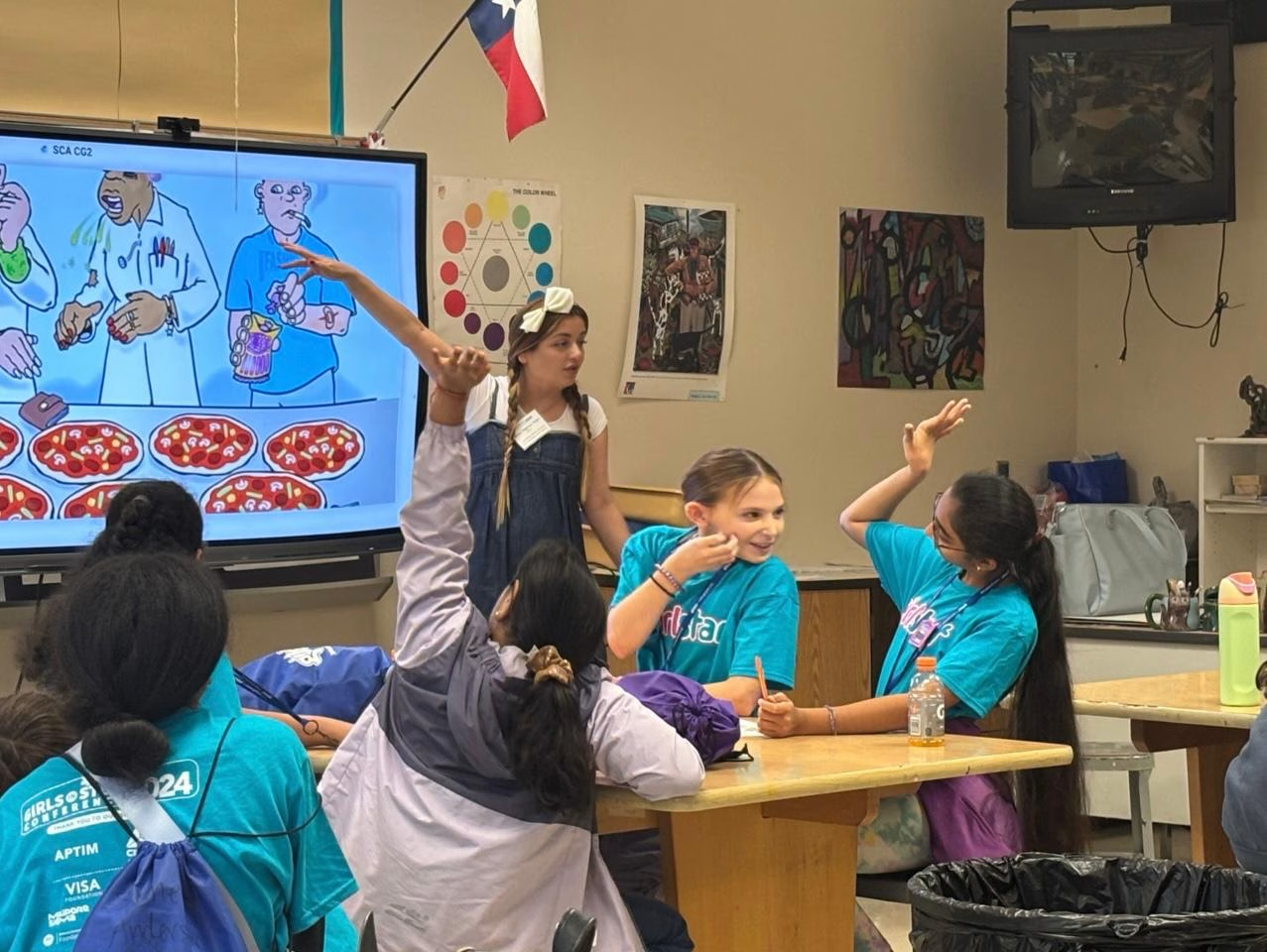
While virtual learning opens doors worldwide, in-person experiences allow learners to connect, collaborate, and see themselves represented in STEM fields. Outreach programs like Girlstart, where I have participated in in-person workshops, provide early exposure and inspiration for elementary and middle-school girls. These workshops ignite curiosity and show students that STEM is accessible, exciting, and full of possibilities. Hands-on experiments, mentorship, and peer engagement create lasting impact far beyond the session.
In addition, established-career professionals may find that adaptive and online learning tools support their continuing education. STEM fields evolve rapidly, and the ability to learn, unlearn, and relearn proves critical. I have mentored colleagues as they transition into sustainability or data science careers by helping them use these tools. Through resources that combine access, flexibility, and mentorship, learners can navigate STEM pathways throughout their lives that once seemed closed off.
However, teaching at MIT reinforced another vital lesson for me: Structured guidance matters, and this mentorship cannot come solely from technological platforms. Preparing lectures, co-facilitating courses, and supervising labs showed me how mentorship sparks curiosity, nurtures confidence, and develops skills far beyond the classroom. Every personal interaction—guiding a student through research design, ethical considerations, or career planning—leaves a lasting impact that technology alone cannot replicate.
Looking Ahead
Virtual, adaptive, and in-person platforms described above all expand equity. They provide learners the chance to explore STEM, gain mentorship, and build skills.
Unfortunately, some barriers remain. Not all students have reliable internet, computers, or environments conducive to virtual learning. We cannot yet fully replace hands-on lab experiences online. Credential recognition remains uneven, though micro-credentials and verified certificates continue to gain traction.
The good news is that emerging technologies— augmented and virtual reality labs, AI-driven mentoring, and personalized learning analytics—promise to reduce barriers further. When paired with mentorship, outreach, and intentional inclusion, these innovations will make STEM education more equitable, engaging, and empowering than ever.
Online platforms also continue to incorporate career guidance and professional mentorship, helping learners find pathways to internships, graduate programs, and industry opportunities. Combining adaptive technology with structured, personal guidance ensures that learners not only gain knowledge but also translate it into meaningful opportunities.
Women in STEM should view virtual learning, adaptive platforms, and MOOCs not just as innovations but also as tools of empowerment, equity, and inspiration. These resources break down barriers, personalize learning, and ignite curiosity in learners of all ages.
By combining technology, mentorship, and intentional outreach, STEM education can empower every learner, turning curiosity into opportunity and opportunity into impact. The future of STEM belongs not just to those who have always had access to it but also to those ready to seize it. Every curious mind can explore, experiment, and thrive without boundaries. Lifelong learning, whether in person, online, or through adaptive platforms, ensures that no mind is left behind and that no curiosity goes unanswered.
 Dr. Yagmur Yegin has an MS and PhD from Texas A&M University, and deep expertise in sustainable systems and interdisciplinary research. Her postdoctoral research at MIT focused on environmentally friendly antimicrobial f ilms, biodegradable edible packaging, and innovative sustainable nano/microparticles to replace intentionally added microplastics in consumer-product formulations. She has received numerous awards throughout her career and contributed to over 30 peer-reviewed articles, book chapters, and patents. Outside her professional endeavors, Dr. Yegin enjoys cooking, road trips, spending time with her family, and volunteering for charitable causes.
This article was originally published in AWIS Magazine. Join AWIS to access the full issue of AWIS Magazine and more member benefits.