
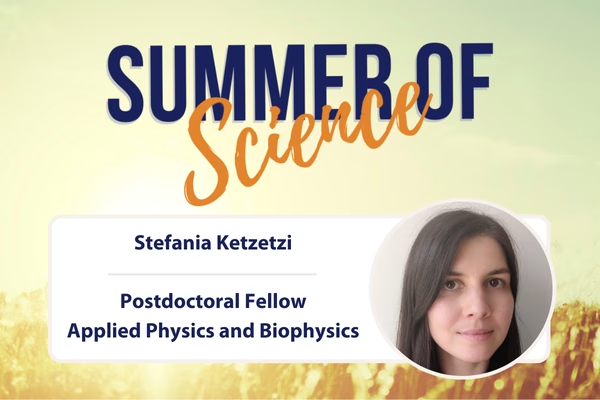
Stefania Ketzetzi, Postdoctoral Fellow at Harvard University, is advancing the frontiers of biophysics and soft materials research. Her work focuses on understanding how living systems destabilize and break apart, with the goal of building a theory of biological disassembly. By integrating advanced imaging techniques with materials science and colloidal physics, Stefania is developing new ways to study microbial lysis, protein complexes, and the design of functional biomaterials. Her discoveries have the potential to inspire innovations in areas such as drug delivery, microsurgery, and tissue engineering.
What does a typical day in your role look like?
I am a postdoctoral fellow at the Harvard School of Engineering and Applied Sciences supported by the Swiss National Science Foundation.
In my day-to-day, I work in the laboratory where – in collaboration with other scientists across physics and biology – I design, perform, analyze, and interpret complex experiments. The topics that I currently investigate are at the intersection of biophysics and soft materials. I seek to understand how living systems become destabilized and break apart, ultimately aiming at building an accurate theory of biological disassembly.
To that end, I am integrating advanced techniques that enable real-time imaging of microbial lysis and the disassembly of photosynthetic protein complexes.
The Path to Materials Science
My long-term goal is to build an independent research program to engineer biocompatible systems at the nano- and microscopic length scales with target dynamical properties, as precise control of these properties especially in such scales can have far-reaching implications for biomedicine and micro-robotics, e.g. for drug delivery, microsurgery, and defect repair.
Throughout my scientific journey, I have been engaging in multi and interdisciplinary science. I was primarily trained in physics at the Aristotle University of Thessaloniki in Greece and, subsequently, I specialized in applied physics, condensed matter, and colloidal science during my pre-doctoral and doctoral studies at the University of Amsterdam and Leiden University in the Netherlands.
Afterwards, I expanded my research in materials science as a postdoctoral scientist at ETH Zurich in Switzerland. My research on colloidal systems played a key role in developing experimental strategies and quantification tools that isolate key properties of synthetic systems at the microscopic scale, such as self-assembly, dynamics and organization, which I still employ to date. Driven by recent advances in imaging techniques, I am now bridging methods from colloidal science with the rapidly growing fields of biological physics and protein engineering at Harvard University.
I have been passionate about science since my school years, where my love for mathematics eventually led me to physics. There, I discovered that mathematics could be a powerful tool for understanding and modelling real-world processes.
During my time in the Netherlands, I became part of a vibrant community focused on soft matter research, which opened my eyes to the fascinating idea that biological systems could be studied using the principles of soft matter physics and materials science. This deepened my interest in exploring the intersection of biology, physics, and materials science.
Today, I am excited by the potential of bridging and integrating these fields as I see great opportunities for new discoveries and innovations. At the same time, I find great fulfillment in outreach, empowering young researchers, mentoring students and engaging in teaching, all of which have become integral to my journey as I believe that fostering the next generation of scientists is our duty and responsibility.
Over the years, I have encountered several obstacles, from adapting to different countries and academic environments to mastering a new language — both in informal settings and in the highly demanding context of scientific communication.
Developing confidence in public speaking and academic writing was not immediate, but through persistence, I turned these initial difficulties into strengths.
Hard work and determination have been a constant, for example, in building technical expertise but also in cultivating the mindset necessary to navigate a competitive scientific community.
Developing a mindset that prioritizes independence, discipline, and excellence was key in maintaining self-motivation and focus.
Transitioning from a mentee to a mentor has further bolstered my active duty to serve as a positive (female) role model and to keep committed to growing personally and professionally.
Science with Impact
How has your work or research helped drive discovery, innovation, or impact?
I have developed different classes of self-propelling colloids, synthetic microparticles that mimic microorganisms and can serve as synthetic micromotors.
I received distinctions for contributing fundamental understanding of their behavior and interactions inside complex environments and for developing strategies of scientific and technological interest (Discoverer of the Year 2020 at Leiden University and runner-up for best PhD thesis in Soft Matter in the Netherlands in 2021).
During my doctoral studies, I was also part of the team that microfabricated colloids with virtually any shape, including the Smallest Boat in the Guinness World Records.
More recently, my research in biophysics has the potential to lay the groundwork for a general theory of disassembly that could serve as a guiding principle for realizing future technologies, with focus on, e.g., how disassembly pathways can be disrupted or engineered to inspire the design of novel functional biomaterials, or for creating new methods for drug delivery and tissue scaffolding.
What is your proudest achievement in your career so far?
I was recently selected as a Finalist for the Emerging Investigator Award in the field of Colloid and Interface Science, an award open to researchers 6 years from their PhD. This acknowledgment motivates me to continue pursuing innovative research that can impact the scientific community.
The Power of Science and Community
What does the power of science and community mean to you?
To me, science and community together represent the power to drive meaningful change. While science gives us the knowledge and tools to solve complex problems, community is what transforms that knowledge into real-world impact. Collaboration within diverse scientific communities fosters innovation, new perspectives, and shared problem-solving that drives progress. It’s through community that we realize the true potential of science, turning discoveries into tangible solutions to global challenges.
How has science shaped your sense of community—and how has community supported your journey?
My journey has been characterized by international integration and adaptability, and has provided me the opportunity to bridge cultures and foster large-scale change.
Through my network, I’ve participated in developing workshops, meetings, and programs that brought together early career researchers working on interdisciplinary problems, and others that offered mentoring opportunities for students. The scientific community, particularly societies supporting women in science, has provided me with a platform to share and integrate my own cultural background and experiences, which has broadened my perspective and approach to research.
Additionally, my involvement in these communities has been instrumental in my development, offering me professional support, opportunities for collaboration, and a sense of belonging. As a mentor for Greek women in STEM, I now strive to give back by reinforcing opportunities for others and helping female researchers navigate their scientific careers. Community has shaped not only my professional growth but also my commitment to fostering inclusion and creating pathways for future generations of scientists.
To a Future Scientist Just Starting Out
What advice would you give to someone just starting out in your field?
I have been fortunate to have role models whose achievements inspired me, as well as mentors who believed in my potential and provided unwavering support. They helped me stay focused on my passion for discovery and my commitment to contributing meaningfully to my field.
My advice to those just starting out is to seek mentors who care not only about your scientific progress but also about you as a person. Science can be challenging, and having someone who believes in you is invaluable. Be persistent, keep asking questions, and embrace every opportunity to learn. Do not be afraid to face setbacks, as they are often opportunities in disguise. And do not forget to prioritize your mental health and well-being, as resilience is just as crucial as intelligence in this journey.
What message would you share with future scientists about the power they hold to make a difference?
To future scientists, I would say that you hold immense power to make a difference — both through your discoveries and by the way you contribute to the scientific community. Every idea and every challenge you face has the potential to bring about new solutions and open up new frontiers. Your work may take time, and it may present obstacles, but each step you take builds towards something that you may not even foresee.
Science is not just about what you discover, but also about how you inspire and mentor others. You are part of a global network, and through connection and shared knowledge, you can amplify your impact. Stay curious and know that your efforts are shaping the future in ways that will benefit the next generations.
What would you tell your younger self about your STEM journey?:
If I could speak to my younger self about my STEM journey, I would tell her to acknowledge and appreciate every step of the way. The process of learning and growing both in science and as a person is often non-linear, with plenty of challenges along the way, but each step builds towards something greater. I would remind myself to embrace the challenges as opportunities for growth and to not to be discouraged by setbacks, as they often teach the most valuable lessons and cultivate resilience.
I would emphasize the importance of balancing ambition with self-care, remembering that the journey is just as important as the destination, and recognizing that it is a marathon, not a sprint.
Lastly, I would remind myself to enjoy the process, be curious, and continue to engage with the community, as it is often the people that make the journey fulfilling.