
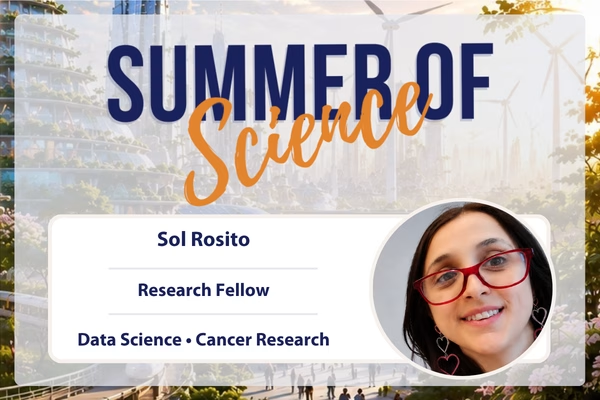
Sol Rosito is a Research Fellow at Dana-Farber Cancer Institute and the Harvard T.H. Chan School of Public Health, where she applies mathematics, statistics, and artificial intelligence to cancer research. After earning degrees in mathematics and astrophysics, she brought her quantitative expertise to the study of cancer genetics, risk prediction, and early detection. Through her work developing statistical models, simulations, and AI-driven tools, she helps researchers better understand cancer risk and make more informed decisions about prevention, screening, and patient care.
A Day in the Life of a Research Fellow
What does a typical day in your role look like?
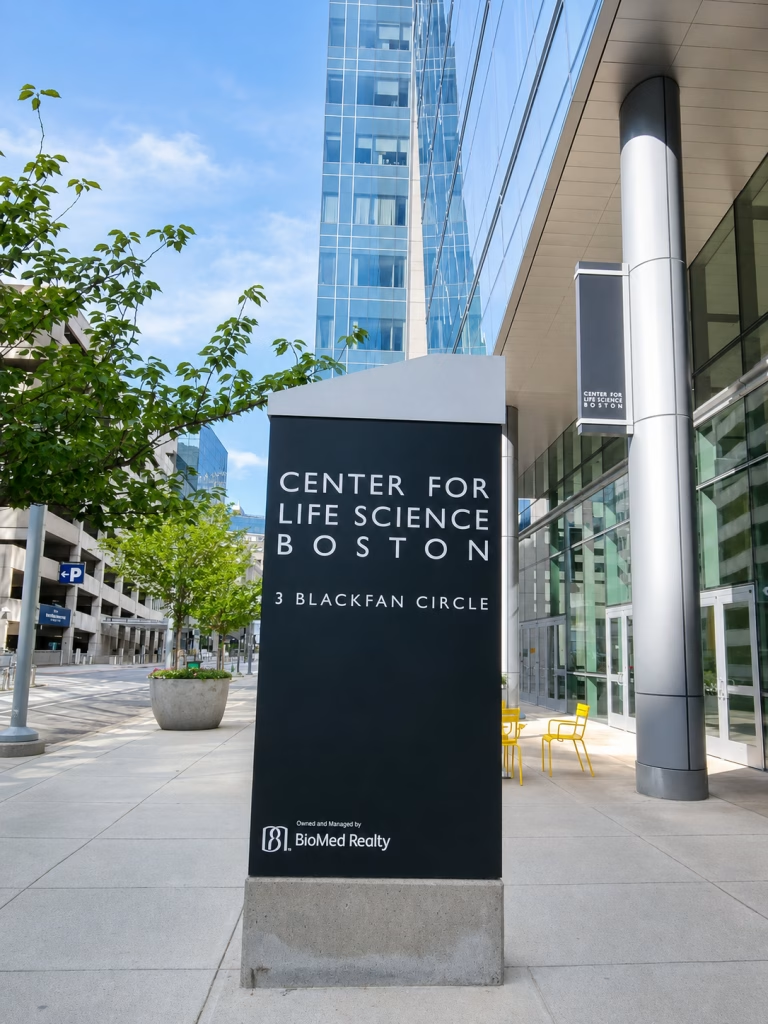
My work focuses on applying mathematics, statistics, and artificial intelligence to cancer research, especially cancer genetics, cancer risk prediction, and early detection. I am part of the BayesMendel Lab, a collaborative team whose name reflects the connection between Bayesian statistics and Mendelian inheritance.As a mathematician and physicist by training, I bring a strong quantitative foundation to research projects that span established statistical methods, probabilistic modeling, simulations, and emerging AI approaches. This training has allowed me to contribute to projects related to cancer screening, inherited cancer risk, genetic counseling, and BayesMendel Lab’s computational tools that help translate complex models into practical applications.A typical day can include reading scientific papers, building and testing models, writing code, analyzing results, mentoring students and interns, and translating my findings into presentations, manuscripts, and discussions that help share our work with the scientific community.Our team works in a hybrid setting, which gives us flexibility while still allowing us to meet regularly in person. My office is located at the Center for Life Science in Boston, and my dual affiliation with Dana-Farber and Harvard creates many opportunities to participate in scientific, academic, and community events.
How would you explain your field of work to a kindergarten class?
I would explain that I am a science detective. Our bodies carry little instructions that come from our families, and sometimes those instructions can help us understand who might need extra care to stay healthy. I also like to show that mathematics is a powerful tool: the same ways of thinking that help us study galaxies can also help us understand human health.
The Path to Cancer Research
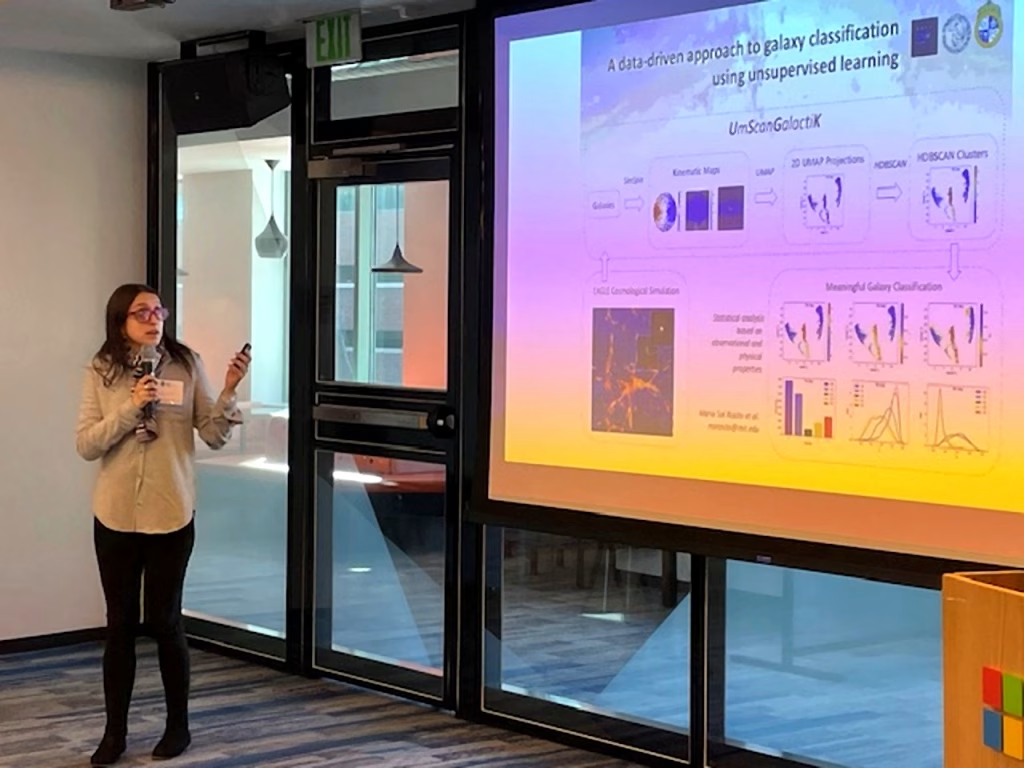
I consider myself an applied mathematician. I earned a degree in Mathematics, where I studied both theoretical areas, such as topology and differential geometry, and the mathematical foundations and applications of statistics, along with computer programming. This training gave me a deep understanding of mathematical tools, not only how to use them, but also how they are built, what assumptions they rely on, and how they can be applied thoughtfully to real-world problems.After that, I completed my PhD in the fascinating field of astrophysics, where I studied the formation and evolution of galaxies. Applying mathematics to understand something as vast as the universe showed me the power and versatility of quantitative thinking. In parallel, I collaborated with a team working in oncology, which broadened my perspective and helped me see how similar mathematical approaches could contribute to human health.I am deeply grateful for this path, because it taught me that mathematical thinking is highly transferable: it can help us explore galaxies, understand human health, and approach complex problems across many domains.
My interest in science started very early. I was a very curious child, and my mother says I spent my days asking questions. As I grew up, that curiosity developed into a love for mathematics and for understanding how nature works.I believe all children have this natural curiosity and joy in learning, and keeping that eagerness alive is part of what makes someone a scientist. What keeps me excited today is the same desire to investigate, look for answers, and connect ideas. In my current work at the BayesMendel Lab, that excitement is strengthened by the possibility of helping others. Many of us have personal reasons to care deeply about cancer research, and that gives the work a strong sense of purpose.
AWIS provides an important platform for women in science to share their work, learn from one another, and feel part of a larger community. I am grateful for this opportunity to contribute my story and to be inspired by the experiences of other women across STEM fields.
The Science That Moves Us Forward
How has your work/research helped drive discovery, innovation, or impact?
My work helps drive discovery and innovation by bringing quantitative methods into cancer research. I develop probabilistic models and simulations to study cancer progression, and screening strategies. This includes work related to non-invasive multi-cancer early detection tests, which are designed to detect signals from multiple cancers through a single blood test.In cancer genetics, I contribute to methods for estimating cancer risk in individuals with inherited genetic mutations and to statistical analyses that study how genetic testing and genetic counseling can inform patient care and decision-making. Another part of my work uses machine learning to improve the quality of large family-based genetic datasets, which is important for making risk estimates more reliable.I am also working on agentic AI systems built on large language models to help researchers extract, organize, and interpret complex scientific information for early detection and screening research.For me, the impact is in connecting rigorous quantitative science with practical needs: helping researchers make better use of evidence, ask better questions, and move toward more informed prevention, genetic counseling, and early detection.
Where do you see your work heading next?
I see my work continuing to move toward questions where mathematics can help make sense of complexity. Looking ahead, I hope to bridge the gap between mathematical modeling and clinical practice by integrating novel predictive models into clinical tools that can benefit a wide community of clinicians, researchers, and patients. I also see mentoring as an important part of my future work, because training the next generation of scientists is one of the ways research grows beyond any single project.
How do you see your work helping shape the future of STEM?
I hope my work helps shape the future of STEM by showing how powerful it can be to connect ideas across fields. My path has moved from mathematics and astrophysics to cancer research, statistics, and artificial intelligence, and this has shown me that some of the most meaningful advances happen when methods developed in one area are adapted to solve problems in another.I also hope to contribute to a future in which mathematical and computational tools are not only technically strong, but also accessible and useful to the people who need them. In fields such as medicine and public health, this means developing models that are interpretable, trustworthy, and connected to real-world practice. To me, the future of STEM depends not only on new technologies, but also on our ability to build bridges between disciplines and create tools that allow more people to participate in scientific progress.
To a Future Scientist Just Starting Out
What are some strategies you use to maintain resilience and persistence in the face of obstacles?
One strategy that helps me is to accept that research often feels unclear before it becomes clear. When I face an obstacle, I try to slow down, write down what I know, identify what I do not understand yet, and break the problem into smaller steps. This helps me move from feeling overwhelmed to having something concrete to work on.I also rely a lot on discussion. Talking through a problem with collaborators, mentors, or students often helps me see it from a different angle. Over time, I have learned that persistence is not only about pushing harder; it is also about being flexible, asking for help, and being willing to try a different path.
What advice would you give to your younger self / someone just starting out in your field?
I would tell my younger self not to worry so much about having a perfectly linear path. My path has taken me across different areas of science, and each step has given me tools and perspectives that became useful later in ways I could not have predicted.I would also say: ask questions, even when they feel simple; look for mentors and collaborators who help you grow; and do not be afraid of entering a new field. A strong foundation, curiosity, and persistence can take you farther than you may imagine.