
As a graduate student, you neglect yourself a lot to focus on earning your degree. This is amplified even more when the social climate is riddled with worry, stress, and uncertainty. This year alone, Black and Brown students witnessed the murders of George Floyd and Ahmaud Arbery on viral videos. In addition, the COVID-19 pandemic has had a greater impact on Black and Brown communities and has caused learning to move online—putting the visa status of international students at risk and disrupting bench research.
Unfortunately, Black and Brown communities have internalized these challenges for years. Many have become desensitized to these traumatic experiences, due to repeated exposure to the same ordeals. During these times, it is important for us to not only speak up, but we must also supply resources. We cannot continue to forget Black and Brown students. There is a heightened need for free conversation, the exchange of experiences, guidance, mentorship, and networking opportunities.
This was precisely my mindset when I created S.T.E.M.ING WHILE BLACK, a free virtual series that offers an inviting atmosphere for anyone and everyone to come together with the aim of talking through some of the greatest challenges in STEM academic programs and careers. This series, purposefully created to provide encouragement during a time when hopes are low, features twenty panelists who are Blacks in various stages of their STEM journeys. There is also a mental health corner, consisting of Black psychologists who provide mental health support, assistance, and resources during pivotal parts of the panel discussions.
If you’ve tuned in to previous sessions, you may have already built an understanding of the needs of current Black and Brown graduate students through the panel discussions. All discussion topics are based on questions submitted during the registration process, many of which focus on the barriers faced by Black and Brown students in STEM. Most of the questions reveal hopelessness and a drastic need for support, as these students face challenges with inclusivity, racism, macroaggression, lack of representation, and more.
One registrant asked, “In a STEM world, where there are so few of us, especially within our own departments, where do we start to make a change to help pave a path for those Black and Brown students who come after us?” Dr. Nathan A. Smith, a neuroscientist in Washington, D.C., responded, “Representation matters in all that we do. We can actually bring in students of color. I bring in students, and I want them to feel that science is an option. I want my lab to re flect what the country and the rest of the world looks like. Too often, students of color are treated like they are not human or are invisible—causing them to abandon science as a career choice. We are losing their contributions to science.
“It is very important for people of color like myself and others to embrace students of color, embrace the differences that they have, and show them that science can be a welcoming environment for anyone and everyone. They might be the next Nobel Laureate, but because of the experiences they have had before, we have lost the person who could cure cancer, HIV, and anything else.” Dr. Adrienne Stephenson, assistant dean of the graduate school at Florida State University, echoed similar points by advising Black and Brown leaders in STEM to “Lift while you climb, bring someone else along, position yourself where you can make changes, and educate others, because that’s how you get your allies.”
But where do inclusivity and anti-racism really start? Is it too early to address these matters at the grade-school level, or should we wait to let graduate school departments address them? “Middle school and high school are some of the most impressionable years of a child’s life. Keep young people encouraged,” says Elam Cutts, a NIH Prep Scholar. Lateakwa Jones, a cyber-security analyst, later expanded on the topic by saying, “Everybody needs to be able to talk about these topics in the household. I think that’s one of the things that’s going to change soon and that’s going to help with things in America. We have to start in the household. The mindset has to change at home.”
If change really starts with conversation, how do you have these conversations, and how can an ally be supportive? “A lot of times these can be used as educational moments. It now opens the doors to discussion and dialogue. It’s very important to address those moments because now, allies have the ability to identify those moments so that they can stand up and fight and be allies for somebody going through those things,” says Maynard Okereke, a civil/ environmental engineer. Multiple panelists agreed that the responsibility of an ally is greater now than ever before. Allies are often in the best positions to use their voices to effect the changes needed to increase diversity in STEM.
“As a Black woman and person of color, I don’t think it needs to be us always speaking up. What I want to propose is that if you’re not a person of color and see something, help take that burden off of us. From the moment we were born, we were already Black. We need advocates because we are tired. We need people who are in power and in privilege,” says Dr. Siobahn Day Grady, a computer scientist and assistant professor at North Carolina A & T State University.
Change rarely happens overnight. It especially won’t happen because of one event. The S.T.E.M.ING WHILE BLACK series has provided a space for people from many walks of life to come together to discuss issues that were once avoided. Topics like macroaggressions from senior staff, confidence issues, the imposter syndrome, and the effects of the social issues faced by Blacks take the conversation to some of the most unimaginable places—all of which are needed by current Black and Brown graduate students. For so many years, these students have neglected themselves to earn their degrees, often internalizing and desensitizing themselves to traumatic issues that have occurred for centuries. S.T.E.M.ING WHILE BLACK provides an outlet for these individuals to feel inspired and strong enough to work through every challenge presented. It provides them with a voice that is lifted and heard by many. Furthermore, S.T.E.M.ING WHILE BLACK provides other individuals with an understanding of these debilitating issues and helps create the advocates and allies we need to amplify our voices.
Join us in the fight to advocate for inclusivity in STEM while encouraging students, professionals, and allies. S.T.E.M.ING WHILE BLACK has four editions currently in production that will persist through 2021. You can catch all of the episodes on YouTube at www.youtube.com/c/HeyDrTay. To learn more, you can write us at s.t.e.m.whileblack@gmail and/or follow us on Facebook (@stemingwhileblack), Instagram (@stemingwhileblack), and Twitter (@stemingwhileblk).
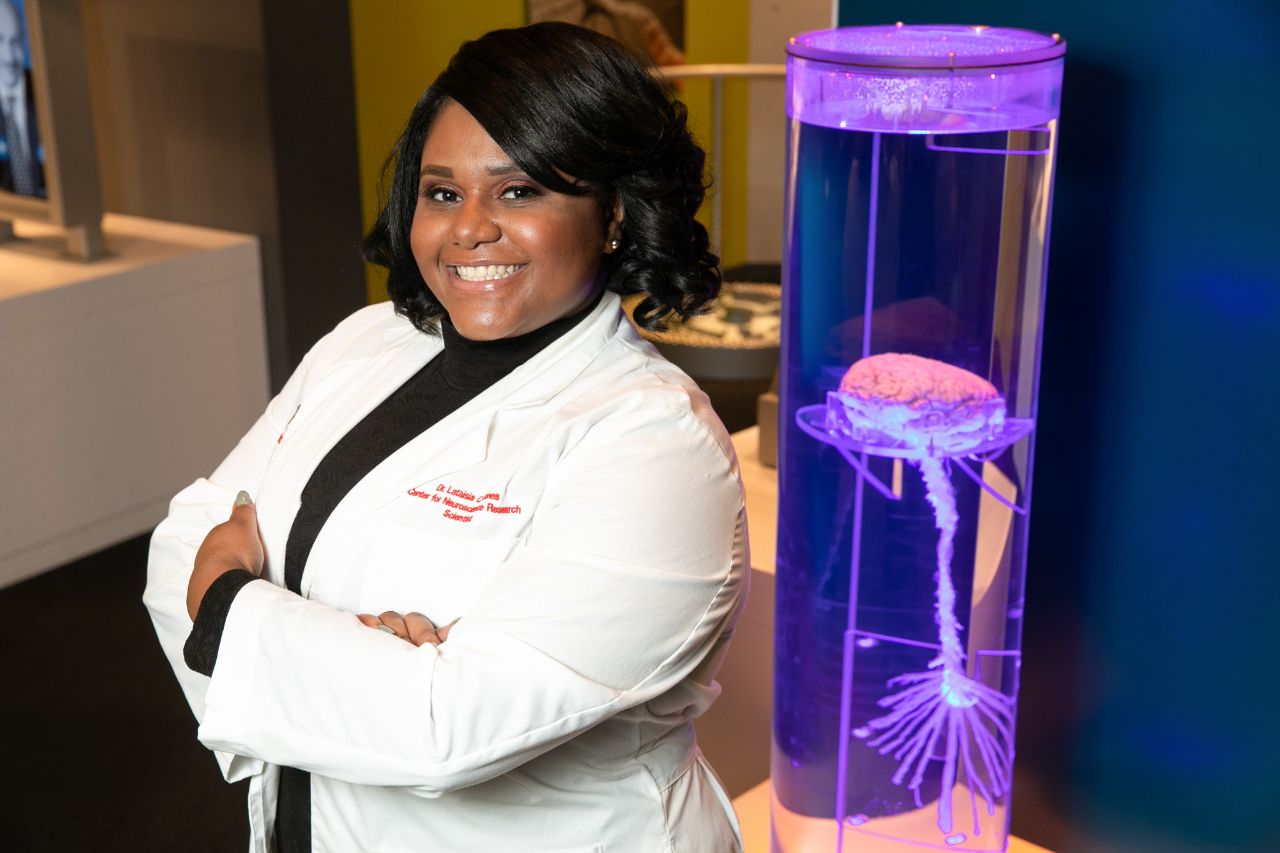
About the author: With thirteen years of experience as a scientist, Dr. Lataisia Jones is currently an Ethics Fellow at the American Society for Microbiology, an AAAS IF/THEN Ambassador, mentor, and STEM consultant. As the first African American to earn a PhD from the Florida State University College of Medicine, Department of Biomedical Sciences, Jones advocates for inclusivity within STEM careers and academic programs through several programs and media platforms.
This article was originally published in AWIS Magazine. Join AWIS to access the full issue of AWIS Magazine and more member benefits.