

Growing up in Nigeria, I became interested in public health and teaching early on. My mum was a nurse who had earned an additional degree in nutrition. She worked for the Ministry of Health to promote breastfeeding through different community-health outreach programs in Abia State. When my parents separated, my mum got full custody of my siblings and me, but she died in a plane crash on a work trip when I was just nine years old. My world came crumbling down.
We started living with my grandma, a midwife who had a maternity clinic. Her clinic was at the short end of our L-shaped home. I would always spend time with her there after school while she tended to her patients. Most of the patients were women who came to give birth, and the rest came for medical treatment for various reasons. I wondered why the patients she treated kept returning. I questioned why the medicines (primarily antibiotics) weren’t working, an interest I would return to as a young adult.
Grandma’s patients would always bring their young children, who played outside. I noticed the kids and started gathering them together to teach them mathematics and English. This experience made me fall in love with teaching. I wanted to provide an environment conducive for others to learn in.
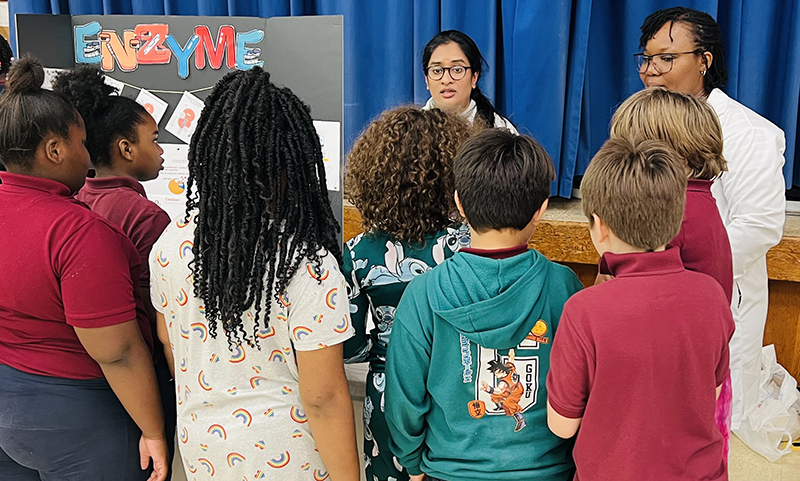
When I was in junior high school in Nigeria, I took a variety of required subjects and noticed that I was more interested and motivated to take the STEM-related courses because of the hands-on and group activities. Due to my interest in science and exceptional junior-high-school grades, I was placed in a group for gifted students and continued to take STEM courses in senior high school.
As a girl who might not otherwise have pursued science, being in this group increased my confidence in myself and in my STEM identity. The content, teachers, and mode of instruction strengthened and sustained my interest in science and mathematics. Our technology and engineering classes featured hands-on activities, although we didn’t have the opportunity to build on a design process. Instead, we were given already-designed projects that we needed to replicate. These STEM classes provided me with formal and informal problem-solving and group-learning experiences.
Gaining Skills
My high school chemistry teacher was passionate, knowledgeable, and skilled in her subject. The way that she delivered the content, designed hands-on activities, and encouraged us to ask questions kept me interested and motivated. She recognized students’ struggles and supported collaboration. She also started an out-of-the-classroom research and science project that required us to use locally sourced materials to make products. The goal was to persuade industries to start looking at how to use local materials to reduce their production costs and, in turn, to increase customers’ access to the products. I was involved in this project and had opportunities to represent my school in statewide and nationwide competitions, where we won awards.
My mathematics teacher was very strict and emphasized mathematics practice every night. We all kept a notebook with our practice problems to show him every morning, and I loved solving them. He also started a mathematics club for his best-performing students. In addition, he assigned us the task of teaching the younger students. We’d meet with them before classes started to answer any questions they had on their school assignments. We also reviewed specific topics with them to reinforce mathematical concepts. This tutoring experience strengthened my identity as a STEM student and as a future STEM teacher.
Beyond excelling in STEM, I started applying my growing problem-solving, critical-thinking, and teamwork skills to other areas of life and took up several leadership positions. During my holidays, I continued teaching outside the school and volunteered as a substitute teacher in my dad’s brother’s high school, which his wife ran. I lived with his family for several years before graduating from high school after my grandmother had a stroke.
Choosing a Path
Despite these successes, completing high school was tough without my parents. My dad had started a new family, and my mum’s siblings upheld her mandate to keep us away from him. I didn’t have access to textbooks and had to rely on borrowing them from other students or from the library when they were available. I couldn’t engage in STEM activities during school breaks because of the chores I had to do in the various homes I lived in when I was on vacation from boarding school.
When I applied to college, I didn’t have someone to guide me in deciding what to study or which school to attend. There weren’t exploratory STEM activities or programs to help me determine my academic path. My father was a doctor and wanted me to study medicine. My mum’s siblings wanted me to enroll in medicine as well, but my interest in understanding host-pathogen interactions and antibiotic resistance propelled me to study microbiology. My classmates and other friends would say, “I think you should be studying engineering; you are so good at mathematics and solving problems.” I didn’t think I had a good foundation in engineering, I wasn’t interested or motivated to study it, and there were few young women in engineering. It was mainly ascribed as a young man’s path.
Apart from the freshman introductory biology labs and my thesis work in college, there were few of the hands-on activities and collaborative projects that I loved. My biochemistry lecturer would ask us to imagine molecules while he was teaching. This approach made the course abstract and difficult for me to understand. I earned an A, but I became less motivated to take any more biochemistry courses. Sometimes I found myself wishing that I was studying education because I wanted to be a professor. However, I would tell myself that I needed to know the content to teach science or to be an authority. So, I kept going.

Two internship experiences before my final college year helped me connect microbiology content to real-life applications with hands-on lab experiences and fieldwork. At last, I got to work with STEM professionals in different areas of microbiology. Now, it felt real! I enthusiastically returned to complete my final year of courses and to conduct research in a laboratory focused on antibiotic resistance. The internship experience encouraged me to attend the University of Lagos, Nigeria where I earned a Master of Science in Public Health and then the Imperial College London for a Master of Science in Molecular Biology and Pathology of Viruses. I then came to the United States to pursue a PhD in Biological Sciences and Masters in Science Education at Louisiana State University.
Putting It Together
The sum of these experiences has kept me in STEM. I now teach science, provide mentorship, advocate for girls and women in STEM, and provide informal opportunities for students to engage in STEM activities. My experience is coming full circle in that I’m excited to combine my love of education and my passion for science. I am in an interdisciplinary graduate program, which, in a short time, has increased my knowledge of STEM education and of the interplay of different challenges that students face while pursuing STEM-related fields. [Side note: I met my dad here in the United States after 30 years of not seeing him, and he mentioned again that he wants me to pursue medicine. Despite this wish, he supports my chosen career path and appreciates my interest in and motivation for science.]
As an educator, understanding my identity as a scientist is crucial to supporting my students to develop a positive affect, one that encompasses the right attitude, interests, aspirations, motivations, and values regarding STEM. I plan to stay informed and updated by attending professional training classes, by continuing to read science-education literature, and by conducting my own research. In these ways, I will increase my knowledge and awareness of how to positively influence my students’ science identities.
I will also strive to create an atmosphere of learning that emphasizes a sense of belonging for my students. I will tailor my instruction to cover the content and context and to provide experiential learning opportunities for them to connect the content to real-life applications. My lessons will provide opportunities for students to engage in evidence-based learning and hands-on activities; to work in groups and to build problem-solving, research, critical-thinking, decision-making, and communication skills.
As I plan small-group activities, I will consider the relationship between gender and student participation. According to Jovanovic and King (1998), boys and girls engage differently in small-group activities. Knowing about this gender difference, I work to increase the representation of girls and women in STEM, and I plan my lessons to provide positive and gender-equitable experiences with appropriate scaffolding. I intend to use a survey instrument called STEM Observation Protocol (STEM-OP) to learn more about my students’ experiences, interests, and motivation in science.
The results from this survey will help me design my lessons. I will model a positive STEM identity and highlight other STEM professionals of many different backgrounds and the work they are pursuing. I will provide mentorship where needed, a resource I am currently offering to my undergraduate students in the biology lab where I do research. I will share with them other opportunities outside the classroom that can help them develop their STEM identity, interests, motivations, beliefs, and attitudes.
In addition, I am committed to ensuring that every child can access quality education through initiatives like the Elaine Education Foundation. Through scholarships, mentoring, out-of-school learning opportunities, provision of school supplies, and support for teachers, parents, and schools, I aim to impact the lives of young learners positively.
I will also encourage my students to join organizations like the Association for Women in Science (AWIS) that build and foster communities to support individuals in science. These organizations have contributed to building my interest and growth in science. I hope to share my passion for science with the next generation.
Acknowledgment: I would like to thank everyone who has been part of my journey and, in particular, my science education professor at Louisiana State University, Dr. Emily Dare, for the prompts to write this reflective journal while taking her class in the fall of 2023. After completing this class, I decided to share this journal as a publication and appreciate Ellen Kuwana, MS, of Kuwana Consulting, for providing editorial support.
Elaine Nkwocha is a Doctoral Student in the Department of Biological Sciences and a Master’s student in the Lutril & Pearl Payne School of Education at Louisiana State University. Her research in biological sciences focuses on determining the mechanisms by which a biofilm regulator protein regulates bacterial physiology and f itness. This protein is a multiple antibiotic resistance regulatory (MarR) protein family member. Understanding this protein’s regulatory effects is essential for antibacterial agent development. Her research in science education focuses on determining the impact of the LSU Course-based Undergraduate Research Experience (CURE) program on first-year biology students. She is interested in exploring how much the program has helped undergraduates develop a sustained interest in science compared to other undergraduates who did not take the course and whether it impacted their decision to pursue STEM careers.
Nkwocha founded Brave Space with Elaine, which provides academic mentorship, and the Elaine Education Foundation, which helps children access education. She also sits on the board of the Women’s Council of Greater Baton Rouge at Louisiana State. She is a change maker, an education advocate, and an emerging global leader who is passionate about helping young people tap into and live up to their potential through teaching and mentorship.
This article was originally published in AWIS Magazine. Join AWIS to access the full issue of AWIS Magazine and more member benefits.