

You might say that pioneer Dr. Svetlana A. Malinovskaya, a Professor of Physics at the Stevens Institute of Technology (SIT), brings a laser focus to her cutting-edge work.
Dr. Malinovskaya investigates the interactions between laser radiation and atoms/molecules, and her research centers on the interaction of ultrafast laser pulses—particularly femtosecond laser pulses—with atomic and molecular systems. These pulses, which emit light with durations on the order of a quadrillionth of a second, prove essential to both fundamental and applied research. Beyond their well-established applications in ophthalmic surgery, where they enable precise tissue ablation with minimal collateral damage, femtosecond laser pulses play a crucial role in probing and controlling molecular dynamics, including in the formation and dissociation of chemical bonds. They help scientists study the positions and interactions of molecules at the atomic level, including the real-time observation of in chemical bond formation and dissociation. Her work extends to ultrafast Raman spectroscopy, which she uses to provide insights into vibrational coherence and molecular energy transfer, as well as to quantum control strategies for cold and ultracold matter
Dr. Malinovskaya holds a PhD in theoretical physics and mathematics from Novosibirsk State University in Russia. She has gotten acclaim for her contributions to both research and teaching, receiving the Alexander von Humboldt Research Fellowship in Germany and a Teaching Faculty Award from the Society of Graduate Physics Students at SIT. Her publications in leading journals, such as Optics Letters, Physical Review, Quantum Science and Technology, and Nature Scientific Reports, showcase her influence on the field of ultrafast and quantum optics. She has also published the book From Atomic to Mesoscale: The Role of Quantum Coherence in Systems of Various Complexities.
In addition, Dr. Malinovskaya works to mentor young scientists. Her ongoing commitment to encouraging students to pursue science reminds us that anyone, regardless of their origin or circumstances, can achieve their dreams. By organizing events like the 2025 Conference for Undergraduate Women and Gender Minorities in Physics (CU*IP), she creates platforms for networking and empowerment within the scientific community. This interview is based on a conversation with Dr. Malinovskaya during the recent conference.
The Year 2025 is the International Year of Quantum Science and Technology, marking a century since the groundbreaking development of quantum mechanics. Quantum computers and lasers represent a new technological revolution. What inspired your passion for science, particularly in the fascinating fields of lasers and femtosecond pulses?

When I joined the University of Michigan as a postdoctoral researcher, I worked at the Frontiers in Optical Coherent and Ultrafast Science (FOCUS) Center. I immersed myself in cutting-edge studies on the interactions of femtosecond laser pulses with molecules. At that time, Professor Phil Bucksbaum’s group was advancing experiments in Raman spectroscopy and exploring optimal control techniques through pulse shaping. Theorist Professor Berman also provided significant theoretical insights that enriched the center’s efforts. I was captivated by those experimental works and aimed to pursue theoretical studies under his guidance.
This experience ignited my deep enthusiasm for investigating interactions between lasers and matter. Simultaneously, my background in atomic, molecular, and optical physics allowed me to make substantive contributions to the research. During this period, I developed a deep appreciation for quantum control techniques, particularly for designing tailored electromagnetic pulse sequences to manipulate molecular dynamics with precision. This approach provided critical insights into vibrational motion in complex molecular systems, which has since remained a central focus of my scientific investigations.
Mentorship can be a powerful force in shaping a scientist’s career. Was there a mentor who significantly influenced your journey in science?
My father was a physicist, and my mother specialized in arts and design, giving me a well-rounded education that spanned subjects from English to music and dance. My father spent countless hours guiding me through mathematics and physics, and we often played chess together. I consider them both to be my earliest and most influential mentors.
In my professional career, I consider Professors Duncan Steel, Christopher Monroe, and Phil Bucksbaum as the most influential figures in shaping my path. They provided me with invaluable opportunities to collaborate with both experimentalists and theorists, expanding my understanding of the dynamic relationship between theory and experiment. Through these collaborations, I became deeply captivated by the transformative potential of ultrafast lasers in areas such as material science, photonics, and precision engineering. I also came to appreciate the significant role that strong mentors play in personal and professional growth, as their guidance not only enhanced my technical expertise but also helped me navigate the complexities of scientific research and career development.
There are not many female quantum physics professors working today. Can you share some challenges you faced as a woman in STEM and how you overcame them?
As I mentioned earlier, I spent a significant amount of time with my father, who helped me develop a strong sense of confidence and independence, regardless of the gender dynamics in my professional environment. I now focus on delivering results based on my expertise and abilities, without being defined by my gender. I apply my intellectual capacity directly to advancing scientific work, alongside my colleagues, ensuring that my contributions are valued for their merit rather than for any external factors. I remain focused on my strengths and core values, working to drive my success from within rather than seeking external validation. Regarding the imposter phenomenon, whatever that may entail, I certainly experienced it in the early years of my career
It is important to step out of your comfort zone and also to embrace positive self talk. Instead of stressing over a conference presentation, prepare by practicing at home or in your office, seek feedback from trusted colleagues, and be mindful of the time you are allotted to ensure you appropriately scale your talk. A well-prepared presentation should not only convey your message clearly but also look polished and professional. I recommend always striving to do your best, even in challenging situations, as each experience contributes to growth and confidence.
You have received numerous grants from the NSF and other funding sources, a truly impressive accomplishment. Could you share the key elements that make a grant proposal stand out?
There is no perfect formula for guaranteeing that a grant proposal gets approval, but there are key aspects that proposal writers should consider to increase their chances of success. I have learned the essentialness of carefully following the grant application instructions. Adhering strictly to the guidelines ensures your application meets the necessary requirements and demonstrates attention to detail. Keeping the application concise and focused is crucial. When applying for a new research project, particularly in physics, it is critical to justify the novelty and relevance of your ideas. While innovation is key, new concepts often have their grounding in established principles and prior research. Make sure to draw clear connections to these foundations to demonstrate that your proposal builds upon a solid scientific framework. Highlighting these connections not only strengthens your argument but also increases the perceived feasibility of your project and the likelihood of its success.
How can early career scientists find and develop supportive relationships?
Being proactive is key to establishing meaningful connections. Attend conferences and workshops, which provide opportunities to network and showcase your work. Also, take professional development training and try to work for your community, such as volunteering for committees or events within your institution or professional society. Stay committed, take initiative, and watch your professional network flourish!
I find your research on femtosecond pulses fascinating. Could you share some of their exciting applications and explain how they are poised to revolutionize our understanding of the quantum world?
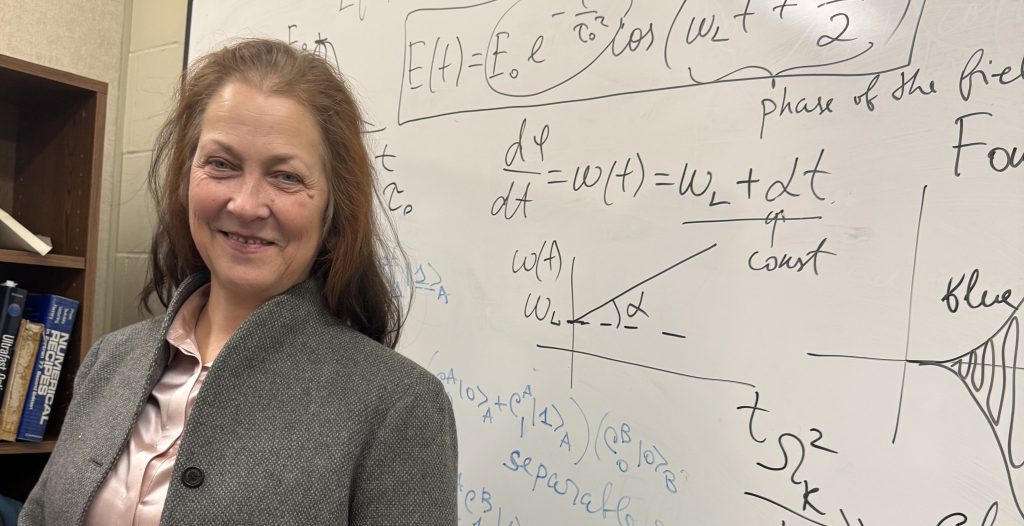
My research primarily focuses on analytically controlling the interaction of femtosecond pulses with matter. By precisely shaping and timing these ultrashort pulses, I can probe and manipulate atomic and molecular systems at the quantum level. These femtosecond pulses allow us to observe rapid processes, such as bond breaking, electron dynamics, and excitation of specific quantum states, providing valuable insights into the fundamental behavior of matter. The ability to control the interaction of femtosecond pulses with matter provides the foundation for precisely steering the quantum dynamics of systems. This control enables us to manipulate the evolution of quantum states with high fidelity, opening up a range of applications across multiple fields.
In quantum sensing, for instance, we can use femtosecond pulses to enhance sensitivity to small changes in external parameters, such as in magnetic or electric fields, allowing for more accurate detection of phenomena that are otherwise difficult to measure. Similarly, in quantum information processing, controlling the interaction of femtosecond pulses with qubits [units of computing information represented by an atom’s state] enables the implementation of high-precision operations that are vital for quantum computing and communication protocols.
Moreover, femtosecond pulses are instrumental in advancing precision measurements. By utilizing these pulses to control and synchronize interactions at the atomic or molecular level, we can achieve ultraprecise measurements of fundamental constants, atomic clocks, and other time-sensitive measurements that underpin the development of future quantum technologies.
Overall, the ability to precisely control these interactions holds immense potential for both fundamental science and the development of next-generation technologies in quantum sensing, information processing, and measurement.
Your institute recently hosted the annual CU*IP conference, organized by the American Physical Society, to support and encourage undergraduate women in physics. How can we improve this conference to help these women?
This annual conference is a remarkable opportunity for undergraduate women since it offers a chance to attend workshops, plenary sessions, networking sessions, and a career fair to empower participants with valuable insights into career paths and graduate school options. The conference would benefit from including more scientific sessions with oral and poster presentations. For example, we could arrange a session where professors from the physics department share their research activities with students and where undergraduate students also give oral presentations.
Such initiatives allow students to receive constructive feedback from experts and open doors for future collaborations. In my perspective, supporting women in research presentations is an impactful way to highlight their commitment and the depth of their contributions to science. It provides a platform to recognize not only their dedication but also the innovative ideas they bring to the field.
You have been in academia for an extensive time. What skills strike you as most important for young women and underrepresented minorities to succeed in STEM?
Young women and underrepresented minorities to in STEM must cultivate resilience, confidence, and a strong support network. My advice? Avoid negativity and isolation, as they can lead to stress and burnout. Instead, surround yourself with uplifting people who encourage your growth. When facing obstacles, view them as stepping stones: They signify that you are on the right track and provide opportunities for growth. It is also important not to compare yourself to others—focus on your unique path. Stay focused, plan ahead, and be confident in your abilities. Your authenticity is your strength, and letting your passion guide you will lead to success in STEM.
 Dr. Shruti Shrestha is an Assistant Teaching Professor of Physics at Penn State Brandywine. She is a particle physicist who worked on the High Voltage Monolithic Active Pixel sensor for the Mu3e Experiment. She also conducts free STEM workshops in the Philadelphia area to empower girls to pursue STEM degrees.
This article was originally published in AWIS Magazine. Join AWIS to access the full issue of AWIS Magazine and more member benefits.