

The real-world impact of pay equality cannot be overstated. In addition to helping women in their professional careers, it has the potential to impact their families, communities, and physical and mental health. The National Partnership for Women & Families has reported that “if the wage gap closed for one year, women could afford: 17 months of food, 15 months of childcare, 32 months to pay off student loans, 7 months of mortgage payments, [and] 9 months of health insurance premiums.”
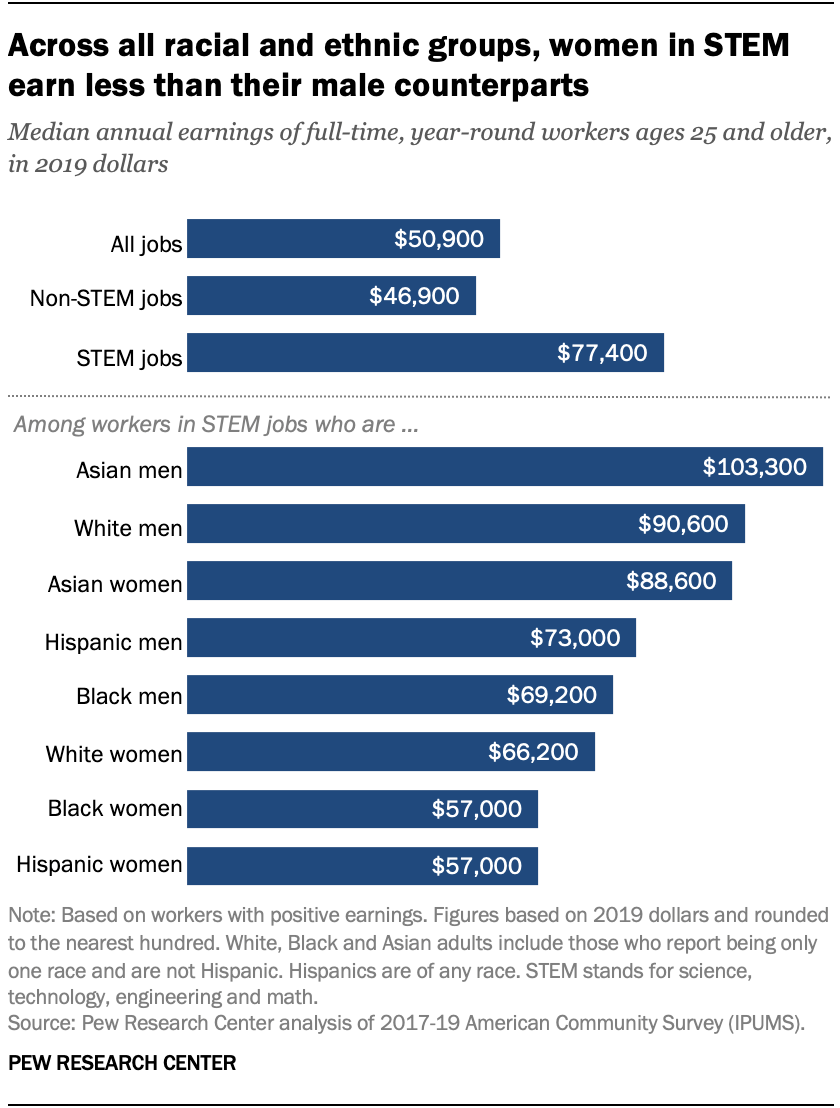 Congress passed the Equal Pay Act in 1963 to ensure men and women who perform substantially equal work receive comparable wages. Despite decades of progress, women still earn less than men with the largest gaps being in science and engineering. Pew Research has reported that women in STEM from all racial and ethnic backgrounds earn less than their male counterparts (see the table). We need new legislation and enforcement to address the disparity.
Since 1997, U.S. Representative Rosa DeLauro (D-CT-03) has continuously introduced the Paycheck Fairness Act. This legislation aims to increase wage transparency, protect employees against retaliation, and help close the gender pay gap. Despite receiving support from notable political figures, the legislation has failed to pass. Rep. DeLauro has reintroduced HR 17 to the current Congress with 216 House sponsors. It was referred to the Committee on Education and Workforce and the Committee on Oversight and Government Reform. Sen. Patty Murray (D-WA) reintroduced S. 1115 with 46 co-sponsors.
Here’s how the Paycheck Fairness Act works:
The Paycheck Fairness Act requires employers to demonstrate that any pay differential is job-related with respect to the position in question and consistent with business necessity. If the employee can demonstrate that an alternative business practice can support the same outcome but has not been adopted by the employer, the employer must pay the same rate.
The Paycheck Fairness Act would increase transparency. First, the Act would prohibit employers from retaliating against employees who discuss wages. Currently, some employers require employees to sign contracts or waivers that prevent them from disclosing their salaries to co-workers. Employees who fail to comply with this requirement may face retaliation, including termination.
Second, the Act instructs the Equal Employment Opportunity Commission (EEOC) to issue regulations for collecting compensation data—specifically related to the sex, gender, race, and national origin of employees. While some websites, like Glassdoor, strive to make salaries more transparent, their efforts to anonymize information can result in unreliable data. A national database would help increase transparency.
To further help employees, the Paycheck Fairness Act simplifies the process of initiating a class action suit, which will allow more employees to benefit from complaints against an employer. The Act also includes a provision of salary negotiation training. Effective negotiation training, combined with greater transparency about the actual salary range for a specific position, will help ensure fair pay for all. The Act also calls for the creation of a National Equal Pay Task Force to address employer compliance, enforce equal pay laws, and educate the public on pay equality.
Critics of this legislation suggest that the Paycheck Fairness Act would increase the regulatory burden on businesses. Specifically, one senator said, “This Act would make our economy less dynamic and prosperous.” Opponents have not offered any amendments to the Act that might help it get through Committee hearings.
The future of the Paycheck Fairness Act remains uncertain. It will likely continue to face political obstacles despite widespread public support. There are several ways in which you can get involved:
- Call your representatives and urge them to support the reintroduction of the Paycheck Fairness Act, and any related legislation.
- If you have more time, consider reading Women Money Power: The Rise and Fall of Economic Equality by Josie Cox or attending a financial literacy event hosted by AAUW.
- Beyond policy changes, employers and advocacy organizations can do their part by making their pay scales publicly available and encouraging salary discussions.
The Paycheck Fairness Act is a significant step toward closing the gender wage gap, but its success relies on continued efforts from lawmakers and proactive affirmation from fair pay advocates to move it forward.
Sydney Woods, Kimberly Scata, Megan Polhmann, and Eposi Elonge are members of the AWIS Advocacy Committee and would like to thank their fellow committee members who helped provide research for this article. The AWIS Advocacy Committee works to ensure that all women in science and STEM related fields can achieve their full potential. Our advocacy work focuses on achieving positive system transformation, equitable workplaces, and recognition of women’s scientific and leadership achievements.