
Nike Idowu is a doctoral researcher at the University of Nebraska–Lincoln, where she explores how underexplored bacterial strains produce powerful, heat-stable antifungal compounds. Her work aims to uncover solutions with the potential to transform infection control and support sustainable agriculture. With a passion for research and teaching, she’s advancing discoveries that operate behind the scenes—yet have far-reaching impact on global health and food systems.
What does a typical day in your role look like?
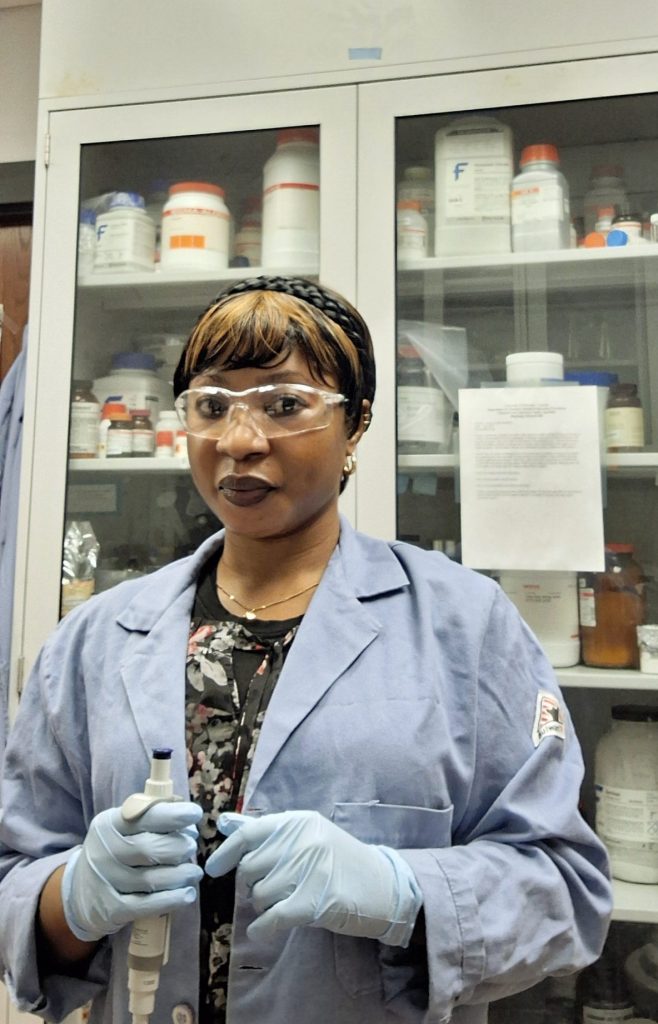
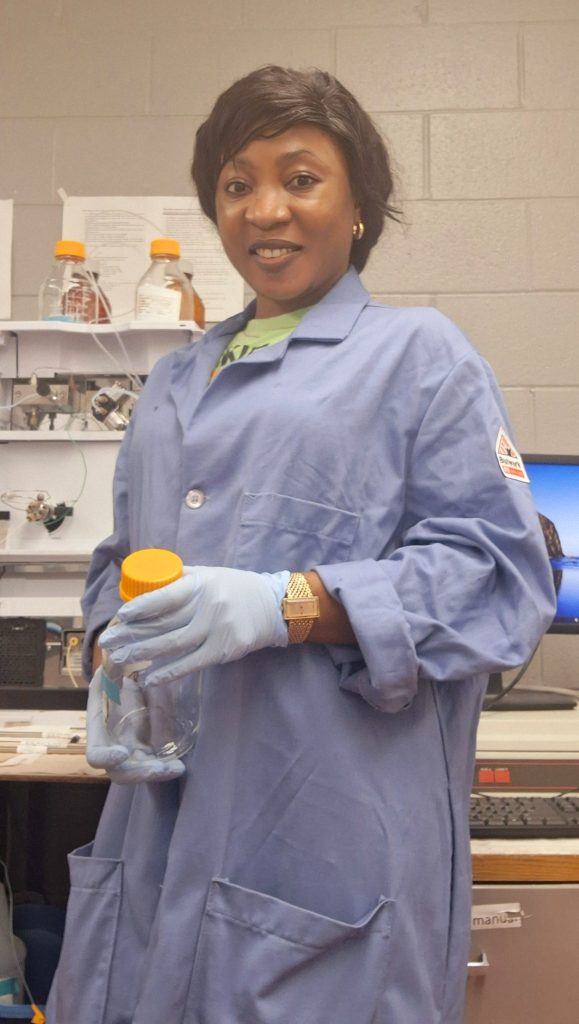
I am a teaching/research assistant in the Chemistry department, UNL. I teach Chemistry labs, hold office hours to clarify lab reports and exercises, and I grade the labs and exams. As a researcher, I am involved in reading research journals, performing experiments, analyzing my data and meeting with my supervisor to discuss progress and align our research goals.
From Chemistry to Cutting-Edge Cures
I completed my Bachelors degree in Industrial Chemistry, Osun State University, Nigeria where I developed my theoretical and practical skills essential for academic research and teaching. While I was an undergraduate, I took courses that cuts across all aspects of Chemistry, data analysis and academic writing. I participated in independent research projects and group collaborations which made me proficient in basic research methods, few statistical tools, and academic writing which gave a foundation to contribute meaningfully to graduate research as a Research Assistant. My experience presenting in class and leading study groups helped me build the confidence and communication skill essential for explaining science concepts clearly and effectively, a necessary skill as a Teaching Assistant. Been able to balance research projects and extracurricular activities is a tool that helps me manage multiple responsibilities, meet deadlines and maintain balance.
At an early age, I was close to a few teachers who made scientific concepts come alive by connecting theoretical aspects to real world applications. My undergraduate research inspired my research interest In chemical biology because I was able to realize that tiny molecular or biochemical changes could have a profound effect on a living system. My teacher’s teaching, passion and experience was contagious and It showed me that Chemistry isn’t just about reactions in a flask but can be also used to solve huge biological questions and develop new therapeutics. I am always excited about our research findings having the potential to make real world impact.
I listen to podcasts or music while working in the lab to keep me more motivated.
Learning from my mistakes or from my predecessors’ mistakes so it doesn’t persist. In my research, i set short term goals breaking my tasks into achievable ones so as not to feel overwhelmed and giving me an achievable and measurable progress.
Science with Impact
What is your proudest achievement in your career?
Becoming a PhD candidate and getting fellowship awards to help propagate my research.
How has your work or research helped drive discovery, innovation, or impact?
I am studying the regulatory/molecular mechanism of production of a heat stable anti fungal factor which is a natural product from an underexplored bacteria, Lysobacter Enzymogenes. This study is targeted towards warding off antibiotic resistance and also knowing how to improve the yield of the compoud for large scale application in the pharmaceutical and agricultural Industries.
The Power of Science and Community
What does the power of science and community mean to you?
I am studying the regulatory/molecular mechanism of production of a heat stable anti fungal factor which is a natural product from an underexplored bacteria, Lysobacter Enzymogenes. This study is targeted towards warding off antibiotic resistance and also knowing how to improve the yield of the compoud for large scale application in the pharmaceutical and agricultural Industries.
How has science shaped your sense of community—and how has community supported your journey?
Collaborations, conference attendance and lab teamwork has taught me that science flourishes in idea exchange. Progress is achieved through collaborations across disciplines. The fact that I am able to share my research findings to others in the field and get feedbacks keeps me going.
To a Future Scientist Just Starting Out
What advice would you give to someone just starting out in your field?
I’d advise anyone just starting out in Chemical biology field to get grounded in the basics of Chemistry, biology and related courses. Chemical biology research sits in the interface of Chemistry and biology, so be prepared to learn new techniques, think critically, study strategically and get a good mentor. Also, attend scientific meetings to learn about innovations in the field, collaborate and network with high flyers.
What message would you share with future scientists about the power they hold to make a difference?
To future scientists, you have the power to think of and build what has never been in existence before, shape the world, and make significant influence.
What would you tell your younger self?
Failed experiments do not define your worth, stay curious, be persistent. Surround yourself with peers who challenge, ask questions even if it feels stupid to you.