
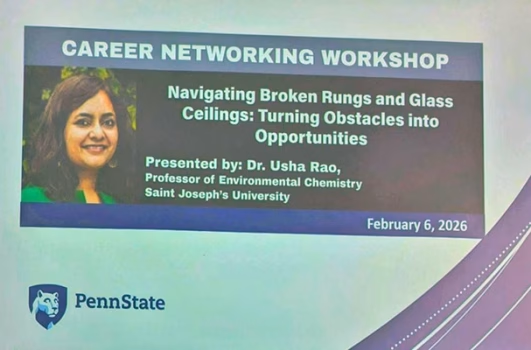
In Spring 2026, as a part of the mission of the Chancellor’s Commission on Empowering Women at Penn State Brandywine, the Commission organized a workshop to uplift a new generation of undergraduates, particularly women, individuals from diverse backgrounds, and first-generation college students. This workshop, led by AWIS member Usha Rao, PhD, Professor of Chemistry at Saint Joseph’s University, highlighted the structural barriers that still impede women’s career advancement and offered suggestions for finding success in spite of them.
Research shows that women have made significant strides in education. In the US, undergraduate enrollment stands at approximately 57% female and 43% male, with women earning higher college GPAs, yet they remain underrepresented in top positions in academia and the private sector. In fact, upon entering the workforce, women quickly lose the educational advantage they held. The largest longitudinal study of women in corporate America, summarized in The Broken Rung: When the Career Ladder Breaks for Women—and How They Can Succeed in Spite of It, authored by three female senior partners at McKinsey, shows that for every 100 men promoted to the first managerial role, only 81 women overall and 77 women of color receive the same promotion.
In this workshop, Dr. Rao explored the sources of this disparity and offered the following insights and strategies to help women turn obstacles into pathways to empowerment, drawing on the data presented in The Broken Rung and other sources.
Key Insights
1. Broken Rungs and Leaky Pipelines
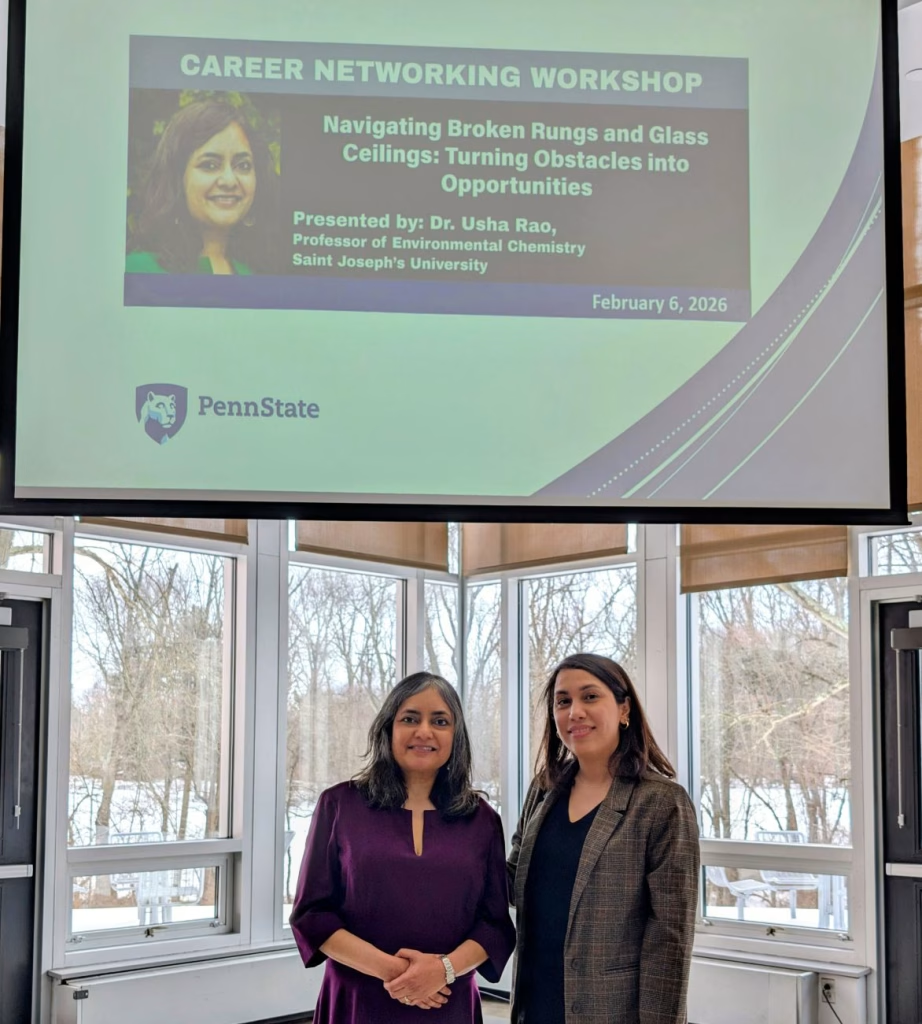
One of the most significant barriers contributing to this inequality is the “broken rung,” which is the critical early career step where women often lack equal access to first-level leadership roles. Thus, many women fall behind early, making it difficult for them to achieve higher-level roles, including executive leadership. Over the time, this leads to a “leaky pipeline” where talented women gradually exit their careers due to a lack of mentorship, limited opportunities, and insufficient experience capital. Furthermore, those who persist face the “glass ceiling,” an invisible barrier that restricts the advancement of women into senior leadership positions in academia and the corporate world.
2. Intersectional Bias
Women, especially Black and Hispanic women, often face multiple layers of bias. A review of thousands of performance reports reveals gendered and racialized stereotypes, portraying women as more emotional, unlikeable, or difficult to work with, and Black and Hispanic employees as less intelligent. Women are more likely to internalize negative career feedback and experience imposter syndrome, regardless of their actual performance or capabilities. Even where women’s contributions are verbally appreciated, the McKinsey study finds that they still do not count towards advancement through increasing rank, responsibility, pay, or visibility.
Strategies for Turning Obstacles into Opportunities
1. Choose a Work Culture, not Just a Job
The culture of the workplace ultimately determines whether a person can thrive in it. When searching for opportunities, women should look beyond the job description and seek to understand workplace culture, as some cultures reward similarity rather than merit. To identify their fit in a workplace, candidates should review what external sources and current employees say about the culture, and seek to understand the leadership style and institutional values. Supportive environments are essential for long-term success, especially for underrepresented groups.
2. Start Strong with a Line Role
For women in STEM and academia, long-term success starts with a line role that is core to an organization’s mission and drives profit and loss, as these roles are shown to accelerate career growth and leadership opportunities. These roles also build experience in decision-making and have a measurable impact on the institution. Compared to support staff roles, those in line roles were found by the McKinsey study to gain higher visibility and achieve longer term success, while still retaining the ability to transition to staff roles at a later stage.
3. Gain Digital Fluency
Research conducted by Accenture, the global professional services firm, shows young women are less likely than young men to acquire the digital skills that accelerate career growth. They lag behind men both as early adopters and as continuing learners of new and evolving technologies. Women must acquire better digital fluency to narrow the gender pay gap and thrive in their jobs, especially in the age of artificial intelligence.
4. Build Resilience
Women in STEM often face pressures to repeatedly establish their competence, even as their achievements are overlooked. The burden of being the only woman in a lab, classroom, department, or board, can create fear of failure or feelings of imposter syndrome. Women should reframe professional challenges as opportunities for learning rather than see them as evidence of inadequacy; seek mentors; practice self-care to prevent burnout; and build peer networks that offer encouragement and advocacy. Dr. Rao reminded the audience that by cultivating resilience, not only do women persist in the STEM workforce, but also have the opportunity to build missing institutional support structures and pave the way for all who follow after them.
Final Reflections
Women in STEM encounter obstacles such as broken rungs and glass ceilings throughout their careers. On this journey, progress may feel slow due to frequent setbacks, but each step forward builds visibility and compounds experience capital. By choosing a supportive environment, strengthening technical and leadership skills, building experience capital by identifying the core jobs that signal leadership in their industry, gaining institutional literacy, and leaning on resilience, women can transform obstacles into opportunities. With a combination of strategy and persistence, women in STEM can advance their own careers while reshaping the workplace for future generations to come.
 Shruti Shrestha, PhD, is an Assistant Teaching Professor of Physics at Penn State Brandywine. Dr. Shrestha, a particle physicist, worked on the High Voltage Monolithic Active Pixel sensor for the Mu3e Experiment. She also conducts free workshops in the Philadelphia area to motivate and empower girls to pursue STEM degrees.