

Ten years ago, I was a high school student working in the orchard fields of California’s Central Valley. At the time, I did not know what a research lab was, and my goal was to become a medical doctor, fulfilling my parents’ hope — a common theme among the children of immigrants. So, as the daughter of two Mexican American immigrant workers, I was thrilled when I was accepted by the University of California, Merced (UC Merced) to begin my undergraduate studies in molecular biology.
During the end of my first year at UC Merced, I came across the Society for Advancement of Chicanos/Hispanics & Native Americans in Science (SACNAS). SACNAS is an organization dedicated to fostering the success of college students and young professionals who are part of these underrepresented groups, helping them to attain advanced degrees, careers, and positions of leadership in STEM. SACNAS introduced me to experimental lab research opportunities, and I was fortunate to eventually get to work in labs at the University of Alabama in Birmingham, Stanford University, Genentech, and even Kagawa University in Japan.

These research opportunities have helped confirm for me the importance of diversity in STEM, as well as the significance of inclusivity in modern team science. As an undergrad I initially felt powerless in tackling the problem of underrepresentation, as I was sure that this was not a new issue and that many before me had probably tried to address it. Nevertheless, I gradually came to understand that if I applied the same work ethic I had used to work in the orchard fields, just as I was now doing in my classes, I could make a difference.
At UC Merced I became motivated to start addressing these problems, so I joined SACNAS and began discussions with students and faculty about improving diversity in higher education and science. Our focus was to foster academic and professional development for first-generation students and students/people of color (POC). We began by creating programs and workshops dedicated to helping participants develop the skills necessary for obtaining advanced degrees, establishing careers, and moving into positions of leadership in STEM. These included workshops on CV or résumé writing and on how to “pitch yourself” for job and graduate school interviews.

Despite UC Merced being a Hispanic-serving institution, it was by no means shielded from both intentional and inadvertent biases against POC. As an undergraduate, and later as a graduate student and woman scientist, I encountered men who were peers and who attributed my achievements to my ability to check off diversity boxes, rather than to my intellectual merit. For a long time, I believed them and worked even harder to prove myself, until I realized that their claims were baseless. The effects of misogyny in science are apparent and often orders of magnitude worse for women researchers of color, a minority both in terms of lower numbers and limited access to more senior positions. Such experiences are not confined to academia, of course. As Sheryl Sandberg, former chief operating officer at Meta Platforms, and Adam Grant, an organizational psychologist, wrote in The New York Times in 2015:
“When a woman speaks in a professional setting, she walks a tightrope. Either she’s barely heard, or she’s judged as too aggressive. When a man says virtually the same thing, heads nod in appreciation for his fine idea.”
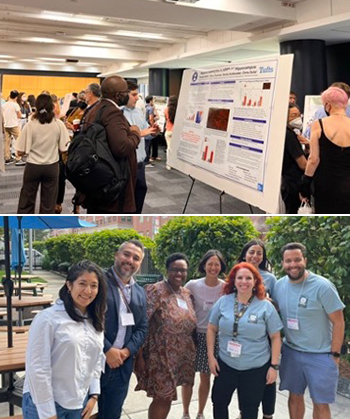
There came a point in my own journey in STEM where I found it imperative to create a platform that would showcase women scientists in various leadership roles. Our SACNAS chapter at UC Merced invited women speakers, such as NextGen Jane CEO Ridhi Tariyal and 23andMe senior scientist Olga Sazonova, to engage with students on campus. These women served as important role models for my peers and myself. Seeing other women succeed in STEM can help young women envision achieving similar success.
When I started graduate school at Tufts University, I faced new barriers that I had to overcome. I realized that there was a hidden curriculum, a set of lessons that some students absorb intuitively but which are not explicitly taught: norms, values, and beliefs assumed to be common knowledge in both the classroom and social environment. These things include, but are not limited to, which topics are appropriate for discussion and how one should dress. This curriculum at Tufts was different from what I had as an undergraduate. The challenge in overcoming a hidden curriculum is that it is different from one institution to another. My advice to anyone trying to navigate this system is: do not be afraid to ask for guidance. You can get such support from women or men peers, faculty, or staff. Many times, people are willing to help you, but you have to ask.
When I asked for help, I found a group of people who were also interested in understanding the hidden curriculum and in bringing attention to diversity, inclusion, and equity efforts. These conversations encouraged us to establish an informal Tufts SACNAS chapter. Our first SACNAS workshop was on academic code-switching, or strategies that POC use to navigate academic interactions so that they are not perceived as different. These intentional, self-imposed behavioral changes can have an adverse impact on their well-being, economic advancement, and even physical survival. We facilitated a panel discussion by diverse academics at distinct stages of their careers, including graduate students, postdocs, and professors. We asked panelists to discuss how they used code-switching to navigate academia and the hidden curriculum and how this behavior prevented them from bringing their whole selves to the workplace. This workshop highlighted the many ways that members of the Tuft’s community use code-switching to assimilate to an academic environment comfortable for white, Eurocentric men. Our hope is to continue to shine light on this phenomenon in order to encourage members of our community to bring their true, complete selves to work.

We have also kick-started new efforts to increase the visibility of different communities at Tufts. We highlight different cultures and countries represented by students in our institution by having culture-specific social events that include regional foods, music, and crafts. In addition, we are interested in connecting and supporting current and former trainees of Tufts’s Pipeline Programs, which seek to increase the diversity of our biomedical workforce and thus to strengthen the research enterprise overall. We have developed and hosted symposia to support the mission of these programs. Now in their third year, the symposia feature alumni as speakers. They give scientific talks and participate in career panels and networking sessions with current trainees. Each symposium culminates in a keynote talk by a distinguished scientist. We have previously hosted Dr. Beronda Montgomery, the vice president for academic affairs and dean of Grinnell College, and Dr. JoAnn Trejo, Professor and also an assistant vice chancellor in the department of health sciences faculty affairs in the Department of Pharmacology at the School of Medicine at University of California, San Diego. Both of these women are dedicated advocates working to foster equity and inclusion in academia.
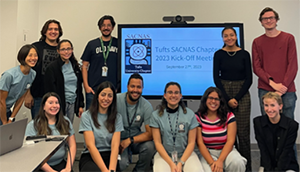
Throughout my various academic and professional experiences, I have consistently placed a strong emphasis on the significance of recognizing and nurturing robust alliances, whether among undergraduate students, graduate students, or alumni. I have recently benefited from working with two key allies at Tufts, graduate student leaders Rebecca Condruti and Maria Brouard. Together, we organized an alumni networking event to help connect our community with professional resources and to provide current students with specific job prospects and mentoring relationships.
This coming year we hope to establish Tufts SACNAS as an official chapter, and we will continue to lead workshops, host cultural events, and run our annual symposium to promote diversity throughout the university. I hope that undergraduate and graduate students, as well as faculty and scientists across the country, will also work to engage with and improve DEI at their universities and companies. However, if you are a POC know that it is okay to say no now and again when asked to be a part of DEI committees. The work for equity is everyone’s work. My advice for anyone trying to increase visibility for POC in their communities and to improve DEI efforts is have a vision for what you want, find allies, gather information from others doing similar work, and show up as yourself, because that is going to encourage others in your community to do the same!
 Iris D. Montes received her BS from UC Merced in cell and molecular biology. She is a current PhD candidate in Dr. Malavika Raman’s lab at Tufts University School of Medicine. Montes works on understanding protein homeostasis and the biogenesis and maintenance of organelles, such as peroxisomes. During her graduate school training at Tufts, she has received the NIH Ruth L. Kirschstein National Research Service Award Individual Predoctoral Fellowship (F31) for her thesis work. She has served on numerous DEI and other committees at Tufts and is a founding member of the Tufts SACNAS chapter. Tufts has honored her with the Presidential Award for Civic Life, the highest recognition for service, leadership, and civic engagement conferred by the university.
This article was originally published in AWIS Magazine. Join AWIS to access the full issue of AWIS Magazine and more member benefits.