

How can we convince pre-teens and young teens to consider STEM as a career?
According to Lucy Madden, CEO of Letters to a Pre-Scientist (LPS), “The first [step involves providing some sort of connection to STEM…the sort of connection that Letters to a Pre-Scientist is focused on building.” This innovative program encourages women scientists to become pen pals with middle school girls in order to inspire them to consider STEM careers for themselves.
Research consistently shows that the formation of a STEM identity depends not only on academic achievement but also on a sense of belonging and personal relevance. The National Academies report that identity, mentoring, and psychosocial support are central to persistence in STEM fields. Madden emphasizes the importance of timing: “Middle school is a very identity-forming time. Students are trying to answer the questions ‘Who can I be?’ and ‘Where do I fit?’”
In classrooms across the country, simple envelopes meet these questions head on, and yet, these envelopes contain something so much more meaningful than concrete answers. “How special it is to watch a group of students, each holding and opening something that has been so specifically crafted for them…. You can tell that they each feel seen and heard and special,” Madden explains.
A Pen Pal Program That Connects
 Madden created this year-long pen pal program, which connects STEM professionals with middle school students, particularly for youth in low-income communities. Students and volunteers exchange themed letters during science class.
“It’s four rounds of letters throughout the school year…and yet, every year, the relationships go really deep fast,” Madden says.
She acknowledges that running a nationwide program inside classrooms requires rigor and care. “We work with young students’ data…so we have to adhere to a lot of data privacy laws,” she explains. “We hold our program to a very high standard of implementation.”
AWIS member Shruti Shrestha, an Assistant Teaching Professor of Physics at Penn State Brandywine, felt the appeal of LPS immediately. “Writing letters seemed like a great way to share my story, spark curiosity, and help students see that they belong in STEM,” she says.
The structure of LPS embodies equity and access. “One hundred percent of students get a letter at every single letter-opening party,” Madden notes. Volunteer Jessica Vélez, Senior Manager of Engagement, Community Building, and Professional Development for the Genetics Society of America, adds, “I love that this program ensures every student in the class is matched and has a letter to open on letter opening day.”
Importantly, Madden reflects on the organization’s commitment to lowering structural barriers, when she explains, “We offer the program for free…. Costs should not be a barrier to entry.”
More girls are drawn to LPS than boys. “Over 75% of our volunteer pen pals identify as women,” Madden shares. She adds that the program includes internal evaluations that rely on the Draw-A-Scientist Test, a psychological tool that asks participants to create a picture of what a scientist looks like. “Students [are] drawing way more women at the end of the program than they did at the beginning,” she notes.
This shift aligns with broader research demonstrating that exposure to diverse role models improves a sense of belonging and STEM persistence among girls and underrepresented students.
This exposure proves essential for girls in particular. Lilly observes that the letters from pen pals reveal inequities that students often face: “The letters continually remind me how unequal access to opportunity can be,” she says.
Shrestha reflects on challenges in her own trajectory. “When I was growing up, I didn’t have a role model in physics because I never had a female physics teacher,” she says. Direct connection to women scientists helps students see themselves reflected in a world beyond the classroom.
Mentorship Through Storytelling
 Unlike traditional outreach programs that emphasize content delivery, LPS emphasizes narrative exchange.
“Writing a letter is almost like a journaling experience for both the STEM professionals and for the students,” Madden explains. “Because of the journaling experience—the writing down—it allows for the relationship to go deeper.”
Storytelling is an evidence-based form of connection. Research shows that weaving a narrative together enhances engagement, comprehension, and retention in science communication.
“Storytelling is incredibly important in science mentorship,” says AWIS member Kaitlynn Lilly, a PhD student in Applied Mathematics at the University of Washington. “I think students can relate and follow along a lot more to a story than they can to a list of disjointed statements.”
AWIS member Jessica Vélez agrees: “It matters so, so much! You need to hold someone’s interest and also make sure they feel heard.”
Impact of Pen Pal Conversations
LPS students receive multidimensional letters that draw on multiple facets of the personal and professional lives of the scientists to show that opportunity comes from multiple places.
 “My biggest goal is to make sure they know I have lots of interests. I want them to know I’m on their side,” Vélez says.
Lilly explains that she likes to address the challenges she has faced in the letters she writes. “I also like to communicate that getting to where I am now didn’t come without struggles or doubts. I like to normalize these feelings and show students that they can still succeed despite those struggles.”
Students’ perceptions shift accordingly. Madden illustrates this in quoting one student’s take from a program survey: “Before I wrote to my pen pal, I thought STEM professionals were only people who were super smart. And now I realize that they’re just normal people that work hard.”
Shrestha emphasizes the importance of vulnerability in this pen pal relationship: “Sharing these stories helps students see that career paths aren’t always straightforward.”
Volunteers commit roughly 10 hours per year yet describe a profound impact from participating.
“Having the opportunity to give that support to the next generation was more than enough motivation for me to volunteer as a letter writer,” Lilly says, while adding, “Access to STEM is not just about ability. It’s about opportunity, encouragement, and resources.”
For Shrestha, the experience is reciprocal: “Writing to students makes me reflect on how I got here, what inspired me, what challenged me, and what keeps me going.” She describes belonging as an active practice: “I encourage students, recognize their challenges, and show them they belong in STEM.”
Vélez has taken inspiration from the pen pal exchange: “Sending a real letter to a young student who may never get another actual letter is so amazing. I most want them to know how amazing they are, and how strongly I believe in them!”
Lessons for Participants and Beyond
Volunteers agree to really commit themselves to LPS. Each participant must complete training that dives into consideration of the reading and writing levels of their pre-scientists.
“We need to make sure we’re using accessible language and not talking down,” Vélez says. One of the training challenges is to write down what one does in an accessible way and share it with other volunteers for constructive feedback. Having specific examples to fall back on, writing about larger journeys, and hearing from the students creates an ongoing dialogue that goes beyond the page.
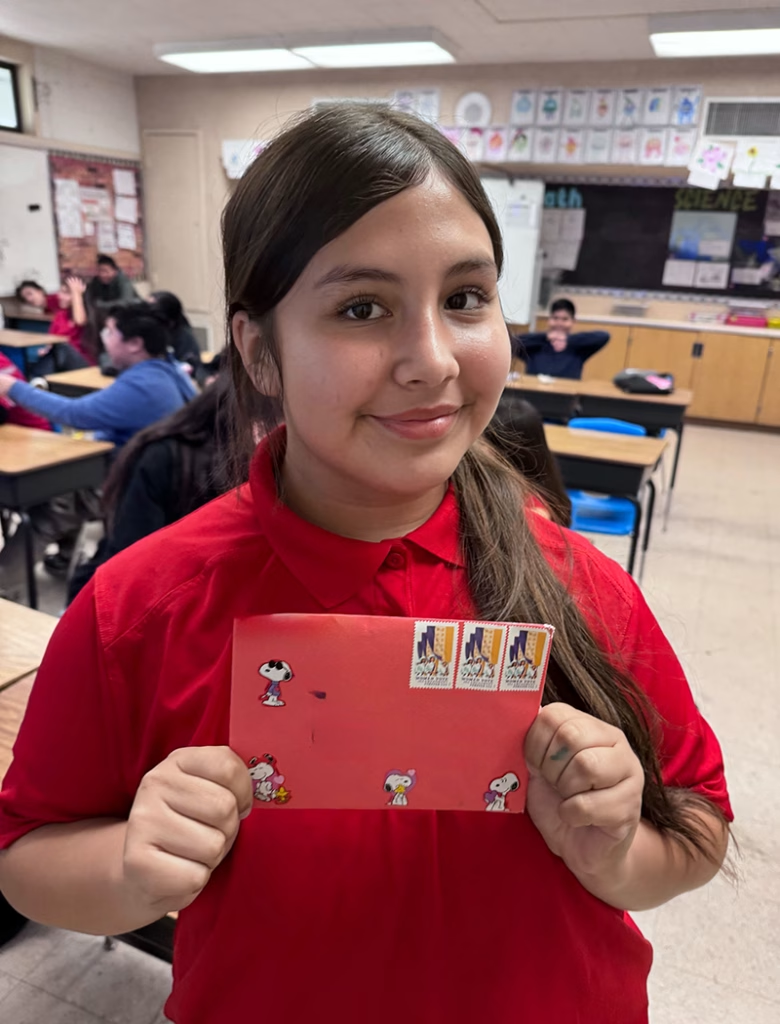 “Students are whole people with complex lives, interests, and challenges outside of school,” Lilly reminds us.
Perhaps most counterintuitively in the digital age, students who participate in LPS find that their attention increases. Madden says, “Having to wait for something [in this case, having to wait for a letter] actually really increases engagement.”
Ultimately, the handwritten letter becomes more than correspondence; it becomes a reminder of the power of being seen.
“I would want my students to remember that I believe in them,” Lilly shares.
Shrestha emphasizes the importance of LPS when she notes, “Science isn’t just a career; it is a story we share to inspire the next generation.”
Madden summarizes the program perfectly: “I really hope that these letters provide inspiration for students for years to come. I hope they do save them, and I hope that they are reminded that people are rooting for them, that they can be what they want to be, that they can overcome the challenges that they face. I hope it’s inspiration for them to think expansively about who they can be in the future [and to feel] a lot of excitement about STEM.”
If STEM identity begins with connection before content, then perhaps the most powerful tools in science outreach aren’t a microscope and a computer but a pen and a stamp.
 Frances Tietje-Wang has a BS in biology and chemistry from Le Moyne College in Syracuse, NY. In 2018, they founded Fermly, a data portal for craft brewers, and became a TTB-certified brewing chemist that same year. Tietje-Wang works as a Cicerone Certified Beer Server, serves as a provisional Beer Judge Certification Program judge, and has earned their Brewing and Malting Science certificate from the Master Brewers Association of the Americas. They volunteer on both the MBAA DEI Committee and the American Society of Brewing Chemists Webinar Committee, and they teach as a subject matter expert in the MBAA Brewing and Malting Science Course. They speak on various subjects in the fermentation sciences and raise money for nonprofits that elevate marginalized communities in the brewing industry. They are a passionate hiker, runner, and rock climber in preparation for the zombie apocalypse.
This article was originally published in AWIS Magazine. Join AWIS to access the full issue of AWIS Magazine and more member benefits.