
My Dad, Dr. K.C. Sharma, always used to say, “What we plant in the soil of contemplation, we shall reap in the harvest of action.” His wisdom has sustained me throughout my long journey with patience and zeal. Inspired by my parents’ profound influence, I found my path toward research—a pursuit that unites my love for science with my desire to serve humanity.
From the earliest days of submitting my PhD applications, an unwavering flame of hope carried me forward. What began as a simple aspiration to pursue doctoral studies eventually blossomed into the privilege of securing graduate admission to one of India’s most premier institutes, Jawaharlal Nehru University (JNU) in New Delhi, an accomplishment made possible by the very hope that sustained me.
Having achieved this initial goal, I then trained for my PhD in life sciences at JNU under the supervision of Dr. Ajay Kumar Saxena, Professor of the Structural Biology Section. Under his guidance, I focused first on the structural biology of proteins associated with chronic disease. During my doctoral work, I gained expertise in protein biochemistry by characterizing structural, biophysical, and biochemical aspects of proteins. My main aim was to elucidate the structural and functional aspects of the protein Ergp55, which can lead to prostate cancer when it fuses with the TMPRSS-2 gene.
The second part of my thesis zeroed in on the proteins involved in the development of malaria and further whetted my appetite for the research life. My involvement in an array of studies contributed to several publications while I worked toward my PhD. I also had the privilege of mentoring and supervising many bachelor’s and master’s students, guiding them through their training.
In particular, I threw myself into a malaria project led by Dr. Kailash Chand Pandey of the ICMR–National Institute of Malaria Research in New Delhi. We focused on the biochemical characterization of cysteine proteases (CP), which play an important role in the life cycles of malaria parasites by blocking hemoglobin hydrolysis. This role suggests that CPs could serve as therapeutic targets. Our efforts helped us to identify potential ways to stave off drug resistance.
After completing my PhD, I began navigating the arduous and highly competitive landscape of finding postdoctoral positions around the world. In a field as uniquely defined as structural biology, such opportunities are scarce and difficult to obtain. Yet, once again, sheer hope became my compass, leading me to earn a place at Albert Einstein College of Medicine (AECOM) in the Bronx, New York, where I now work as an instructor.
A new scientific journey began for me during my postdoctoral training. I used my previous skills and expertise to unveil mechanisms underlying peptide MHC complexes involved in type 1 diabetes. My mentor, Dr. Teresa DiLorenzo, has gained recognition for her work in the field of type1 diabetes and has successfully identified autoantigenic peptides bound to MHC molecules, which absolutely underlie the development of the disease. Our efforts focused on understanding the immunopathogenesis of type 1 diabetes and aim to develop improved tools to monitor and manipulate pathogenic beta cell-specific T cells.
Our lab collaborated with another eminent scientist, AECOM’s Dr. Steven Almo, whom I fortunately counted as my co-mentor. His lab focuses on the development of strategies and technologies that explore biological functions for the development of treatments for infectious diseases, autoimmune diseases, and cancers. I used the lab’s crystallization robotics and high-end protein structure solution facility. During my collaborative work with this lab, I had the distinction of receiving the prestigious American Heart Association (AHA) Postdoctoral Research Fellowship, which supported my research endeavors over a two-year term.
I recently also received a distinguished Career Development Award from the AHA for my early research work. My interdisciplinary experience and extensive research training in the distinct fields of molecular biology, biochemistry, and structural biology have enhanced my goal of working to cure life-threatening diseases.
My long-term aim consists in running my own independent lab. Furthermore, I look forward to expanding my horizon in research by correlating approaches from different fields to study a diverse array of human diseases. I hope to reveal life at the molecular level in order to lay the foundations for better understanding diseases.
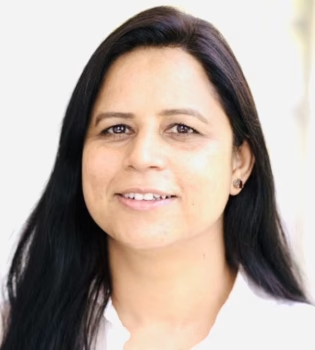
 Ruby Sharma, PhD, works to advance scientific discovery and innovation in type 1 diabetes. After completing postdoctoral studies funded by the American Heart Association at AECOM, she transitioned into a faculty role as an instructor. She recently received the Career Development Award from AHA for early-career investigations.
This article was originally published in AWIS Magazine. Join AWIS to access the full issue of AWIS Magazine and more member benefits.