
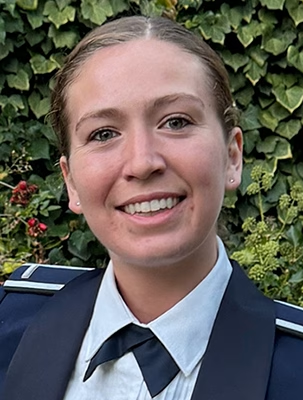
You often hear the old adage: some people are born leaders, some achieve leadership, and some have leadership thrust upon them. I don’t know which category I fall into, but I do know I have stumbled into some intense leadership roles in my young career.
I commissioned into the US Air Force as a weather and environmental science officer because I wanted to become a scientist. I never imagined becoming a leader with the ability to affect people’s lives—for better or for worse— when I signed up for this lifestyle. I take this honorable responsibility very seriously.
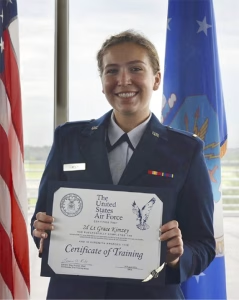
 My leadership training began when I was a cadet in the Air Force Reserve Officer Training Corp at The Pennsylvania State University, where I studied Meteorology and Atmospheric Sciences for over four years. I commissioned as a second lieutenant, completed a two-and-a-half-month initial skills course in Mississippi, and was stationed in Tucson, Arizona, at the 25th Operational Weather Squadron. I got certified as a senior duty officer, shift supervisor, and surface analyst. In these roles, I learned operational forecasting for phenomena like Santa Ana winds, virgainduced (dry-storm-caused) wind gusts, atmospheric rivers, and convective season storms (severe, seasonal, frequent thunderstorms that include strong wind and heavy rainfall).
I also led a 33-airmen operations center where we produced environmental forecasts to provide commanders with advance warning of inclement weather. Our work helped to protect 213,000 personnel and $76 billion in assets at 53 sites across two continents. I earned a promotion to first lieutenant and selection as the very first weather officer at my current base in the United Kingdom. I went back to Mississippi to complete an advanced weather management course before moving overseas to take on a position as a flight commander.
In my new role, I established the first-ever 420th Air Base Squadron Weather Flight. Here in England, I’ve learned to forecast specific fog indices and space weather impacts from geomagnetic storming, X-ray flares, and increased radiation dosages. I have led 14 Total Force airmen to provide airfield weather support that has guided 792 diverse missions, 846 deployers and over 4,000 flying hours. I even got to lead the first cooperative use of home station airfield observing equipment with 17 US and UK meteorologists for two iterations of the world’s largest military air show: the Royal International Air Tattoo (RIAT). In RIAT 2025, we published 160 products for 175,000 visitors, 224 aircraft, 27 nations and 41 chiefs, which strengthened the NATO alliance and earned plaudits from the Headquarters US Air Force Director of Weather.
I often read leadership literature to learn more lessons and strategies that I should implement. In practice, however, I have come to realize that sometimes the best leadership lessons consist of those that I must unlearn. In fact, I always have to unlearn more as a woman leader and scientist, so let’s unlearn seven myths together right now.
Myth #1: Leaders have the loudest voices in the room.
What we say and how we say it matters more than how loudly we say it. The right people will listen.
Myth #2: We must be humble.
Humility, though admirable, should never diminish pride in our accomplishments. My proudest moment as a scientist involved using my research with integrated vapor transport to identify an atmospheric river flooding event that would severely impact the US Pacific Northwest within 48 hours. I alerted 16 installation leaders and secured $4.3 billion in assets. My research was incorporated into climatology briefs for seasonal training and has helped to enhance the accuracy of Air Force heavy rainfall forecasts. My proudest moment as a leader occurred when one of my airmen reached out to me personally to thank me for my mentorship, crediting my help with enabling her to earn an advanced promotion. We do amazing things; it’s okay to admit that.
Myth #3: We need to know the answer to every question.
 This expectation can prove unrealistic and even dangerous. When we fail to admit that we cannot answer a question or become too preoccupied with unimportant details, we may fail to find a solution. A far more useful skill consists in knowing how to find answers.
Myth #4: Her success means our failure.
We are not in competition. One woman’s achievement does not diminish our efforts or accomplishments. So, let’s cheer on other women and encourage them to achieve their goals while also continuing to succeed in our own lanes.
Myth #5: All scientists have degrees.
Degrees are well-deserved credentials however they should not be the only measure by which we label scientists. I’ve worked with some brilliant airmen who don’t happen to have a degree yet. According to the World Meteorological Organization, you’re not considered a meteorologist if you don’t have a degree. Well, I’ve had airmen who could forecast circles around me any day of the week, so they are beyond deserving of the title of meteorologist in my book. I treat them with the same respect I give to all other scientists in an effort to change that narrative.
Myth #6: The best leaders are liked by everyone.
If we’re liked by everyone, that means we’re people pleasers. Our goal is not to befriend everyone. Our goal is to be a genuine leader, capable of honoring our true selves and encouraging our people to do the same. Acknowledging each other’s differences and cultivating a culture of understanding will result in the respect and trust that we need to work together cohesively.
Myth #7: Imposter syndrome.
We are capable. We are confident. We are deserving. Enough said.
 Grace Kimzey earned a BS in Meteorology and Atmospheric Sciences from The Pennsylvania State University and a commission as a second lieutenant and weather and environmental science officer in the US Air Force in 2021. While on active duty, she earned an MS in Environmental Management from the University of Maryland Global Campus in 2024. She currently serves as a Weather Flight Commander stationed in England.
This article was originally published in AWIS Magazine. Join AWIS to access the full issue of AWIS Magazine and more member benefits.