

Science and comedy live in separate worlds: one careful and serious, the other chaotic and playful. But for the scientists performing with Science Riot!, the fusion of both has become an act of intellectual joy, personal liberation, and cultural resistance.
Through workshops and live shows across Colorado, the program trains scientists to transform their research, expertise, and lived experiences into stand-up comedy. The microphone magnifies their voices, clarity, and connection—especially for femme-bodied scientists in fields where they have historically been dismissed, underestimated, or rendered invisible. I spoke with several of them and am a performer myself.

For former Program Director Jessie Hanson, who has a background in microbiology, medical diagnostics, and science communication, the path into Science Riot! began long before she ever stepped onto the organization’s stage. “In 2016, I was already embedded in the comedy scene in Denver,” she explains, describing her dual identity as “a scientist by trade and by training and a comedian by calling.” So, when she encountered the new nerd-centric open mics that would become the program, “stepping in to develop [it] in Denver was a perfect fit. The Science Riot! format of communicating technical information and tempering it with comedy is still catnip to my brain. It lights up so many overlapping neural circuits.”
Dr. Julie Horwitz discovered Science Riot! from the audience side first. “I had zero intention of putting myself in such a compromising position but figured I’d be happy to come watch!” she recalls. But by the end of seeing her first show, she realized she might want to perform. Having recently become a board-certified neuropsychologist— and newly separated from her spouse— she found that comedy presented a new challenge during a significant period of transition.
The draw was immediate for Dr. Phoebe Lostroh, a molecular biologist at Colorado College: “I love political stand-up comedy, like The Daily Show or the news sketch on SNL. I love science. So, I thought I should check out the show!”

Current Science Riot! Executive Director Taylor Soderberg took a different route: “I started as a performer in 2019, and I absolutely fell in love with teaching people through humor,” she says. That experience eventually inspired her to shift careers entirely from pediatrics to running her own science-communication company, Doctor Tay, LLC, and to leading the organization that sparked her interest in comedy.
Rejecting Embodiment Bias Onstage
Femme embodiment shapes humor in ways many performers articulate with precision. Hanson describes the tension plainly: “Femme-bodied people are given extra challenges in both science and comedy. The initial response that most people have to us is to distrust us or think that we are less capable simply because of the bodies we live in.” However, credibility undergirds both scientific authority and comedic timing. She explains, “I take more time at the top of my set to establish who I am and why I have authority to speak on the topic.”
Dr. Lostroh centers the ethics of care in her comedy and says, “It was really important for me to not make any jokes or implications that criticize anybody’s body…I was trying to be this real, fat, embodied scientist who could laugh about sex and politics and be funny but not at the expense of other fat people.” She extends these ethics across identities: “I’m a lesbian in a femme body, and I don’t like anti-gay jokes, either! I don’t believe in punching down.”
Rachel Johnson, who previously worked for the Space Foundation as an educator, ties her embodiment to the limits her community placed on her: “I grew up in the South and was not encouraged to pursue the sciences. Girls/women are treated differently in regard to science and math-focused fields.”
Neuropsychologist Dr. Horwitz adds, “Particularly given the sociopolitical climate in the US, I’ve often used … [stand-up] to highlight the intersection between science and our current political landscape, an intersection which I think has disproportionately affected women, as well as other less advantaged groups.”
These experiences reflect broader research showing that femme and women scientists frequently need to counteract assumptions of incompetence or lack of authority. Lena Demuth, who currently pursues an MS in biotechnology at Harvard, agrees: “Particularly with open mics, I feel once the audience sees a femme-bodied person go up … they automatically think, ‘Women aren’t funny, so make me laugh,’ and are much judgier than they would be of masc-bodied comedians.” Humor can mitigate this prejudice; it humanizes speakers and increases perceptions of their warmth without compromising their competence.
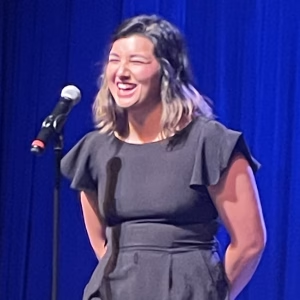
The Science of Making Jokes
Science Riot!’s workshop model begins with technical rigor. Dr. Soderberg explains: “We emphasize starting with clear and accurate science and then layering on [what’s] funny. …With Science Riot!, it’s all about finding the jokes in the content rather than building content around jokes.” Each scientist first writes several dense paragraphs about their topic, which they share with the group. Participants identify and dissect any jargon, help add clarity, and zero in on core teaching points. Then they practice in front of each other for critiques and opportunities to find the funny.
The process works. Hanson describes her method: “I always start by writing down what I think is really cool about my topic…After a couple of not-funny drafts to polish up the material, I start brainstorming what free-association connections I can come up with.” The humor arises when she reveals “the surprising truth that two things are alike in a way that the audience didn’t expect.”
Dr. Horwitz leans on similarities too: “I tend to incorporate a lot of analogies into my sets … as it can be a very effective way to promote understanding and talk about often sensitive and challenging topics in a way that is hopefully destigmatizing.” In contrast, Demuth often starts with a workplace story that resonates with the audience, “mostly because it’s universally relatable. Everyone has work stories.… Then I break it down into its f iner details and why this matters.”
Dr. Lostroh loves the collaborative dynamic: “I loved the energy of brainstorming jokes for each other…. The other people in Science Riot! are very funny!”
Research aligns with their experiences in showing that humor enhances learning and retention by increasing attention, reducing anxiety, and helping audiences process complex information.
Feeling Nerves and Endorphins Onstage
Despite their expertise as educators or researchers, many of the performers find comedy uniquely nerve-wracking, even though they commonly speak in public. Dr. Horwitz remembers anticipating “significant anxiety leading up to the show,” even though she had experience dancing on stage since she was 3 years old, mostly ballet but incorporating hip hop and jazz through college and beyond. However, she adds, “much if not most of the anxiety dissolves once you get started with your performance.”
Dr. Lostroh finds comedy paradoxical: “It’s weird to me that I get so nervous…. I spend my life standing in front of students, teaching and cracking jokes, but somehow I get nervous for Science Riot! Being nervous really screws up cognitive function!!”
Being onstage feels electric to Hanson. “Performing is amazing!” she enthuses. “The endorphins are the best high that life has to offer!” When the audience laughs at a well-crafted joke, she says, “It’s an incredible feeling.”
Neuroscientific evidence supports her reaction. Studies show that humor activates mesolimbic reward circuitry associated with dopamine release and positive affect.
Finding Clarity
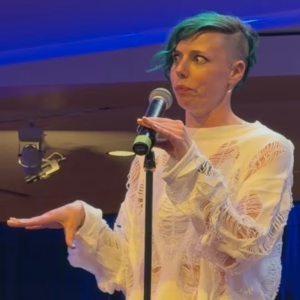
For many participants, science comedy changes how they communicate in other contexts. It reshapes how they speak, teach, advocate, lead, and even understand themselves as scientists. Hanson captures this shift vividly and enthusiastically: “Boy, howdy, has it! Working with Science Riot!…has trained me to communicate what I do and what it means for the world clearly and succinctly.” She emphasizes that most people—scientists included— struggle to describe their work in a way that makes sense to anyone outside their field. Comedy forces clarity. It requires identifying the core of an idea, stripping away the unnecessary steps, and translating the language of the lab bench into a story the audience can remember.
Dr. Horwitz notes, “One important element of science education is breaking down concepts into more basic and straightforward language.” Jargon can create barriers to understanding complex concepts. Some performers center their entire set on the definition and understanding of one word that can demystify their career and purpose.
Science Riot! comedians do not simplify language for simplicity’s sake. Instead, they use real-world situations to make concepts relatable and memorable. “People [on the outside] look at STEM fields with such an air of seriousness, Demuth explains. “In reality, those [scientific] egos are still playing with the dry ice.” Humor punctures barriers, she suggests, and invites the public into the curiosity scientists already share.
Building Transferrable Skills
For others, the transformation takes place in a deeply internal way. Comedy builds a kind of confidence that differs from the self-assurance that results from academic success or professional public speaking. “Science Riot! helped me get the courage to say yes when I had the chance to work at the National Science Foundation,” says Dr. Lostroh.
Johnson echoes this sentiment in her own way. She explains, “Science Riot has helped me better understand my connection with science and feel more confident in who I am and how my brain works.” For her, performing while openly discussing neurodivergence has helped her claim an identity she once felt uncertain about acknowledging in scientific spaces. By teaching the audience through humor, she learned to trust the validity and value of her own perspective.
Biotechnologist Demuth adds, “I now have an almost reckless lack of fear when it comes to public speaking. Client meetings are substantially less intimidating.” Her humor has become a transferable skill, something she regularly brings into her workplace, team settings, and professional relationships. It has also changed how she sees her expertise: “Having the confidence to write a joke down and tell myself, ‘Yeah, that is funny!,’ is really difficult…Convincing yourself you are a funny person is the hardest part.” For Demuth and many others, publicly claiming humor becomes a way to assert authority.
These comedian scientists have changed both quantifiably and emotionally. As Dr. Soderberg notes, “When Science Riot! did a big study on their impact in 2019, 95% of scientists who participated said they felt more confident and more likely to pursue additional outreach opportunities.” For many, that confidence becomes a hinge point in their careers, marking a new sense of possibility. Some begin leading public programs. Others speak more openly with families about their work. Some become more ambitious in their research agendas. Almost all describe the experience as catalytic for shifting how they imagine themselves as scientists, communicators, and public thinkers.
Increasing Public Trust
As scientific misinformation proliferates on social media and in politically biased news outlets, humor also offers pathways to understanding the facts. Dr. Soderberg describes a recent vaccine-focused set: “[The comedian] went through the mental heuristics that have led people to become more vaccine-hesitant and less trusting of science … to empower the audience to make informed opinions, whatever they end up being.”
Dr. Lostroh emphasizes that facts alone rarely persuade. “Explaining and explaining and explaining is not enough to change people’s minds,” she says. “Emotions have to be engaged, and we have to win the people, even if we don’t win the specific single interaction argument.” Studies affirm her stance: Humor can lower resistance and increase openness to scientific information, especially around contentious issues like climate change and public health.
Making Our Scientific Future More Inclusive
Pushing for equity matters in any setting, and diverse representation in comic performances helps. Dr. Horwitz notes, “Seeing women on stage talking passionately and humorously…can be particularly inspiring and empowering.” This is only a step in the right direction, as multiple science fields are still shaped by historical exclusion.
For Hanson, humor brings people together. “If you can make someone laugh, you’ve just humanized both yourself and the other person,” she asserts.
Dr. Lostroh has broader but less idealistic hopes. She says, “STEM is still very male- and white-dominated, and I dream of a more inclusive STEM.”
Interestingly, according to Dr. Soderberg, Science Riot! consistently attracts more women than men, an inversion of trends in both STEM and comedy. She suspects the program’s structure and supportive culture play meaningful roles in that reversal.
Communicating with a Punchline
For femme-bodied scientists, stepping into the world of comedy becomes more than entertainment: It represents a reclamation of expertise, visibility, and joy. Science Riot! demonstrates that scientists can use humor as a serious tool for reshaping public perception of science, expanding who feels welcome in STEM, and empowering scientists to speak with clarity, vulnerability, and conviction.
As Hanson puts it: “DO IT!!! You will find new depths in yourself and develop skills that will serve you in every area of life.”
In a moment when the public’s trust in science appears fragile, femme scientists stand confidently on stage, microphones in hand, preparing to offer something rare and necessary: truth delivered courageously with intellect and laughter.
 Frances Tietje-Wang has a BS in biology and chemistry from Le Moyne College in Syracuse, NY. They founded Fermly, a data portal for craft brewers, in 2018 and became a TTB-certified brewing chemist that same year. Tietje-Wang works as a Cicerone Certified Beer Server, serves as a provisional Beer Judge Certification Program judge, and has earned their Brewing and Malting Science certificate from the Master Brewers Association of the Americas. They volunteer on both the MBAA DEI Committee and the American Society of Brewing Chemists Webinar Committee, and they teach as a subject matter expert in the MBAA Brewing and Malting Science Course. They speak on various subjects in the fermentation sciences and raise money for nonprofits that elevate marginalized communities in the brewing industry. They are a passionate hiker, runner, and rock climber in preparation for the zombie apocalypse.
This article was originally published in AWIS Magazine. Join AWIS to access the full issue of AWIS Magazine and more member benefits.