

I first heard the word histrionic used casually in a group of psychology seniors I admired, we were sitting together after class, half-studying, half-decompressing, speaking in the shorthand that comes with too many lectures and too little sleep. Someone mentioned a woman they knew, she was confident, expressive, always the loudest in the room and another responded, almost reflexively, “She’s so histrionic.” Everyone nodded and no one questioned the statement, at the time neither did I. We were psychology students familiar with Histrionic Personality Disorder (HPD). As I thought about it later, was this intended as a diagnosis, or was the comment repurposed as a descriptor of her personality. I also wondered about the gendered nature of the word. The attention-seeking behavior and emotional expressiveness being described were simply ‘feminine’ (or at least culturally read as such). This realization made me question whether some psychological categories are scientific necessities at all, or whether some were granted clinical authority for reasons that had little to do with science.
Evolution of HPD
As defined by the American Psychological Association, HPD is a chronic condition characterised by excessive emotional displays and attention-seeking behaviours. HPD remains one of the most ambiguous diagnostic categories within psychology and it is the only disorder that has retained conceptual links to the historically regressive idea of hysteria (Sulz, 2010).
The term “histrion” can be traced back to Hippocrates, who associated women’s emotional distress with the concept of the “wandering womb,” proposing that sexual frustration led to neurotic behaviour (King, 1993). During the Middle Ages, this explanation shifted into a demonological framework, where emotional excess in women was interpreted as evidence of possession (Tasca et al., 2012). Women who displayed autonomy or assertiveness were condemned, as seen in events such as the Salem witch trials, where deviation from gender norms was treated as a sign of moral or supernatural deviance (Xia, n.d.).

By the mid-19th century, Ernst von Feuchtersleben offered one of the earliest psychological formulations resembling HPD, describing hysterical women as sexually inappropriate, selfish and indulgent (Millon, 2011). These reflected broader cultural anxieties about female behaviour and social roles, including gendered assumptions medical reasoning. The transition from “hysteria” to “histrionic” in later diagnostic manuals did little to remove these underlying biases, as many of the defining traits such as being flirtatious, theatrical or emotionally labile, continued to describe stereotypes of femininity.
Empirical research complicates the legitimacy of HPD as a distinct disorder, studies examining the DSM-IV criteria found that HPD has low prevalence rates and substantial overlap with other personality disorders, including Borderline, Narcissistic and Dependent Personality Disorders (Blais & Baity, 2006). This raises a question about whether HPD represents a unique clinical entity or whether it reflects a cluster of traits already captured within existing categories. The overlap with Narcissistic Personality Disorder is significant, as both involve attention-seeking and interpersonal sensitivity but only one has been historically feminised in its interpretation and application.
The pattern of diagnosis also demands scrutiny. HPD has been diagnosed predominantly in women, even though alternative perspectives have suggested that similar patterns of distress can occur across genders. Pierre Briquet for example, argued that hysteria was linked to sociological conditions such as industrialization and could manifest in both men and women. Yet even this broader view was absorbed into a framework that feminised distress, as collective social unrest was described in terms such as “uterine fury,” recasting political or economic tensions as expressions of a feminised pathology (Nezhat et al., 2020). This tendency reveals how easily social and cultural dynamics can be translated into diagnostic language in ways that reinforce existing biases.
These historical origins, empirical instability, and gendered patterns of application create tension in the field.
Should HPD Remain in the DSM?
The historical and empirical foundations of HPD raise serious concerns about its validity and ethical implications. However, the formalisation of HPD in diagnostic systems such as the DSM reflects an effort to identify consistent patterns of emotional and interpersonal functioning that may cause distress or impairment. For some clinicians, having a label allows for structured assessment and the possibility of targeted therapeutic intervention. The inclusion of HPD in the DSM-III, where “hysterical” was replaced with “histrionic” following Paul Chodoff’s proposal, can be seen as part of a broader attempt to modernise and standardise psychiatric language (Novais et al., 2015). Later revisions in the DSM-IV also indicate that the field has made efforts to refine diagnostic criteria in response to emerging research, suggesting an ongoing process of scientific adjustment.
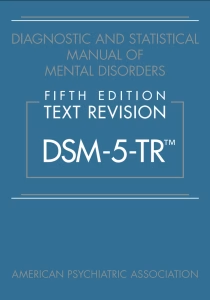 HPD has never been the sole explanation for emotional instability. Diagnoses such as Borderline Personality Disorder (BPD) and Narcissistic Personality Disorder (NPD) are more extensively researched and more commonly diagnosed (Blagov & Westen, 2008). Yet, neither BPD nor NPD reveal same gender disparity as HPD. According to the DSM-5, HPD is diagnosed approximately four times more frequently in women than in men (APA, 2013), a disparity that researchers have linked to clinician bias as much as genuine prevalence differences.
Men are also identified with the disorder, although the presentation is interpreted differently within clinical settings. In men, traits such as attention-seeking, charm and interpersonal manipulation are more likely to be framed as assertiveness or narcissistic tendencies, which can lead to underdiagnosis or misclassification under other personality disorders (Millon, 2011; Sperry, 2003). In contrast, similar behaviors in women are more readily labelled as excessive emotionality or dramatization, reflecting how gendered expectations affect the recognition and interpretation of symptoms.
Dismissing HPD entirely would mean ignoring a body of research that has attempted to validate it as a clinical construct. Some studies document measurable patterns of interpersonal dysfunction, emotional dysregulation and maladaptive attention-seeking causing genuine distress in relational contexts (Blais & Baity, 2006). Personality researchers have also mapped histrionic traits onto dimensional models of personality pathology, arguing that these features cluster in clinically meaningful ways (Millon, 2011). Blagov and Westen (2008) argue that individuals diagnosed with HPD show distinctive affective styles and relational strategies that cannot be collapsed into BPD or NPD, lending some support to its diagnostic separability.
Samuel and Widiger (2008) analyzed personality disorders using the Five-Factor Model and found that histrionic traits represented the personality dimensions of high extraversion and high neuroticism. These findings suggest that HPD reflects a measurable configuration of personality traits, supporting its validity within dimensional models of psychopathology. However, these defenses rest on shaky empirical ground because of small sample sizes, shifting diagnostic criteria and heavy reliance on clinician judgement that make the disorder acutely susceptible to the cultural biases its history supports.
Conclusions
In my view, the empirical record is too thin to distinguish genuine pathology from social discomfort with emotionally expressive women. From the policing of outspoken women in earlier periods to contemporary scrutiny of women’s visibility, society has a broad pattern of regulating female behavior. Could HPD simply reflect extreme extraversion and emotional expressiveness that makes men uncomfortable?
I see several possible directions for the field moving forward, though each comes with its own limitations.
One potential approach would involve removing HPD from the DSM entirely and redistributing its criteria across Borderline, Narcissistic, or Dependent Personality Disorders, where conceptual overlap is already significant and the empirical foundations are comparatively stronger. However, such a step may not be viable given the current state of evidence, as there is still insufficient consensus to justify fully dismissing the diagnostic category. It is also important to recognize that HPD, regardless of its contested validity has been normalized within clinical frameworks over time, making its removal both theoretically and institutionally complex.
The current evidence suggests that removing HPD altogether could risk overlooking a pattern of distress that may exist, so another possibility involves retaining the diagnosis while committing to far more rigorous, methodologically sound and gender-conscious research. This would require existing studies to be replicated across larger sample sizes and more diverse populations while reducing the influence of culturally specific biases. Expanding the research base in this way would allow the diagnosis to be applied with more clinical confidence.
A third solution lies in actively re-evaluating how HPD is taught, interpreted and used within clinical and educational spaces, so that the diagnosis is grounded in clearer and more accountable criteria. Educational spaces, training programs and institutional practices must place greater emphasis on the responsible use of diagnostic language, encouraging students and practitioners to engage critically with the terms they adopt so that they do not perpetuate gendered bias.
The disorder exists at the intersection of clinical necessity and cultural inheritance and this position makes it difficult to evaluate without acknowledging both dimensions. It seems reasonable to argue that HPD requires far more rigorous and critically engaged research before it can be applied with confidence, given the extent to which its defining traits overlap with broader social interpretations of femininity. Until such clarity is achieved, the continued presence of HPD within diagnostic frameworks raises important questions about how psychological knowledge is constructed, whose behaviours are pathologized, and whether certain categories persist because of the cultural narratives they continue to uphold.
 Mahika Tampi is a psychology student at Drexel University whose work spans research and field-based mental health initiatives. She has designed a community-based mental health support program called Project Muskan, developed under the guidance of mental health professionals in India. Her interests lie in clinical and neuropsychology, with research exploring behavior and cognitive functioning, alongside analytical writing on psychology in real-world contexts.