
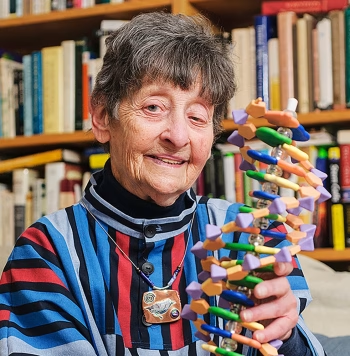
I am delighted to share excerpts of a recent conversation with my friend Dr. Dorothy Semenow, a woman scientist whose life is a testament to perseverance, intellect, and the power of pivoting. Born during the Great Depression, this trailblazer pursued a fulfilling career as a chemist and became the first woman to earn a PhD from the California Institute of Technology. As a women’s rights activist, Dr. Semenow broke barriers at Caltech and advocated for diversity in science. Now, in her tenth decade, she has found a way to communicate the wonder of CRISPR science. Throughout her life, she has bridged disparate passions and has inspired women and girls to engage in science. She continues to motivate me and many other women who follow in her footsteps.
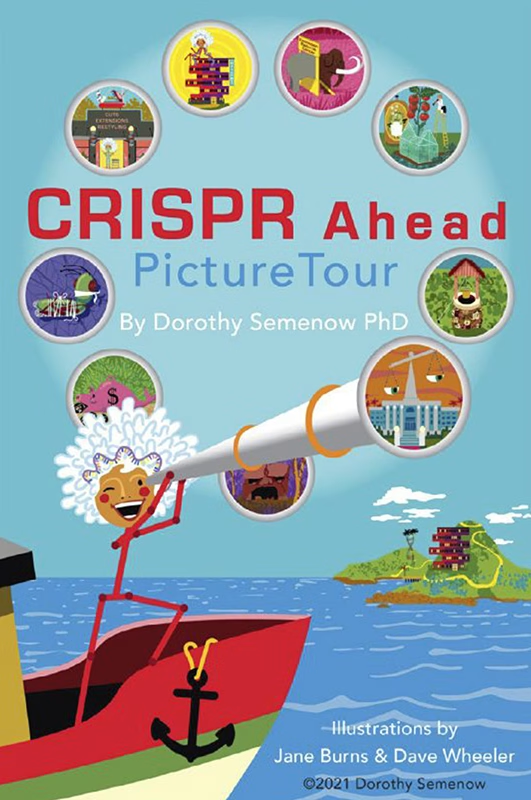 Dr. Semenow’s CRISPR Whisperer Picture Series – a free downloadable PDF that offers complete coverage of CRISPR in short episodes, with playful art making the story easy to understand and fun to explore – will soon be available through CRISPRwhisperer.org and PGED (Personal Genetics Education & Dialogue), whose mission is to raise awareness about genetics and to provide information about the impact of genetic technologies on people’s lives, both now and in the future.
You began your chemistry career at Mt. Holyoke College. What led you initially to pursue a doctorate under the guidance of Dr. John D. Roberts at MIT?
Mt. Holyoke had this extraordinary chemistry department made up of four brilliant women—Dr. Emma Perry Carr, Dr. Mary L. Sherrill, Dr. Lucy W. Pickett, and Dr. Anna Jane Harrison, and and one gentleman chemist, Dr. George E. Hall. My senior year, Dr. John D. (Jack) Roberts, a rising star from MIT, gave a lecture series at Mt. Holyoke, and I decided I wanted to do my doctoral research under his direction. Not long after I arrived at MIT, courting season began – when students jockeyed for spots in the labs of their chosen research directors. Catching Roberts in his lab on a Saturday, I told him I wanted to teach college chemistry. He boomed, “You mean, you have a burning desire to teach and do nothing else?” I piped back, “Well, teach—and research, of course!” I believe that my response to that question was critical to his accepting me into his lab.
What prompted your move to Caltech? Was that an easy decision?
When Roberts was offered a full professorship at Caltech, he arranged for his students to come along. However, Caltech didn’t accept women. Dr. Linus Pauling, Caltech’s Chemistry Division Chair, who won the Nobel Prize in Chemistry and the Nobel Peace Prize, went all out to get me admitted. The story circulated was that my application went through many committees and boards. The final step was an all-faculty vote, requiring a two-thirds majority. A third supported me and a third swore, “No way. Over my dead body!” Pauling pitched his case: “Caltech has always stood against discrimination of every kind!” which was patently untrue. “Refusing her admission is discrimination! Let us vote.” He won over the middle third! The telegram I received from Roberts read: “YOU RICHLY DESERVE THE HONOR, BUT I WILL NOT ENVY YOUR GOLDFISH BOWL!”
What are some of the most memorable moments from your time at Caltech?
I attended Pauling’s course titled “The Nature of the Chemical Bond.” He acknowledged my arrival with, “Good morning, boys … and girl.” He lectured from what looked like the original handwritten notes for his famous book also titled The Nature of the Chemical Bond.
I recall a jokey conversation with Dr. Dick Feynman, winner of the Nobel Prize in Physics, in a park, where he was riding a unicycle, and I was on a bike. We were just laughing nonstop.
Warm greetings were rare and receiving them from two luminaries I had no other contact with helped make me feel more at home. Geneticist Dr. George Beadle, Chair of the Biology Division, and cowinner of the Nobel Prize in Physiology or Medicine, always smiled at me; and Dr. Robert Oppenheimer, the theoretical physicist known as the father of the atomic bomb, smiled and tipped his pork pie hat at me.
Roberts had me take over the research project of Howard Simmons, who had opted not to transfer from MIT. The project was one of Roberts’ favorite—and riskiest— experiments. By the end of my first year at Caltech, I’d done enough research to draft a dissertation.
What other barriers did you face in your career?
I learned about an opening to teach in the Caltech undergraduate organic chemistry lab and was eager to finally teach. But Dr. Roberts told me it was too soon after Caltech had just admitted its first woman, so I wouldn’t be able to fill that slot. Caltech didn’t even admit women undergrads until 17 years later, in 1970. My main rival in our group, who had less teaching experience than I, got the job. Soon after, he also landed a faculty position at a top university. Roberts continued to support me. He tried to get me a faculty job elsewhere by introducing me to many visiting chemists. I learned years later that he even wrote a letter to Dr. R.B. Woodward at Harvard, recommending me for a faculty position. The only mention that revealed I was a woman was hidden far into the letter as a single sentence on the second page, but the tactic was to no avail.
After receiving your PhD, you made a significant pivot to psychology. What inspired that change?
My PhD was in hand but my hopes for getting a chemistry job at a major research institution were not high. I obtained a mobile postdoctoral fellowship, which I used to do research at UCLA and then at Pomona College, the small, excellent school where I became a faculty member and was also able to teach. My colleagues there were outstanding chemists and great guys, who welcomed me enthusiastically, and even included me in their practical jokes. The fun I was having with them and the deep satisfaction of working with students began to outweigh my motivation to dig up the secrets of molecules. My old interest in psychology resurfaced. The admissions director at UC Berkeley had a chemical engineering background and saw a kindred spirit in me. I was able to get a government fellowship for clinical psychology training, and it later covered the tuition for a PhD at Claremont Graduate University. I found the practice of psychology deeply satisfying — sharing the inner lives of people and helping them to unleash their creativity.
And now you’ve combined your chemistry, psychology, and communications passions to become a “Science Edutainer.” Tell us about your latest work.
The double helix model of DNA has always fascinated me. After the Human Genome Project produced the first sequence of the entire human genome, my “science genes” turned back on, and I started digging into this burgeoning field. I decided to find a way to help others understand this breakthrough and created a board game, “DNA Ahead Game and More.” When I added draft illustrations to the game, and my love affair with telling stories through pictures began. The game was published in 2017, and more than 600 teachers attended workshops to explore its use in classrooms.
What is your goal with these projects?
I want to keep doing something with what I have learned! Lately, I’ve been casting about for simple games and activities that help players try on an increasingly likely future in which genetic engineering of all living beings—humans included—is possible. It’s so important that we help shape the guardrails, not just race past them. Activities like my CRISPR Whisperer Picture Series and PGED’s “Share Your Stance” card game matter because they give all kinds of people a chance to engage with these complex issues. I also use these activities and games as opportunities to highlight women in science fields so girls can also see themselves as scientists. We’ve made progress since my days at Caltech, but we are far from seeing all the barriers removed.
 Dr. Joanne Kamens received received her PhD in genetics from Harvard Medical School and has had a varied career in academia, pharma, biotech and nonprofit. Over two decades ago, Dr. Kamens founded the Boston chapter of AWIS after an entire week passed with no meetings with any other women. She served as Executive Director/CEO of the international biotechnology nonprofit, Addgene, achieving single-digit employee turnover for her entire tenure. Dr. Kamens is a leader in creating and supporting mentoring programs and has been nominated for the Presidential Medal of Honor in STEM Mentoring. She brings her unique business and science experience as a consultant to STEM organizations and is currently Director of Alumni Programming at PharmStars, a digital health startup accelerator. She serves on multiple boards including AWIS, OpenBiome, and Cohort Sistas.
This article was originally published in AWIS Magazine. Join AWIS to access the full issue of AWIS Magazine and more member benefits.