
If you had asked me in 2013 what my path would look like a decade later, I would not have predicted that “advocacy and policy in technology” would be part of the answer. At the time, I was buried in my dissertation, experimenting with how to merge my love for technology with my deep concern for marginalized communities. Specifically, I wanted to ensure people with disabilities could access the web equitably. It wasn’t glamorous. It wasn’t policy in the formal sense. But it planted a seed. Technology isn’t just about tools; it’s about who gets to use them and who gets left behind.
That realization reshaped everything for me.
When Curiosity Meets Uncertainty
The funny thing about stepping into advocacy is that no one hands you a road map. There wasn’t a course I could take that said, “Here’s how you take your background in behavioral science, education, and HR management and transform it into a voice in tech policy.” I dwindled in this work for a while, feeling like an outsider. Advocacy and policy sounded like giant, complex systems. Who was I to enter those spaces?
The turning point came when I stopped worrying about fitting into a system and instead started asking: What do I already bring to the table? The answer was layered: a commitment to belonging, an insistence on ethical technology, and lived experience navigating multiple intersections of identity and profession. Those pieces were all different. However, once I leaned into them, I realized that advocacy often combines the personal and the professional. It’s about finding the courage to stand in what overlaps and say, “This perspective matters.”
Showing Up Without the Answers
My first real steps into advocacy were not flashy. I didn’t write a groundbreaking white paper or march into Congress with a policy proposal. Instead, I showed up. I sat in rooms where advocacy and policy conversations were already happening; often quietly, notebook in hand, listening more than speaking. I learned the language. I studied how seasoned advocates framed issues and told their stories. And slowly, I began to contribute.
At first, it was small things; sharing an article, joining a committee, or offering to support projects where equity and technology intersected. Eventually, it became writing, coaching, consulting, and working alongside organizations, shaping bigger conversations.
If I’m honest, most of the time I didn’t feel like an “expert.” But that’s one of the biggest myths about advocacy: you must be an expert to start. What matters most is your willingness to learn, connect, and take action.
Building a Broader Impact, One Step at a Time
Looking back, I see my path not as a leap but as a series of small, deliberate steps. And that’s something I want anyone reading this to hear: significant change grows from small beginnings.
Joining a group that aligns with your values. Writing about an issue that stirs you. Volunteering your skills for a cause. Even better, sharing questions in the rooms you already occupy. Each act might feel minor in isolation, but together they build momentum. And in that momentum, you discover your power.
The momentum came from realizing that my unusual mix of skills and passions—technology, education, HR, behavioral science, and advocacy for belonging—wasn’t a liability. It was my advantage. As I like to say, it made me a bit of a unicorn in this work. And advocacy needs unicorns: people who see connections that others overlook and bring perspectives that make systems more just and inclusive.
Advice for Those Just Beginning
So, how do you begin if advocacy and policy feel intimidating or distant? My advice is simple: start with what you already have: your expertise, your story, your values. These are not just raw skills; they are your strength. Then, find the communities where those strengths can be amplified.
Don’t wait until you have a five-year plan or a polished policy brief. Begin with curiosity. Let yourself stumble. Learn the language. Listen deeply. Share what you know. Each imperfect step moves you closer to impact.
And most of all, give yourself permission for the process to be messy. Because it will be. Advocacy is not a straight line; it’s a crooked line of learning, trying, failing, connecting, and trying again.
Why I Keep Going
The work I started more than a decade ago with web accessibility has grown into a broader commitment to equity and ethical technology. Along the way, I’ve learned that advocacy isn’t about arriving but continually showing up. It’s about knowing that the questions you ask, the stories you share, and the communities you build can project outward in ways you may never fully see.
If you are standing at the edge of this work, wondering if you belong in it, my message is this: you do. You don’t need to know everything, and you don’t need a perfect plan. You need the courage to start and the faith that the path will unfold as you go.
In the end, advocacy and policy are not about having all the answers. They’re about insisting that better answers are possible and being willing to help find them.
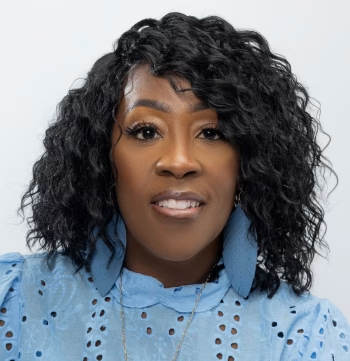
 Dr. Misty D. Freeman is a thought leader with over 25 years of experience in education, an expert in belonging, and an ethical AI and inclusive technology leader. She founded Mocha Sprout, a coaching and consulting lab that leverages behavioral science to help organizations build inclusive, innovative, and human-centered cultures within the AI ecosystem. Her work addresses AI bias, the digital divide, and student agency, while guiding industries to embed belonging and ethical innovation. Dr. Freeman bridges culture and technology, ensuring historically marginalized voices help shape AI products and environments where all people feel seen, valued, and included.