

Almost 10 years ago, the city of Flint chose to switch its water source to save money. Complaints about water quality from residents after the switch were not heard or acted upon. In fact, some people went out of their way to cover it up. The Flint Water Crisis served as a wake-up call for the need to invest in the nation’s aging infrastructure, strengthen regulations to protect water quality, and address disparities in access to safe drinking water.
Do you know all the factors that led up to the tragedy? The various ways it could have been avoided? The heroes behind the fight for justice and the ongoing battles they are still fighting?
Corporate Greed and Politics
In her book, What the Eyes Don’t See, Dr. Hanna-Attisha provided a behind the scenes look at the history of Flint, its population growth driven by the Great Migration and immigration, the autoworkers’ union that gave rise to the middle class, the lead being added to gasoline in 1923 to stop engine knocking, and the subsequent efforts by Alice Hamilton and Clair Patterson to prove the harmful effects of lead exposure.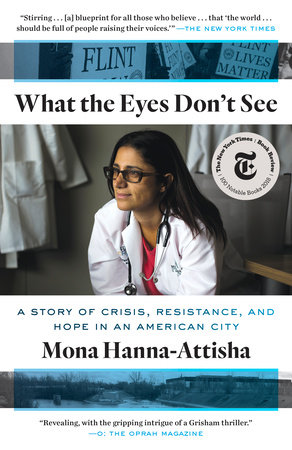
Dr. Hanna-Attisha shared how budget issues drove Michigan governor Rick Snyder to appoint an emergency manager (EM) to run the city of Flint in 2011. EMs were also appointed in Detroit, Pontiac, and elsewhere. EMs were not concerned with re-election and didn’t listen to constituents. By 2013, 50% of Black residents were living under an EM, compared with 2% of whites.
To top it off, several government agencies meant to serve the public looked the other way and worked to discredit those who exposed the truth. Oh, and by the way, Flint was not the first water crisis. In 2002, a DC resident tested 6-8x the EPA action level for lead in the water. No one was ever punished.
Public Health Surveillance
Although she started in environmental science, Dr. Hanna-Attisha quickly made the connection to how the environment impacts a person’s health and switched to medicine. As a pediatrician, she saw kids with asthma and wondered, “Why are we not fixing air quality and health policies?” This motivated her to obtain a master’s in public health.
Factors such as poverty, racism, unemployment, and violence in a child’s environment can cause stress and trauma that adversely impact their health and life expectancy. These are things you would not notice looking at a single child or their family.
Dr. Hanna-Attisha leads a rotation in Community Pediatrics that gets residents out of exam rooms. She shared, “I take them on a city tour, and we do home visits. We learn about the schools in the community and the histories and hierarchies and everything else that makes it hard for families to be healthy.” By looking at the wider population and what’s going on in the community, they can see trends. “The data is shocking. A kid born in Flint will live twenty years less than a kid born in a neighboring suburb. This is not unique to Flint. That is all over this nation. It’s not okay for kids’ opportunities to be determined by their geography.”
Setting Things Right
The damage from lead exposure in children can be significant and irreversible. Dr. Hanna-Attisha took immediate action when she found out about possible lead contamination in the city’s water from a friend connected to someone at the EPA. She engaged her congressional office, got access to data records, enlisted allies, and did not wait for peer-reviewed results. With proof in hand, she stood up at a hospital conference and shared that this was a public health emergency.
She and her science were attacked. They said she was causing hysteria, but the truth was on her side. She said, “One of my job descriptions is I’m an advocate. That’s why I am in this profession. I use my science to advocate for children.”
Government resources were finally directed to Flint. One of the first things that they did was build a registry – with community input. Over 20,000 people enrolled, and the data helps connect people with resources like Medicaid, mental health care, and interventions for children. In 2021, the Bipartisan Infrastructure Act was approved and includes a $15B commitment to replace the nation’s lead pipes.
Dr. Hanna-Attisha is still a practicing pediatrician and gives out Nutrition Prescriptions. This best practice was included in the US Farm Bill and rolled out across the country. She’s also leading a new program called RxKids that will provide unconditional cash allowances to pregnant moms and babies in their first year.
Connections and Community
As a doctor, an immigrant, and a woman of color, Dr. Hanna-Attisha recognized the disparities that many in power do not. How long might the crisis have gone on if she had not taken an active role in advocating for her patients? What if she did not have the network of connections that she had? What if she did not have the sense of community and ethics that her family and her mentors instilled?
Sadly, Dr. Hanna-Attisha shared that there have been other water and environmental crises since Flint and said, “My plea to scientists is to recognize the power that you have and hold and to use your voice in ways they haven’t before. Write an opinion piece. Talk to your policymaker. Talk to journalists.”
Systemic racism, greed, bureaucracy, and capitalism are powerful forces — but so are truth, advocacy, and community. Like the autoworkers of Flint, when people join together, their voices cannot be ignored. This is the power of AWIS.
This article was originally published in AWIS Magazine. Join AWIS to access the full issue of AWIS Magazine and more member benefits.