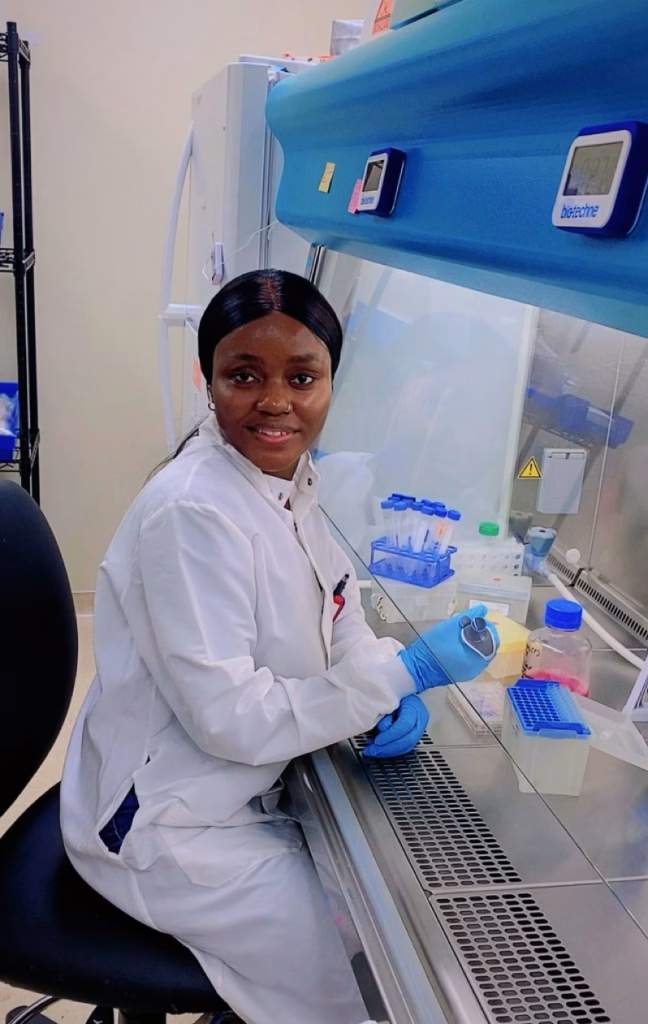
Faizah Alabi is a PhD candidate in pharmaceutical sciences whose research is rooted in compassion and fueled by a drive to heal. Specializing in immuno-oncology, she’s exploring how the immune system can be leveraged to develop safer, more effective treatments for pediatric leukemia—particularly for children and underserved populations. Motivated by personal experiences and guided by a multidisciplinary background in chemistry, pharmacology, and immunology, Faizah is working to translate scientific discovery into lasting impact.
A Day in the Lab
What does a typical day in your role look like?
I’m currently a PhD candidate in Pharmaceutical Sciences, specializing in immuno-oncology. My research focuses on identifying new immunotherapeutic targets for pediatric leukemia, with the aim of improving precision treatments for children and women affected by cancer.
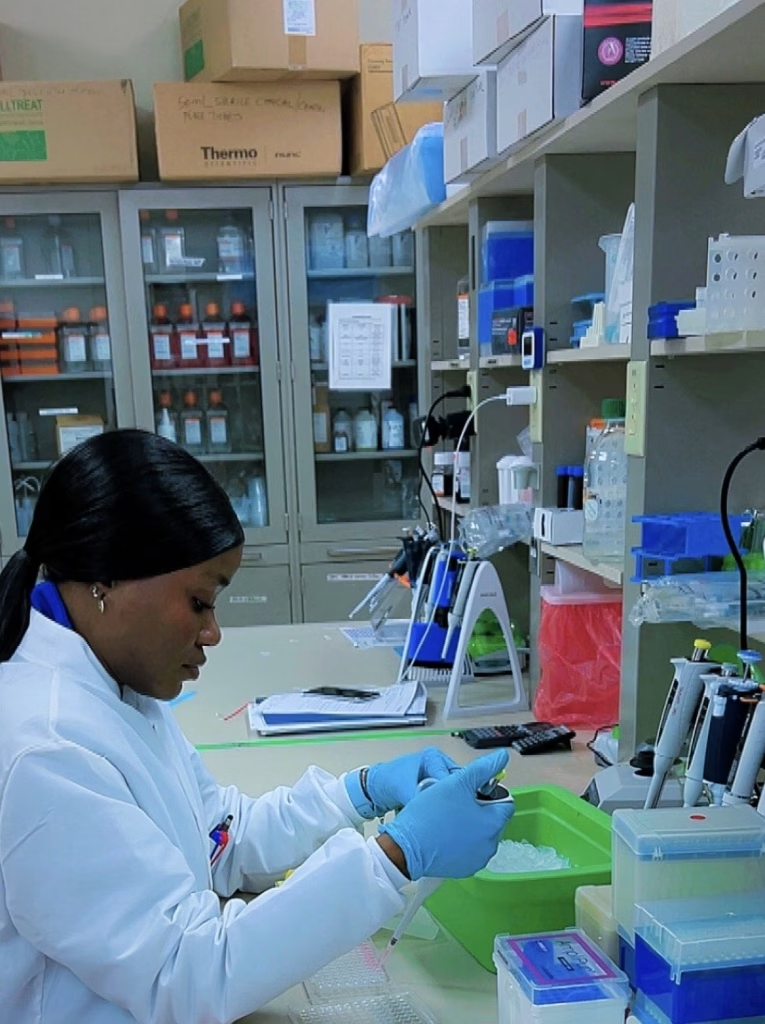
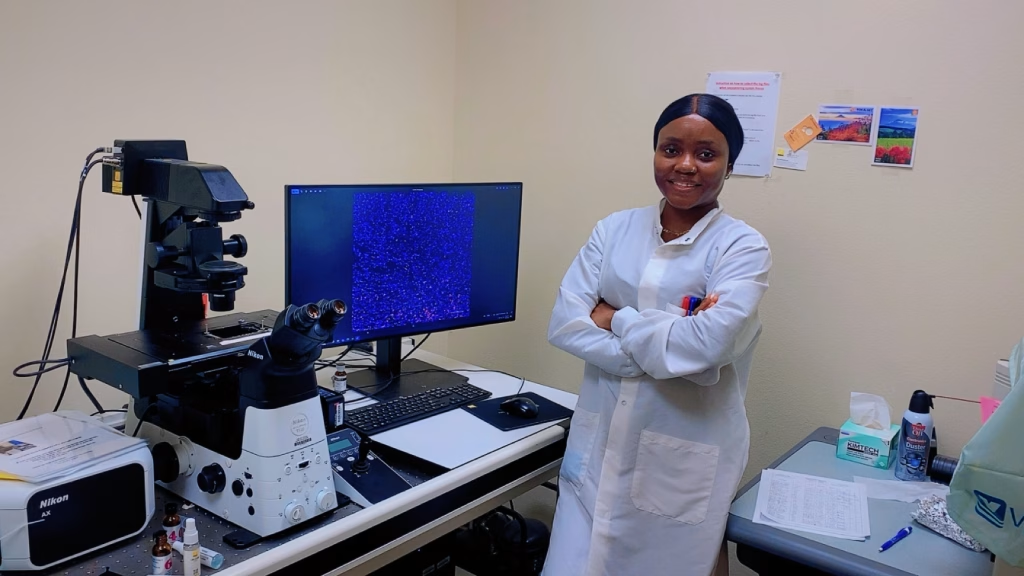
A typical day combines benchwork, data analysis, literature review, and moments of reflection and hypothesis testing. I conduct in vivo mouse experiments to study how my treatment impacts leukemia cells, alongside in vitro and ex vivo studies. I then analyze with tools like flow cytometer, ELISA plate reader, confocal microscopy, and thermocycler.
The software I mostly use includes FlowJo, GraphPad, and Cell DIVE. The results are then interpreted with my supervisor.
Outside the lab, I volunteer, mentor, and take on leadership roles. I also review and judge for journals, science fairs, and symposiums. Evenings are spent on these activities and going to the gym for mental focus. Although no two days are the same, each day brings me closer to the goal of healing.
The Path to Immuno-Oncology
I started my journey as a chemist, earning a bachelor’s degree in industrial chemistry from the University of Ilorin, Nigeria. From my sophomore till my graduation year, I took medicinal chemistry courses that ignited my interest in drug discovery and development. I then continued my education at the University of Lagos, Nigeria, where I received thorough training in this field and earned my Master’s in Pharmaceutical Chemistry. To further my expertise and prepare to become a seasoned researcher, I applied for a PhD in Pharmaceutical Sciences, focusing on immuno-oncology at Texas Tech University Health Sciences Center. I am now entering my fourth year and am very excited about what the future holds for me. My journey has been multidisciplinary, spanning chemistry, biology, pharmacology, and now immunology. This diverse foundation allows me to see problems from multiple scientific lenses and fuels my innovative approach to therapy design. I’ve learned that healing requires not just knowledge, but the humility to question, adapt, and refine.
Growing up in Nigeria, I witnessed how access to timely and effective cancer treatment could mean the difference between life and death, especially for children and women. My personal experience deepened when I lost my younger brother to a preventable death, partly caused by healthcare disparities. This profound exposure ignited my curiosity about how we can develop better therapies. What keeps me excited is the knowledge that science is not static. Every experiment holds the potential for healing. Every breakthrough, no matter how small, brings us closer to saving a life.
My research helps decode how leukemia cells interact with the immune system and how we can harness immune checkpoints, cytokine signaling, and adoptive cell therapies to suppress tumor growth. Specifically, I study T cell acute lymphoblastic leukemia (T-ALL), a form of leukemia that mainly affects children and young adults. Currently, the main treatment involves multiagent chemotherapy, and because this disease mostly impacts children, their bodies are less likely to withstand the treatment, or they may relapse. My work addresses this critical gap by developing safer and more effective treatment strategies. Interestingly, our bodies have the incredible ability to heal themselves through the immune system, with T cells being the most powerful. T cells are highly effective due to their specialized receptor called the T cell receptor (TCR), which allows them to recognize, bind, and kill antigens such as cancer. However, cancer cells are smart enough to evade this attack or weaken T cell responses through mechanisms like immune evasion and T cell exhaustion. My focus is to understand this evasion process in T-ALL, block it, and also enhance T cell killing ability. By exploring new combinations of immune-targeting therapies and identifying specific immune responses, my goal is to contribute to the development of targeted treatments that are both effective and less toxic, especially for young and underrepresented patients. To me, innovation is about compassion-driven science.
I remind myself that progress is not always linear. I journal, stay fit, practice gratitude, and stay grounded in my “why.” When experiments fail or hypotheses unravel, I reframe the moment as a redirection, not a defeat. I also lean on my support network: Allah, mentors, family, peers, and fellow women in science, for perspective and encouragement.
Science with Impact
What is your proudest achievement in your career?
One of my proudest moments was presenting my leukemia research at an international immunology conference and talking with a pediatric oncologist afterward, who said, “This could change how we treat our youngest patients.” It was the moment I realized my science could directly translate into hope.
How has your work or research helped drive discovery, innovation, or impact?
My research helps decode how leukemia cells interact with the immune system and how we can harness immune checkpoints, cytokine signaling, and adoptive cell therapies to suppress tumor growth.
Specifically, I study T cell acute lymphoblastic leukemia (T-ALL), a form of leukemia that mainly affects children and young adults. Currently, the main treatment involves multiagent chemotherapy, and because this disease mostly impacts children, their bodies are less likely to withstand the treatment, or they may relapse. My work addresses this critical gap by developing safer and more effective treatment strategies.
Interestingly, our bodies have the incredible ability to heal themselves through the immune system, with T cells being the most powerful. T cells are highly effective due to their specialized receptor called the T cell receptor (TCR), which allows them to recognize, bind, and kill antigens such as cancer. However, cancer cells are smart enough to evade this attack or weaken T cell responses through mechanisms like immune evasion and T cell exhaustion.
My focus is to understand this evasion process in T-ALL, block it, and also enhance T cell killing ability. By exploring new combinations of immune-targeting therapies and identifying specific immune responses, my goal is to contribute to the development of targeted treatments that are both effective and less toxic, especially for young and underrepresented patients.
To me, innovation is about compassion-driven science.
The Power of Science and Community
What does the power of science and community mean to you?
Science is a tool, but community is the compass. An African adage says, “If you want to go fast, go alone, but if you want to go far, go together.” Together, we form the core of transformative change. Science gives us the means to heal, while community reminds us why we must. When we unite discovery with empathy, we exponentially amplify the healing power of our work.
How has science shaped your sense of community—and how has community supported your journey?
Science is a tool, but community is the compass. An African adage says, “If you want to go fast, go alone, but if you want to go far, go together.” Together, we form the core of transformative change. Science gives us the means to heal, while community reminds us why we must. When we unite discovery with empathy, we exponentially amplify the healing power of our work.
To a Future Scientist Just Starting Out
What do you consider to be the best professional or personal advice you’ve ever received?
Someone once told me, “Don’t just work for success, work for significance.” That advice has shaped how I approach my career. I don’t measure impact by publications alone, but by the lives that may one day benefit from my work. Significance leaves a legacy, success simply leaves a record.
What advice would you give to someone just starting out in your field?
Stay curious, stay kind, and don’t be afraid to take up space. The field of immuno-oncology is evolving rapidly, and your voice, ideas, and questions matter. Seek mentors who champion your growth, and remember that setbacks are part of the process, not the end of it.
What message would you share with future scientists about the power they hold to make a difference?
You hold the power to shape futures, extend lives, and rewrite what is possible. Science is not just a career, it’s a calling. Lead with courage, compassion, and a relentless desire to do good. The world is waiting for your discovery.
What would you tell your younger self?
I would say, “You belong here. The road may be unfamiliar and steep, but your curiosity is your compass. Your work will matter, and one day, it will help others heal. Keep going.”