European and Other Countries Beckoning US Scientists
By Patricia Soochan
In March 2025, Nature polled its readers on the question, “Are you a US researcher who is considering leaving the country following the disruptions to science prompted by the Trump administration?” Among 1600 respondents (over 1000 of whom were early career scientists or grad students), 1200 (or 75%) said yes. Reflecting the overrepresentation of early career scientists among the respondents, one young scientist said, “The PIs [principal investigators] I’ve spoken to feel they’ll be able to weather this storm. As early career investigators, we don’t have that luxury – this is a critical moment in our careers, and it’s been thrown into turmoil in a matter of weeks.”
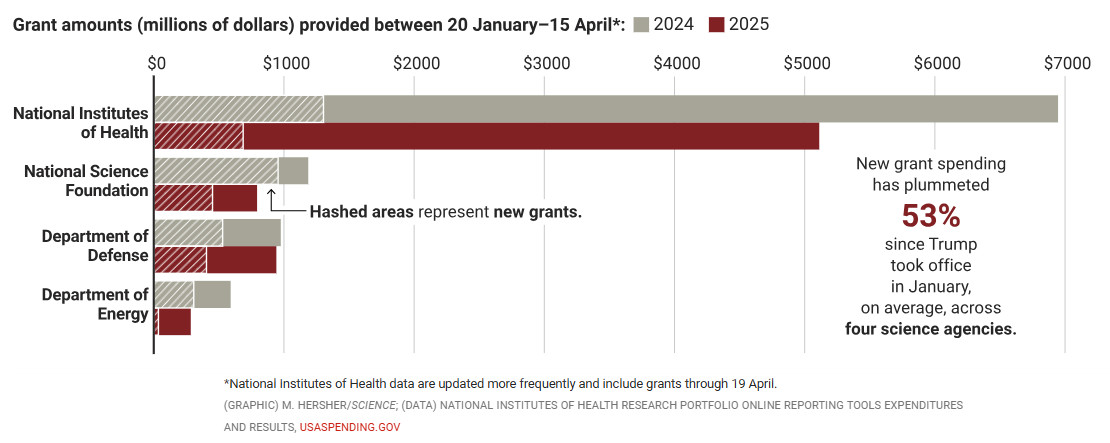
Data on the actual impact on several aspects of science over the first 100 days of the new administration ensued in Science in May 2025. It included the revelation of a 53% decline in new grant spending for the major federal funders of science from 2024 to 2025 (Figure 1).
Looking at the administration’s proposed 2026 budget, the two major federal science funders NIH and NSF would have their budgets reduced by 40% and 55%.
As the grim picture was emerging, Science reported that President of the European Commission (the executive branch of the European Union (EU)), Dr. Ursula von der Leyen, had launched the Choose Europe for Science (CES) program, doing so while invoking the accomplishments of famed researcher Marie Curie, an immigrant to France from Poland. To “make Europe a magnet for researchers,” key elements of the program would include:
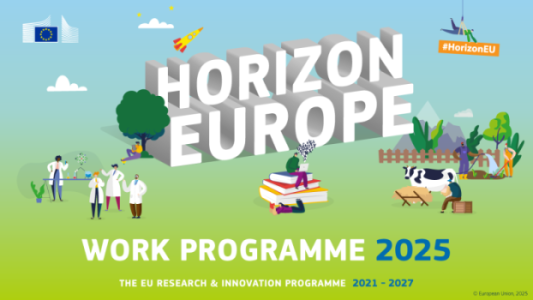
Figure 2. Work programs under Horizon Europe.€500 million in 7-year Super Grants (2025–2027) through the European Research Council (ERC) to fund innovative research.
New legal guarantees to protect academic freedom and safeguard scientific inquiry across the EU to reinforce Europe’s commitment to open and inclusive science.
A new pilot program under the Marie Sklodowska-Curie Actions offering long-term career pathways for young researchers, with a €22.5 million budget under Horizon Europe (Figure 2).
France’s €100 million commitment to support incoming researchers.
In addition to the new commitments, ERC’s Scientific Council pledged to double the funds available to non-European researchers to relocate and set up their labs from €1 to 2 million.
Despite the bright promises these programs bring, challenges remain. Foremost is that although the funding not only provides opportunities but also sends a powerful message through the support of political leaders, it cannot replace the billions lost in US funding for science research. Europe’s leaders themselves acknowledge that compared to their US counterpart, the European research systems are lagging in infrastructure, in ways such as being excessively bureaucratic and not sufficiently geared to translating basic research into commercial applications. As noted in a May 2025 article in the New York Times (NYT), other challenges include the tendency towards lower salaries in Europe. An example is that a 35-year-old researcher might expect to earn a monthly gross income of $4,000 in Europe compared to a Stanford postdoc, who might earn a monthly gross of about $6,700. However, some scientists consider Europe’s generous social safety net such as lower cost healthcare and university tuition as compensation for lower salaries.
Countries Welcoming US Scientists
In addition to the EU’s programs, individual European and Asian countries are providing new or expanded opportunities for scientists of US or other nationalities to immigrate. They include the following:
Many governmental and commercial organizations offer advice for scientists to consider as they contemplate immigrating to another country for work.
EURAXESS Researchers in Motion is a free resource from the EU that offers help with job searches across 43 countries in Europe, Oceania, Asia and Africa, career development, and immigration.
Educations.com, which advises primarily on study abroad programs, also has information on research career development in Europe, with specifics on visa requirements for several countries.
Patricia Soochan was a senior program strategist in Data Science, Research, and Analysis in HHMI’s former Center for the Advancement of Science Leadership & Culture. In her role, she collaborated with the Center’s programs to capture, analyze, synthesize, and communicate program-level data to promote organizational effectiveness and evaluation. Previously she shared lead responsibility for the development and execution of the Inclusive Excellence (IE1&2) initiative and had lead responsibility for science education grants provided to primarily undergraduate institutions, a precursor of IE. She is a member of the Change Leaders Working Group in the Accelerating Systemic Change Network and is a contributing writer for AWIS Magazine and The Nucleus. Prior to joining HHMI, she was a science assistant at the National Science Foundation, a science writer for a consultant to the National Cancer Institute, and a research and development scientist at Life Technologies. She received her BS and MS degrees in biology from George Washington University.