
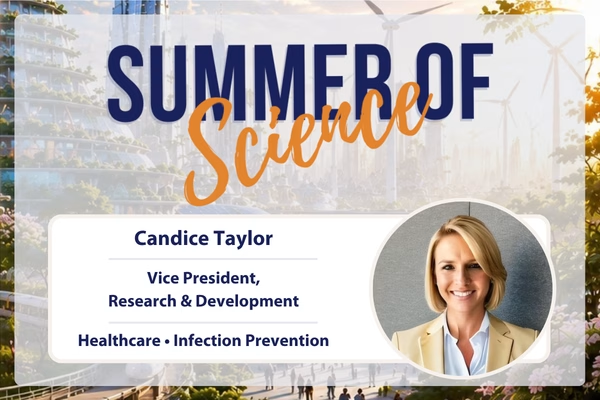
Every day, healthcare professionals, food service workers, and countless others rely on infection prevention products to help keep people safe. Behind those products are scientists who develop, test, and improve solutions designed to reduce the spread of harmful germs and protect public health.
As Vice President of Research & Development at PDI, Candice Taylor leads teams developing infection prevention solutions used in healthcare and food service environments. With a background in chemistry and more than 28 years of experience in product development, she is passionate about translating science into practical solutions that make a real-world difference.
A Day in Infection Prevention
What does a typical day in your role look like?
As Vice President of Research & Development at PDI, I lead a multi-disciplinary R&D organization that delivers innovative, compliant infection prevention solutions in support of PDI’s corporate vision, growth strategies, and business objectives. A typical day is a mix of strategy and people — I might start with a portfolio review, move into a one-on-one coaching conversation with a team member, join a cross-functional meeting with Marketing or Regulatory on a launch, and end the day digging into the technical details of a formulation challenge. The throughline is prioritization: making sure the team is focused on the work that matters most and has what they need to deliver it.
How would you explain your field of work to a kindergarten class?
My job is to help make things really, really clean — especially in places like hospitals where people are trying to get better, and in restaurants and kitchens where our food is prepared. There are tiny germs all around us that we can’t see, and some of them can make us sick. My team and I are like germ detectives and inventors: we figure out how to stop the bad germs using special products, so doctors, nurses, and the people who make our food can keep everyone safe.
What’s a fun fact or lesser-known part of your day-to-day work?
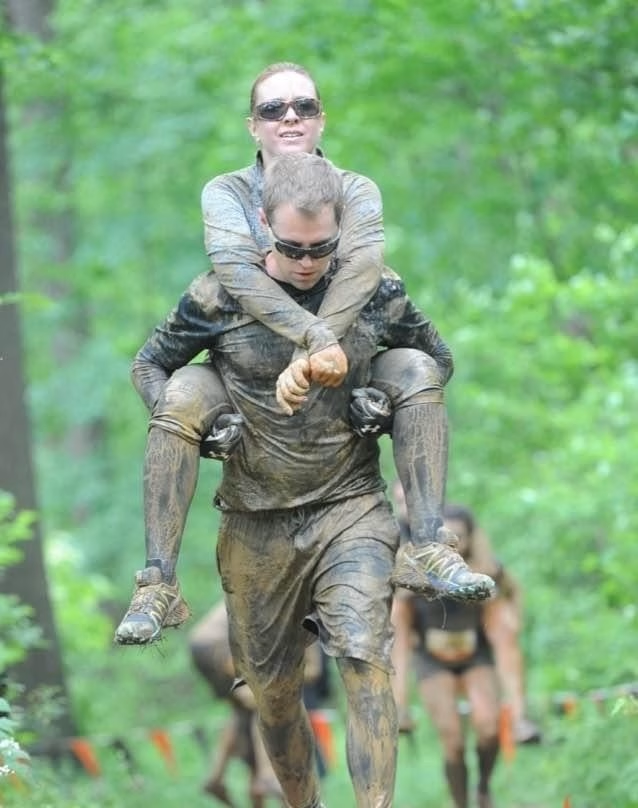
Outside of work, I’ve completed a Tough Mudder — a long, muddy obstacle course that pushes you to your physical and mental limits. I love a challenge, and that same determination and resilience shows up in how I tackle problems at work. I also love home remodeling and design projects; there’s something about transforming a space with creativity and functionality that scratches the same itch as product development — both are about turning a vision into something real and useful.
The Path to Protecting Public Health
I earned my BS and MA in Chemistry from the University of Scranton, where I also served as a Graduate Assistant. From there, I built a career spanning more than 28 years of product development across regulated categories — leading teams in disinfection, specialty products, personal care, and fabric care, as well as analytical sciences and sensorial/performance testing. The technical foundation in chemistry has been essential, but what truly prepared me was the breadth of categories and challenges along the way. Each role taught me something about how science gets translated into products people actually use — and how to lead the teams that make that happen.
I’ve always loved math and been drawn to the medical field — the combination of logical, structured problem-solving and the chance to make a real difference in people’s health is what pulled me toward science. Chemistry became the bridge between the two: it gave me a way to apply quantitative thinking to problems that ultimately affect patients, clinicians, and the broader public. What keeps me excited today is the impact. The products my team develops aren’t abstract; they’re used every day in hospitals to prevent healthcare-acquired infections and in food service environments to prevent foodborne illness — both critical fronts in the fight against community-acquired infections. Knowing the science we do reaches real people is what makes it more than a job.
My proudest achievement isn’t a single product launch — it’s the teams I’ve built and the people I’ve helped grow. Watching scientists I’ve coached step into bigger roles, lead their own teams, and develop their own leadership voice is what I’m most proud of. The products come and go, but the leaders we develop carry the impact forward for decades.
AWIS has given me a community of women who understand both the technical side of science and the experience of leading and advancing in STEM careers. The connections, mentorship opportunities, and shared perspectives have been valuable — both for my own growth and for what I bring back to the women I lead and develop on my own teams.
The Science That Moves Us Forward
How has your work/research helped drive discovery, innovation, or impact?
Across my career I’ve led the development of products in surface disinfection, sanitization, cleaning, personal care, and food service — categories that touch millions of people every day. At PDI specifically, my team develops infection prevention solutions that address some of the most critical challenges in healthcare and food service environments alike. Beyond individual products, I think the bigger impact comes from building the kind of R&D culture where innovation can actually happen: where teams feel empowered to take smart risks, challenge assumptions, and bring novel ideas forward.
Where do you see your work heading next?
Infection prevention is evolving quickly — new pathogens, new regulatory expectations, and new technologies like AI that are reshaping how we discover and develop products. The lens is also broadening: community-acquired infections don’t start and stop at the hospital door. They move through food service environments, public spaces, and everyday touchpoints, which means our work has to as well. I see my next chapter as integrating those advances into how we innovate at PDI — strengthening our impact in healthcare first and food service close behind — while continuing to build R&D capability that’s both scientifically rigorous and deeply connected to the people we serve.
How do you see your work helping shape the future of STEM?
I think the future of STEM depends as much on how we lead as on what we discover. By developing scientists — particularly women — who are technically strong and also confident, emotionally intelligent leaders, we change who shapes the science that gets done. I try to model that every day, and I recently served on the Women in Leadership Advisory Board at the University of Tennessee, Knoxville to extend that work beyond my own organization.
To a Future Scientist Just Starting Out
What are some strategies you use to maintain resilience and persistence in the face of obstacles?
Emotional intelligence is at the core of how I navigate obstacles. When something goes wrong — a failed experiment, a missed timeline, a difficult conversation — the first thing I do is pause and check my own reaction before responding. I also lean heavily on my team and my network; resilience isn’t a solo sport. And I try to remember that setbacks are data, not verdicts. Every obstacle is teaching you something about the problem, the system, or yourself.
What advice would you give to your younger self / someone just starting out in your field?
Invest in the human side of science as much as the technical side. Early-career scientists often think their value is purely in their lab skills or their technical depth — and those matter — but the people who go furthest are the ones who can also communicate, collaborate, and lead. Don’t wait until you’re a manager to start developing those muscles.
What message would you share with future scientists about the power they hold to make a difference?:
The work you do matters more than you realize. A formulation you develop might end up in a hospital protecting a patient you’ll never meet, or in a restaurant kitchen preventing a foodborne illness before it ever happens. A process you improve might free up a colleague to take on a problem they wouldn’t have had time for otherwise. Science is a relay race across generations — you’re carrying the baton now, and what you do with it shapes what’s possible for the people who come next. Don’t underestimate yourself or your impact.