
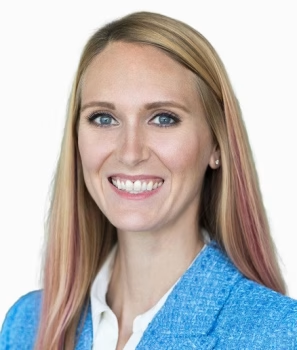
Kara Bennett is an accomplished professional with a diverse career spanning over a decade in the energy and sustainability sectors. Holding an MBA from London Business School and a Master of Science in Energy Resources Engineering from Stanford University, she combines her engineering expertise with strategic business vision. Currently a strategy consultant in Dubai, Kara has a proven track record of guiding clients through the complexities of the energy transition. Her experience includes working with major firms such as Boston Consulting Group (BCG), where she conducted market analyses for diversification strategies and developed operating models for large-scale business units. Her international experience also includes co-founding Grace Boarding, a children’s home in Thailand that provides a stable living environment and access to education for over 150 children. At Grace Boarding, she designed the home with sustainable features like off-grid solar electricity and filtered running water. She has also installed similar systems in rural villages while working with the Border Green Energy Team (BGET) in Mae Sot, Thailand.
What were some of the most significant challenges you faced when transitioning to an international scientific career, and how did you overcome them?
Every time you move somewhere new, especially internationally, you have to start over from zero. It can take a year or more to really figure out a place, for example, to figure out how to get your haircut, or where to find a doctor and dentist. You also have to rebuild your friend group. And while you’re doing that, you need to be very intentional about keeping in touch with people that you want to keep in touch with, to keep them in your life.
Every culture is different, so when I move to a new place I need to really observe, kind of figure out what’s going on, how to behave, what do different things mean—understanding beyond the words, understanding the cultural background takes some time.
One thing is, English is the only language I speak with professional proficiency. One challenge is that I could only go to places where they speak English professionally. If you speak more languages, you have more options, of course.
What advice would you give to other women in science who are considering pursuing international opportunities, but may be hesitant or unsure where to start?
You’re never going to feel ready, so just go. Go before you feel ready.
The hardest part is getting a visa or getting a company that will sponsor you for visas. If you can do an educational program or something like that, it might be easier to get a visa, to get a foothold somewhere. Sometimes that can be very difficult.
Look for networking opportunities from universities, professional groups, and communities that you’re a part of. Leveraging your network is the first step, because trying to convince a company to give you a visa is difficult unless you have an inside route.
For example, I found companies were more receptive to sponsor me for a visa after I had received my MBA. Use education as a launch pad.
How has your international experience shaped your perspective on scientific collaboration and innovation, particularly with regard to gender diversity in STEM?
Having diverse perspectives brings out better ideas. I have had the pleasure of working in really diverse teams in most places where I’ve worked on innovation. The more that those with different backgrounds can come together, the more you’ll see things differently, and you can come up with more creative answers.
I was a bit hesitant to come to the Middle East as a woman, but it’s actually much better than I thought it would be. There were some women in leadership. Even though oil and gas is a pretty male dominated field, there’s still quite a few women at the company. There is even one woman, she’s N-1. [An executive who is a direct report of the CEO is an N-1]. Though in meetings, I’m often still the only woman in the room. I’m the most senior woman in my company, which is a lot of pressure.
I think people are recognizing the benefit of having women be part of the workplace, in the conversation, and trying to encourage more of it. I know that individual companies are doing things; when I worked at Boston Consulting Group in Dubai, they were very open about their diversity and inclusion efforts. For example, they had targets to have a certain number of women on the boards and things.
How has working outside the US opened up career paths you hadn’t considered or couldn’t have pursued in the US?
I graduated with my MBA right after COVID, and the world was doom and gloom. Everyone was thinking about recession, and then I moved to the Middle East, and here it’s just been blue skies. Dream big, be audacious; the mentality here is just so different.
Throughout my career, I’ve worked on some really ambitious projects, like mega projects in Saudi Arabia. That’s been an incredible experience.
I’m sure you’ve heard of NEOM, for example. It’s in the desert in Saudi Arabia, way on the west side, and they’re trying to build the city of the future. And they’re building The Line, a city that’s one giant line. It’s supposed to be super sustainable; that’s one part of it. They’re also building a big industrial complex called Oxagon. They’re doing a big green hydrogen project there. I have a friend who is working there. Another project is a ski resort on this mountain in the desert, and they’re going to host the 2029 Asia Winter Games. It does get cold enough but still will use 100% artificial snow. These are crazy, crazy things, but they do this all over the place.
Read about other women who have explored a global pathway.
 Georgina To’a Salazar, PhD, works to create innovative solutions in science communication, research, and policy. With a BS in chemical engineering from Stanford University and a PhD in biomedical engineering from the University of California, Irvine, Dr. Salazar has fulfilled her dream of exploring the world, having taken research positions in Singapore and Japan before returning to the United States to focus on science communication. She currently works as a freelance scientific writer through her small business, Redwood Scientific Communications, LLC.