
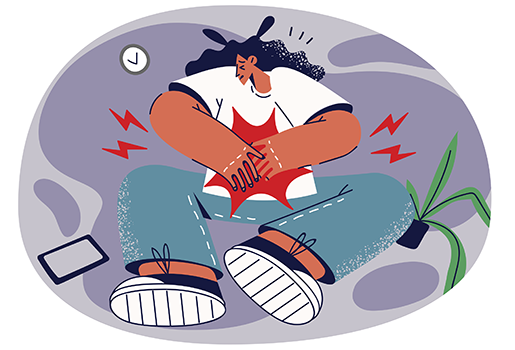
Most of the public is familiar with premenstrual syndrome (PMS) and would likely be unsurprised to hear that it is an uncomfortable experience for approximately half of the world’s population. However, there is much less awareness of the depression, suicidal thoughts, and complete isolation typical of a severe version of PMS known as premenstrual dysphoric disorder (PMDD). Our research allows us to correct this knowledge gap by presenting an evidence-based walkthrough of the menstrual cycle, offer insight into the emotional and physical state of a person experiencing PMDD, and share the effects that this experience can leave behind. We will discuss our insights in part by focusing on a fictional stand-in for PMDD sufferers.
Phase 1: Ovulation
I’m Walking on Sunshine
Emma, our protagonist, faces many common PMDD challenges. She deals not only with life’s usual curveballs but also with the added complexities of severe premenstrual symptoms. Her expressive eyes, infectious smile, and welcoming demeanor perfectly conceal the emotional turmoil she faces each month.
Emma resides in an upscale neighborhood in downtown Manhattan, sharing a two-bedroom apartment with her long-time partner, Simon. Despite their distinct interests—at home, Simon often engrosses himself in FIFA2023 on his Nintendo Switch on one end of the sofa, while Emma immerses herself in the latest Harlan Coben mystery novel on the sofa’s other end—they resonate like two peas in a pod.
In her career, Emma is ambitious and dedicated. She works for a financial corporation located in a high-rise building, with her office featuring floor-to-ceiling glass windows against the backdrop of the Hudson River. This setting speaks of her higher status on the career ladder, an impressive achievement considering her relatively young age. To her credit, she is hardworking, radiates creativity, and exhibits both analytical skills and strong leadership.
Emma is shopping along Fifth Avenue, preparing for a weekend getaway with friends she hasn’t seen in ages. She plans to get her nails and hair done after her retail therapy. Bursting with excitement, she picks a new dress and tries it on, unaware of the PMDD episode that awaits her the following day.
This part of Emma’s story represents the ovulation stage of the menstrual cycle, generally occurring around day 14 for a person with a 28-day cycle. Ovulation itself refers to the phenomenon when the ovary releases an egg, which is correlated with a significant spike in luteinizing hormone (LH) and “decreasing levels of estrogen and progesterone hormones” (Cleveland Clinic, 2022). Scientists theorize that these effects catalyze the fatigue, depression, and anxiety that overwhelm someone with PMDD once this ovulation period has concluded. However, like Emma, individuals with this condition often describe feelings of pure joy and satisfaction with life in the days leading up to luteinization, which suggests a cyclical rise and fall of hormonal levels that prompt the mood swings characteristic of PMDD.
Phase 2: Luteal Phase
I Can’t Bear This Any Longer
The alarm goes off, cutting through the early morning silence. Something is holding Emma back; she can’t seem to get out of bed. It is puzzling. Everything felt perfectly fine last night when she turned in. She was excited about the allgirls weekend, getting away from work and the hustle and bustle of the city. But now she feels dejected, a premonition of imminent disaster.
A notification appears on a phone app: Your period will likely start in a few days. A simple, innocent message that weighs her down.
“Oh no,” she mutters to herself. “It is happening again.” She reluctantly gets out of bed and looks in the mirror. She doesn’t like what she sees, and tears start rolling down her cheeks. There is a gentle knock on the door.
“Are you okay?” asks Simon, his voice filled with concern.
“No,” she replies.
“Is there anything I can get for you?” he gently inquires.
“No; please go away,” she pleads while looking in the mirror, not bothering to wipe off her tears. With a heavy sigh, Simon walks off. Witnessing her monthly struggle once again breaks his heart into a million pieces.
Moments later, Emma receives a text from her friends, “What’s your ETA? We’re on our way!” She lies and responds, “Something urgent has come up at work. I can’t make it. I will treat you to dinner next week, but please go ahead without me.” She can’t go out like this; she will feel miserable all weekend.
“Come on, it will be fun!” one urges, while another friend accuses, “There’s always something with you, isn’t it? You are always canceling last minute.” Overwhelmed, Emma turns off her phone, returns to bed, and cries harder, falling into a fitful sleep.
Emma is now around day 15 of her menstrual cycle, and this is when PMDD becomes most apparent. A combination of psychological, neurological, and gastrointestinal symptoms—including anger, irritability, anxiety, suicidal thoughts, food cravings, changed appetite, mood swings, insomnia, bloating, constipation, backache, vomiting, fainting, muscle spasms, and more— will manifest once any individual experiencing PMDD enters this stage (“Premenstrual Dysphoric Disorder,” n.d.). Such symptoms can be “so severe that women have trouble functioning at home, at work, and in relationships” (Mind, 2021). As one woman reported in an interview, “I get very depressed, and my anxiety goes sky high. I get hugely fatigued and can’t keep my eyes open. I sleep for about 18 hours a day.” (Mind, 2021). Such disruptions to women’s routines and, more importantly, their mental health are massive repercussions of PMDD.
Phase 3: Menstruation
I Pulled Through Another One
Emma is busy typing on her keyboard. The last couple of days have been nothing short of a disaster. She drags herself out of bed each morning, with sleep and appetite elusive, and cries at the slightest trigger. She keeps to herself, locked up in the bedroom, leaving the spare room for Simon. They seldom talk. Simon tries to initiate conversation multiple times, but Emma responds in monosyllables. He is still walking on eggshells around her, and she keeps saying she is okay, but Simon knows otherwise.
Meanwhile, Emma’s friends keep sharing pictures from their trip, assuming that her work excuse was valid and utterly unaware of her discomfort and internal frustrations. They wouldn’t understand her even if she shared the truth. Yes, they may experience PMS, too, but they would assume that their experiences are no different from hers.
At work, she mechanically shifts between tabs, zones in and out of Zoom meetings, stares blankly at the computer screen, and feigns productivity while concealing her emotions and physical issues. Her colleagues are unaware of her cyclic challenges, and she is uncomfortable sharing her concerns because she fears that her coworkers might judge and treat her differently. The company has no explicit policy for requesting sick days during the menstrual cycle. The workload has piled up, forcing Emma to contemplate an all-nighter to be on track without drawing too much attention.
She is exhausted, but at least she is not in extreme emotional distress. Yet a set of growing worries do plague her: how long can she maintain the facade? How soon before her boss notices and hands over her last paycheck? How much time until Simon calls off the engagement? And when will her friends decide to give up on her?
To overcome her growing uneasiness, Emma makes a series of decisions. She texts Simon, letting him know that today she will cook his favorite meal and join him in a movie marathon, which she usually loathes but Simon enjoys. She secures a reservation at a newly opened Italian restaurant in Brooklyn for Sunday brunch with her friends. She sends an email to her boss seeking new assignments. She resorts to a kind of bribery, a preemptive effort to secure everyone’s support so that they won’t leave her drowning when the whirlpool of turmoil resurfaces next month. Emma musters a sad smile.
For people like Emma, the two premenstrual weeks are likely the most challenging because that is when they are overwhelmed with all the unpleasant symptoms of PMDD. As such, the menstruation phase may provide some desperately needed relief because these symptoms “usually go away within the first two days of [their] period” (Cleveland Clinic, 2022). It’s worth noting that treatments like hormonal birth control pills, selective serotonin reuptake inhibitors (or SSRIs, like sertraline and paroxetine HCI), and pain medications may alleviate some of the symptoms experienced in the luteal phase (Cleveland Clinic, n.d.) so that individuals suffering from PMDD might not have to experience the kind of roller coaster seen in Emma’s story.
Phase 4: Follicular Phase
I Feel Normal
Emma wakes up refreshed after a good night’s sleep. She glances at her bedside alarm clock: half past seven. Once again, as she often does when she feels better, she has outsmarted it by waking up a tad early. With a gentle touch, she turned the alarm off before it made a sound, careful not to disturb Simon. She smiles and gets out of bed, but not before kissing Simon’s forehead.
While checking her phone, Emma brews herself a cup of coffee in the kitchen. Her friends have been raving about the Italian restaurant they visited. It has been less than a week, and they want to go back again. She responds with a heart emoji and texts, “I second that; we must book it soon.”
Sipping her coffee, Emma goes through her calendar, gearing up for a day filled with meetings before lunch and a couple of work assignments later. She looks forward to sharing her insights during the meetings, knowing her colleagues always appreciate the fresh perspective she brings to the table. As for the assignments, she is confident she is on top of everything, so there’s nothing to worry about.
Emma relishes the moment. However, she is not oblivious to her medical condition. Is this her happily ever after? Of course not; she is not naive. She has been entangled in this intricate web for far too long. Opening and going over notes she took at a recent session with her therapist, Emma contemplates starting a treatment plan recommended by her physician, something she has been reluctant to do. Her therapist’s voice echoes in her mind: “If not the medicine, then the mood swings will define your actions. Do not be too harsh on yourself.” Encouraged, Emma commits to creating a dedicated space for her mental wellness. In this corner, she can avail herself of treatments, as well as recognize, dissect, and analyze her anxiety and occasional despair over her PMDD. She vows not to fall again into emotional mood swings and to embrace every phase of her life.
She pulls out her favorite summer dress from the closet, quickly showers, and gets ready for work. Emma gives herself a final look in the mirror, affirming to herself, “You look terrific,” and she heads out, closing the door behind her, ready to seize the day.
Between days 6 and 14, people who menstruate undergo the follicular phase, in which a follicle develops in one of the ovaries and eventually becomes the mature egg released during ovulation. Estrogen and follicle-stimulating hormone levels rise during this period, leading to the eventual spike in LH that ushers in the luteal phase and the onset of the crushing weight of PMDD symptoms once again (“Menstrual Cycle,” 2022). As such, people who menstruate must take steps to prepare for these symptoms, such as by meeting with a healthcare provider, prepping meals with less sugar and more protein and carbohydrates, and exercising more regularly (“Premenstrual Dysphoric Disorder,” n.d.). For those with a 28-day cycle, day 14 is the day of reckoning, when the cycle begins again and when, as one woman puts it, “I [press] my own self-destruct button and literally let my (normally very happy and satisfying) life implode around me” (Mind, 2021).
Conclusions
To discuss menstruation without shedding light on PMDD is an ongoing disservice to the 5–8% of people who experience paralyzing symptoms before the arrival of their period (Harvard Health Publishing, n.d.). PMDD goes far beyond typical PMS, causing truly debilitating psychological, neurological, and gastrointestinal symptoms. People who suffer from this condition have widely different experiences and intensities, but the distress they go through should be taken seriously. By providing insight into the symptoms, thoughts, and behaviors of those who often feel too vulnerable to share them, we hope to raise awareness and encourage empathy that helps sufferers deal with the monthly struggle and to be more open about it.
Disclaimer
Readers experiencing similar issues are advised to contact their healthcare provider or specialist and to refrain from referring to this article as a source of personal medical information.
 Aynsley Szczesniak (she/her) is a first-year Bob and Janitta Carithers Honors Carolina Scholar at the University of North Carolina at Chapel Hill, where she studies Biology and Mathematics on the premed track. She’s the Founder and Executive Director of Speak Out Sisterhood and the Student STEM Programs Chair of AWIS North Carolina.
 Irma Avdic (she/her) is a third-year chemistry Ph.D. candidate at the University of Chicago. She enjoys sharing her knowledge and research experiences with others through teaching and the development of resources for teaching STEM. She also serves as the University of Chicago Student Health Advisory Board Ambassador for the Physical Sciences Division.
 Megha Lal, PhD (she/her) is a postdoctoral scholar and Co-chair of the Postdoctoral Alliance at Children’s Hospital of Philadelphia. She is the project manager at STEMPeers Gurukool and is a member of the STEMPeers Leadership team.
This article was originally published in AWIS Magazine. Join AWIS to access the full issue of AWIS Magazine and more member benefits.