
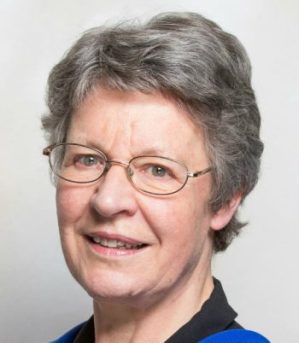
Professor Bell Burnell is best known for the groundbreaking discovery of pulsars when she was a graduate student at the University of Cambridge in 1974. Her advisor, Anthony Hewish, was awarded the Nobel Prize. While she was not included in the Nobel Prize, Professor Bell Burnell received the Oppenheimer Memorial Prize in 1978 and the Heschel Medal from the Royal Astronomical Society in 1989 for her outstanding contribution to modern astrophysics through her role in discovering pulsars. More recently, she received a 3-million-dollar award called “Special Breakthrough Prize Fundamental Physics” in 2018 for her work on pulsars and her inspiring scientific leadership over the last five decades.
Currently, she is in demand as a speaker who talks about astronomy for all audiences. Her discovery of pulsars provided direct evidence of the existence of neutron stars, and it also opened a new field of research by providing new tools for understanding the evolution of the universe by allowing astronomers to delve deeper into the mysteries of the cosmos.
In January 2024, Professor Jocelyn Bell Burnell was the keynote speaker at the American Physicist Society (APS) Conference for Undergraduate Women in Physics (CUWiP). The CUWiP helps undergraduate women in physics experience a professional conference and provides information about graduate schools and careers in physics. Below are some of my takeaways from her talk.
Journey to Astronomy
Professor Bell Burnell came from a family that believed in the importance of a good education. She wanted to be an astrophysicist and went to the University of Glasgow in Scotland to complete her bachelor’s degree. At her time, Professor Bell Burnell was the only female enrolled in an honors physics course and was teased by her male classmates by stamping, whistling, and catcalling each time she walked into the lecture hall. If she blushed, they made more noise. Her advice to young women in STEM is to be confident in themselves and do not be scared.
Professor Bell Burnell recognizes the difficulties that women undergo in higher education settings. She believes that every student will experience some adversity. However, this is not something that should be unwelcome. Why? Because even if you fail, you know you did your level best. Doing an undergraduate degree can feel like you are peddling uphill — and more so if you are in a minority in your college — but a physics degree is worth the toil. It will open so many doors of opportunities for students.
She encourages more girls and young women to engage with STEM subjects and reminds them there is no such thing as failure in science. For example, even a blip could be a generation’s most important astronomical discovery.
Detection of the first Pulsar
Professor Bell Burnell spent two years at Cambridge assisting in the construction of an 81.5 MHz radio telescope at the Mullard Radio Astronomy Observatory in Cambridge. Soon after the telescope went into operation in 1967, Professor Bell Burnell noticed an odd signal while examining the chart recording. After further investigation, she noticed that a sporadic interference was present which consisted of a series of radio pulses, each lasting about one-third of a second and with a repetition period of about 1.337 seconds. She also found another similar pulsed signal with identical properties. Professor Bell Burnell discovered the first known Pulsar, a rotating neutron star that emits a beam of electromagnetic radiation.
This information was published as “Observation of a Rapidly Pulsating Radio Source” in Nature Journal. There was a lot of publicity about this discovery. The press would ask her advisor, Anthony Hewish, about the astrophysical importance of discovery, and they turned to her and asked what her vital statistics were or about how many boyfriends she had. In 1974, her advisor, Anthony Hewish, and another astronomer, Martin Ryle, received the Nobel Prize in physics for discovering pulsars.
Professor Bell Burnell works tirelessly to promote Astronomy, not only through her passion for astrophysics through mathematics but also by expressing her curiosity about astrophysics through poetry. She collects poems with relatively accurate astronomical content, like “Delay” by Elizabeth Jennings. She published them in a book, Dark Matter: Poems of Space, a collection of astronomy-related poems.
Supporting Women and Minorities
Professor Bell Burnell advocates for women’s rights in STEM. As the first female president of the Institute of Physics, she worked hard to increase the number of women in STEM and improve their conditions in academia. She donated her 3-million-dollar prize (Special Breakthrough Prize Fundamental Physics) to the Institute of Physics. This award money is used for scholarships for women, underrepresented minorities, and refugees who want to study physics in the U.K.
Increasing the number of women in STEM is important to her. She believes that diversity makes any organization more robust and successful because there will be a wide range of ideas. Seeing something from a fresh angle may reveal a solution. As a founding Athena SWAN member (the Scientific Women’s Academic Network in the U.K.), Professor Bell Burnell supports gender equality within higher education and research.
You can watch her full inspirational speech to learn more about her life’s journey, her contribution to astronomy, and her advocacy for women in STEM.
 Shruti Shrestha is an Assistant Teaching Professor of Physics at Penn State Brandywine. She is a particle physicist who worked on the High Voltage Monolithic Active Pixel sensor for the Mu3e Experiment. She also conducts free STEM workshops in the Philadelphia area to empower girls to pursue STEM degrees.