
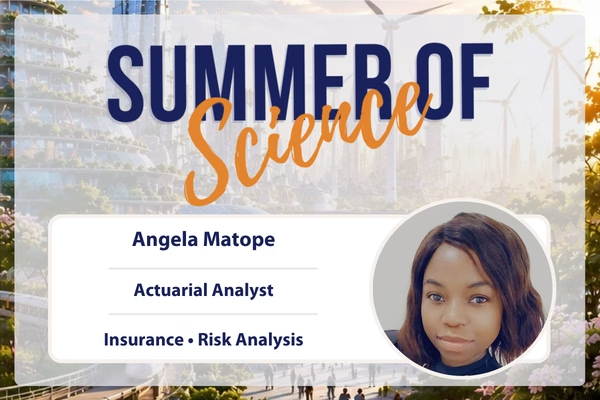
Angela Matope is helping organizations make smarter decisions through the power of data.
As an actuarial analyst, Angela combines mathematics, statistics, and data science to better understand risk and uncertainty. Her work helps organizations prepare for future challenges, evaluate complex information, and make evidence-based decisions that support long-term financial and operational success.
With a background in actuarial science and a growing focus on advanced analytics, Angela is passionate about transforming data into meaningful insights. Her work demonstrates how careful analysis, predictive modeling, and curiosity can help organizations navigate uncertainty and plan for what comes next.
A Day in Actuarial Science
What does a typical day in your role look like?
As an actuarial analyst in the insurance industry, I use data, statistical analysis, and mathematical models to help organizations make informed decisions about risk.
A typical day involves analyzing large datasets, validating data quality, building and reviewing models, evaluating business performance, and communicating findings to stakeholders. I often collaborate with teams across finance, underwriting, product development, and technology to understand emerging trends and identify opportunities for improvement.
What I enjoy most is that every day presents a different problem to solve, requiring both analytical thinking and creativity.
How would you explain your field of work to a kindergarten class?
As an actuarial analyst, I use math, statistics, and data to help companies prepare for future events and make smart financial decisions.
Think about how individuals plan and save money for emergencies, healthcare, or major expenses. My job works in a similar way, but on a much larger scale. I analyze patterns in data to estimate how much money companies may need in the future to support people and their families through life insurance benefits, retirement products, and other long-term financial promises. I also use data analytics to help organizations prepare for unexpected events like accidents, illnesses, or premature deaths, ensuring they have the resources needed to support policyholders and their beneficiaries.
In simple terms, I help organizations answer questions like: “What could happen in the future?” and “How can we be financially prepared for it?”
The Path to Risk Analysis
I earned a Bachelor’s degree in Actuarial Science, which provided a strong foundation in mathematics, statistics, economics, finance, and risk management. Throughout my studies, I developed analytical and problem-solving skills that are essential for understanding uncertainty and making data-driven decisions.
To further expand my expertise, I am currently pursuing a Master’s degree in Data Science. This has allowed me to deepen my knowledge of machine learning, predictive analytics and data engineering, while strengthening my ability to work with large and complex datasets.
The combination of technical knowledge and real-world business application has prepared me to translate complex data into actionable insights that help organizations make informed decisions. In my role as an actuarial analyst in life insurance, I have seen firsthand how data-driven analysis can influence financial strategy, risk management, and customer outcomes. It has also reinforced the value of curiosity and lifelong learning, particularly as innovations in data science, analytics, and technology continue to expand what is possible.
I’ve always been curious about how things work and how patterns can be used to explain the world around us. Mathematics appealed to me because it offered a logical way to solve problems, while data analysis revealed how those solutions could be applied to real-world situations.
What keeps me excited today is the constant opportunity to learn and innovate. New technologies, data sources, and analytical techniques continue to expand what is possible. Every dataset tells a story, and I enjoy uncovering insights that can improve decision-making and create meaningful impact.
One of my proudest achievements has been developing the ability to bridge technical analysis and business decision-making. Early in my career, I focused primarily on calculations and models. Over time, I learned how to translate complex analytical results into practical recommendations that support strategic decisions.
I am also proud of continuously expanding my skill set beyond traditional actuarial work into areas such as machine learning, predictive analytics, and data science. Embracing lifelong learning has allowed me to adapt to new challenges and contribute in increasingly meaningful ways.
Many people think actuarial work is only about mathematics, but a surprisingly large part of my job involves storytelling. Once the analysis is complete, the challenge becomes communicating technical findings in a way that decision-makers can understand and act upon. The best model in the world has little value if its insights cannot be clearly explained
AWIS provides a valuable community that celebrates and supports women across STEM disciplines. Seeing the diverse paths women have taken in science and technology is both inspiring and encouraging. The organization creates opportunities for networking, professional development, and visibility while highlighting the important contributions women make to scientific advancement.
The Science That Moves Us Forward
How has your work/research helped drive discovery, innovation, or impact?
More recently, I have become increasingly interested in the intersection of actuarial science, machine learning, and advanced analytics. Integrating modern data science techniques with traditional actuarial methods creates opportunities to better understand risk, identify emerging patterns, and develop more responsive solutions for complex challenges. Even small improvements in predictive accuracy can have a meaningful impact when applied across large populations and business decisions.
Where do you see your work heading next?
I see my work increasingly moving toward the integration of actuarial science, artificial intelligence, and advanced analytics. As organizations gain access to larger and more complex datasets, there will be growing opportunities to use predictive models and machine learning techniques to better understand uncertainty and support decision-making.
I am particularly interested in developing solutions that combine strong analytical foundations with emerging technologies while maintaining transparency, fairness, and accountability in model development.
How do you see your work helping shape the future of STEM?
Data is becoming central to nearly every scientific and business discipline. The ability to transform information into actionable insights will continue to play a critical role in solving complex problems.
By contributing to advancements in analytics, predictive modeling, and evidence-based decision-making, I hope to help demonstrate how mathematics and data science can be applied to create practical solutions with real-world impact. I also hope that my journey encourages more women to explore quantitative and analytical careers, helping build a more diverse and innovative STEM workforce.
To a Future Scientist Just Starting Out
What are some strategies you use to maintain resilience and persistence in the face of obstacles?
I try to view challenges as opportunities to learn rather than threats. I also focus on maintaining a growth mindset, seeking feedback from peers and mentors, and breaking down large challenges into manageable steps.
What advice would you give to your younger self / someone just starting out in your field?
Focus on building strong fundamentals, but don’t limit yourself to a single path. The most valuable opportunities often exist at the intersection of disciplines. Develop technical skills, learn how to communicate effectively, and remain open to new technologies and ideas.
Most importantly, don’t wait until you feel completely ready before pursuing new challenges. Growth often happens when you step outside your comfort zone and trust your ability to learn along the way.
What message would you share with future scientists about the power they hold to make a difference?:
Whether your work involves data, biology, engineering, medicine, or any other field, your curiosity and persistence have the potential to solve problems that matter. Amazing discoveries often begin with a single determined person who refuses to stop asking questions until they find an answer.