
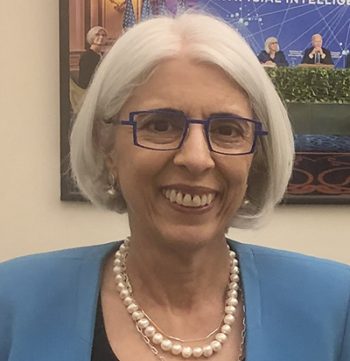
Dr. Arati Prabhakar was the 12th Director of the White House Office of Science and Technology Policy (OSTP). She was appointed by President Biden and assumed office in October of 2022. As Director, she also served as Assistant to the President for Science and Technology, was a member of the President’s Cabinet, and Co-Chair of the President’s Council of Advisors on Science and Technology (PCAST).
Dr. Prabhakar arrived in the United States as a child, following her mother who came to the U.S. seeking higher education. Dr. Prabhakar earned a B.S. degree in electrical engineering from Texas Tech University in Lubbock, Texas in 1979. She earned an M.S. degree in 1980 and a PhD in applied Physics in 1984 from the California Institute of Technology.
In 1984, she served as a congressional fellow with the Office of Technology Assessment. She then became a program manager and founding Director of the Defense Advanced Research Projects Agency (DARPA) Microelectronics Technology Office. In 2012, she became the head of DARPA.
At the age of 34, she was appointed the first woman Director of the National Institutes of Standards and Technology (NIST). During her career, she has also been President of Interval Research, U.S. Venture Partners, and founded Actuate, a non-profit dedicated to innovation for society’s challenges. She has also been a fellow at the Center for Advanced Study in the Behavioral Sciences at Stanford University.
She is a member of the National Academy of Engineering and the U.S. National Academies’ Science Technology and Economic Policy Board.
Can you tell us about your childhood? When did you come to the United States?
My mom was a social worker and earned two master’s degrees in India. She wanted more education, so when I was two, she came to the University of Chicago. My dad and I were supposed to follow immediately but arrived a year later. My father was a physicist and then an engineer.
We moved from Chicago to Lubbock, TX which is where I grew up. When I was young, I was good at math and thought it was just so beautiful. The idea that for every single circle if you divide its circumference by its diameter, you get the exact same number. There’s something just really deeply beautiful about that. It was unusual to be good at math, especially if you were a girl, and I reveled in that.
I was the only Indian kid in my high school. I spent so much of my early life being the only person like me in the room. People weren’t hostile, but I was never like everybody else. It was a long time before I was ever in a room with people who looked like me or had my ethnic background or my gender. I think it served me very well to be able to feel comfortable, irrespective of who else is in the room.
Tell us about your educational experience. What drew you to STEM? Was it your father’s influence as an engineer?
It was definitely my mom. I didn’t have a close relationship with my father. They divorced when I was in high school. My mom was very education oriented. She started sentences with “when you get your PhD,” and it wasn’t a joke. That’s what you were supposed to do in life. She claims that at six years old I was musing about whether I should be a scientist or an engineer. She didn’t push me in one direction or another. It was about getting a good education and being able to make a contribution to the world.
I applied and was accepted to MIT, Rice, and to Texas Tech, which was our local college. My parents had just gotten divorced. We didn’t have a lot of money, so I went to Texas Tech, and I studied electrical engineering. That is where I learned the notion of creating value. That was an idea that lit me up.
Then I went to graduate school at Caltech. When I was about to graduate, I realized that I was not born to be in a lab at two in the morning having a eureka moment. I didn’t know where to go next. My Bell Labs mentor in New Jersey cut out and mailed me a newsletter clip about a fellowship program at the old Office of Technology Assessment. It was a congressional agency at that time under the IRS umbrella. I applied for it, and I got it.
You have worked across multiple sectors. How did you decide whether or not to pivot? Did anyone discourage you from changing jobs along the way?
Every single time I changed jobs, people thought I had lost my marbles. When I left CalTech and took a congressional fellowship, people kept talking about how I was leaving Research. Same for when I went from OTA over on Capitol Hill to DARPA and when I left NIST (National Institute of Standards and Technology, U.S Department of Commerce) to go to Silicon Valley. When I got asked to come back and run DARPA, someone I had worked with at my venture capital firm just couldn’t get his head around the idea that I was going to go and work for the government again. They just can’t imagine it, but I think doing all these different things gives you a perspective you’d never have if you just stayed in one place. I think it looked random to everyone else, but the thing that drove every single move for me was seeking impact.
There are a handful of times when I got to help make something really amazing happen. I never got anything done all by myself. Part of what I’ve loved about my career was not being the single investigator in a lab. I get to do things with people, because that’s the fun part. The biggest one was when I got to DARPA in 2012. So now this is 7 or 8 years before the pandemic. One of my program managers was an infectious disease doc and a geneticist, and he said, ‘we’re going to have another pandemic. It’s going to be terrible because it takes us years or decades to make a vaccine. But there’s this research and mRNA, and it could be the basis for a rapid response vaccine platform.’ He shared that he just met this little company called Moderna up in Boston. They want to work on mRNA for cancer, but we might be able to persuade them to work on infectious diseases. So I said, yes. Everyone thought that was the stupidest idea they had ever heard. You can’t believe the criticism we got because mRNA was just like this crazy idea for vaccines back then.
We started changing people’s minds as we saw an antibody response for Chikungunya, a very different disease, but it got people to pay attention to mRNA for vaccines. Fast forward many years, we’re in the Covid 19 pandemic. I’m no longer at DARPA, but I realized that mRNA vaccines are actually going to be real. When those clinical trial results came out for the first mRNA vaccines, it was just the most amazing moment to know that this spark of an idea from all those years before had led to something that was going to save so many lives. I was always seeking places where you can have that kind of contribution. That is what drove my moves.
When you were specializing in semiconductors early in your career, did you ever dream that it would prepare you to be the head of the OSTP?
My role at OSTP was a two-part job. One is advising the president on science and technology. That’s anything that comes up that involves science and technology that he needs to know or that he asks about. For example, I began in October of 2022, ChatGPT showed up in November of 2022. We needed to show the President what was going on with generative AI. The other is running the Office of Science and Technology Policy at the White House. Making sure that our research and development science and technology ecosystem in the US is robust and is aimed at the great aspirations that we have as a country today. This includes national security, economic opportunity, meeting the climate crisis and health. It’s a very broad portfolio, but this role built on a lot of things I’ve gotten to do across my career, and it gave me a chance to work with a team who has far deeper expertise in each of the areas. It’s been a great privilege.
Would you recommend that other engineers explore the public policy realm?
My great joy across all the things I’ve gotten to do has been public service. It’s just there’s no place for me that I’ve been able to do more things that mattered. It doesn’t line your pocket compared to private sector life, but it’s so satisfying. When you’re in business or if you’re an investor, you’ve got to make money, right? If you don’t do that, then you’re not doing your prime directive. If you do it in a sophisticated, respectful, responsible way, then it’s a really honorable thing. I got to work with some great people doing that.
In every job, you learn things that are going to help you. Some of them are really specific about different technology areas, but the most fundamental skills are how to interact with people and get things done. Those are universal things. At the end of the day, that’s the stuff that really matters.
There are so many different paths, and you have to give it a whirl to find what you’re really great at. What do you care about? Where are you going to go that you can sing and really do something that makes the world a better place and that allows you to fulfill your role in society? When you find that place, that’s usually something that brings you a lot of joy because you are doing something really fulfilling. It takes a while for each of us to figure out what that really is.
Only 26% of engineers are women. Are there any suggestions you could make to encourage women and underrepresented groups to enter the STEM professions?
Every kid should be able to find the thing that works for them, and we’re not there yet. There’s still too many preconditions and expectations. We’ve made progress, and we’ll keep making progress. If it calls to you? Show up. Own it. Go for it. Enjoy the work. Find your way and just know that you’re welcome. If you want it, you can go do it.
 Miriam Swydan Erickson is a member of AWIS and former Senior Counsel for Advocacy and Government Relations for AWIS. She developed and led AWIS’ Capitol Hill Day in 2023. She is President of the Swydan Erickson Group, Director of Government Relations for Brown Williams energy consulting, and Senior Advisor for Responsible Robotics. She is a Board member of two non-profits that donate scholarships to PhD students in the Sciences and provide leadership training for women scientists.
She has been actively encouraging women to enter the STEM professions for over 15 years, and is a guest lecturer at NYU, Johns Hopkins University, MIT, Georgetown University, George Mason University, the U.S. Department of State, and the U.S. Energy Association. She was responsible for the Fairfax Board of Supervisor’s proclamation of women in STEM for Women’s History month and led the Girl Scout’s efforts for badges in engineering and science fairs.
She is an energy attorney with over 30 years’ experience in energy and environmental law and policy, beginning with the Federal Energy Regulatory Commission, the American Gas Association, as Senior Majority Counsel for the US House of Representatives Committee on Energy and Commerce, a Presidential appointee to the Department of Health and Human Services and continuing today.
She received her B.A. from the University of California at Berkeley, studied Urban Planning at the University of Pennsylvania, and her Juris Doctor degree from Georgetown University Law Center, where she was on the Law Review. She also has a certificate in Women’s leadership from Oxford University Said School of Business.