
Science only matters when it reaches the people who need it most. That’s why advocacy never felt optional to me. I want to educate others about the importance of scientific funding, so I joined the AWIS Advocacy Committee. I have contributed to AWIS advocacy posts, and this Spring, I organized constituent meetings with my Congressional representatives. I had never done this before, but I was excited.
Scheduling the meetings was easy. I used the constituent meeting portals available through each representative’s website to arrange 30-minute meetings with staffers from Senator Banks (R-Ind), Senator Young (R-Ind), and Representative Carson’s offices (D-Ind). The best part is that I did not have to travel to Washington, D.C. since I scheduled the meetings to take place in their home offices.
Once the meetings were scheduled, I invited members of the AWIS Indianapolis Chapter to join me. I believe deeply that advocacy is for everyone, so I also wanted to ensure that other local women in science who may not already have been familiar with AWIS knew about the opportunity. I connected with program directors at my school, the graduate school, and School of Science to engage Master’s and PhD students across Indiana University Indianapolis.
During our meeting with Senator Young’s staffer, Tom Fritts, two other women in science and I discussed the importance of sustained science funding and our concerns surrounding deep funding cuts to the CDC budget that threaten critical programs such as community health surveillance and pandemic prevention initiatives. While there was limited receptiveness to our concerns about funding cuts, there was significantly more engagement around discussions of artificial intelligence, especially AI-driven preauthorization processes in Medicare and Medicaid.
Our meeting with Senator Banks’ staffer, Linda Yoakum, was especially encouraging. Her background included bovine experimental safety and understanding of Institutional Animal Care and Use Committee protocols, so she was interested in hearing how funding cuts are affecting women scientists early in their careers.
Our final meeting with Representative Carson’s office was particularly impactful because the team included both local Indianapolis staffers and a legislative staffer from Washington, D.C. who explained how constituent advocacy influences legislative priorities. This behind-the-scenes perspective was incredibly insightful, and the conversation extended to nearly an hour because both sides were learning so much from one another.
This experience showed me that when I speak up, people listen. I used my voice and other skills to coordinate the meetings, encourage others to attend, and create one-page leave-behinds. The success of the meetings depended on consistency, diligence, and follow-through. AWIS provided a toolkit to make it a successful experience.
Although I cannot guarantee these conversations will lead to immediate change, I am proud to have advocated for women in science. Science is strongest when everyone has a seat at the table, and I will always use my voice to help make that possible. I encourage others to meet with your representatives as well.
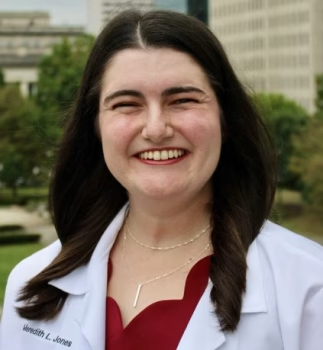
 Meredith L. Shand is a PhD candidate in Anatomy, Cell Biology, and Physiology at the Indiana University School of Medicine. Her research explores kidney-brain communication during inflammation. As a science advocate, she works to advance evidence-based policy, strengthen support for biomedical research, and expand opportunities for women in science.