
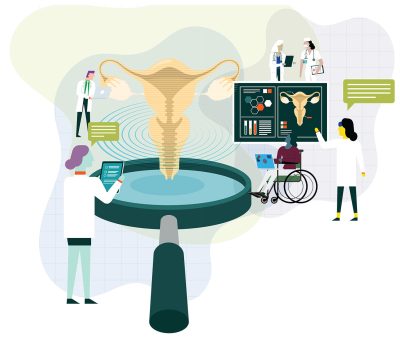
Women continue to face two devastating diseases that specifically affect them: endometriosis and ovarian cancer. Fortunately, we may soon benefit from a collaborative project that promises to help our doctors diagnose these diseases earlier, leading to better prognoses.
Chronic and painful endometriosis affects 190 million women of reproductive age and girls globally. This disease causes tissue similar to the uterus’s lining to grow outside the uterus, which causes inflammation and scar tissue to form in the pelvic region. Symptoms can include life-impacting pain during menstrual cycles, sexual intercourse, and bowel movements, as well as pelvic pain, anxiety, depression, and infertility. Researchers have not yet determined the cause of endometriosis. Early intervention can help women manage pain and symptoms, but no cure exists yet.

Oncologists describe ovarian cancer as one of the most common cancers among women and as the 8th most common cancer worldwide. Symptoms for this cancer can include weight loss, stomach or pelvic pain, and loss of appetite. The known risk factors for this cancer include family history of breast and ovarian cancers, gene mutations in BRCA1 and BRCA2, and genes associated with Lynch Syndrome (MLH1, MSH2, MSH6, PMS2, and EPCAM). No early detection screenings or treatments currently exist for this cancer.
Both these diseases affect female reproductive organs, yet we have not made sufficient progress in developing specific screenings, protocols, and educational materials to help women. Besides the lack of early detection tests, medical centers in low- and middle-income countries also lack multidisciplinary and specialized surgery teams, and this deficiency causes the citizens of these countries to distrust doctors and to struggle in getting access to care.

A researcher at the University of California, San Diego (UCSD), has taken steps toward addressing these problems. Dr. Rebecca Rakow-Penner has recently embarked on a collaborative project with GE HealthCare to increase access to advanced imaging techniques for clinicians to improve diagnosis and management of women’s pelvic diseases. This collaboration aims to fill the gap in screening protocols to provide a more consistent approach to diagnosis and management. The team includes Rakow-Penner, an Associate Professor of Radiology and Bioengineering and Director of Women’s Imaging Lab at UCSD; and Dr. Erin Angel, Global Vice President of Research and Scientific Affairs and Christina Rombola, Director of Research and Scientific Affairs, at GE HealthCare.
I had a chance to interview Dr. Rakow-Penner recently to find out more about this initiative. She received her MD/PhD in Biophysics from Stanford University, completed her residency research track in radiology at UCSD, and followed up with a fellowship in women’s breast and body imaging, also at UCSD. She is now a board-certified physician-scientist dedicated to developing and applying comprehensive breast, abdominal, and pelvic imaging care to improve women’s health.

“The only questions that get answered are the ones that get asked,” Dr. Rakow-Penner said, as she discussed the impact of the new UCSD/GE HealthCare initiative.
What This Project Entails, and Why the Time is Right
When women with pelvic pain see their physician, the doctor typically sends them off for a routine pelvic-imaging exam, which is just a general scan that cannot distinguish different pelvic diseases from each other. This makes women’s pelvic diseases hard to identify with the standard of care that physicians practice globally. Doctors can only diagnose endometriosis, for example, when they conduct surgery on a patient who has most likely been in pain without an appropriate diagnosis for years.
No current pelvic imaging technology distinguishes endometriosis from uterine cancer or from other diseases of the pelvis. In contrast, doctors can properly diagnose male-organ specific cancers, like prostate cancer, by following a standard of care that includes specific tests and technologies. This discrepancy illuminates a gap in medicine: technology and educational materials lack for far more often for the diagnosis and treatment of women’s diseases than for men’s.
The UCSD/GE HealthCare team aims to address this gap by creating an atlas-like database. This database will compile available GE imaging technology and viewing software, including sample scans and information on how to identify female pelvic lesions, so that doctors can accurately distinguish among women’s pelvic diseases, for example, between endometriosis and uterine cancer. As their secondary aim, the team will make this atlas available to any physician across the globe so that they can better diagnose women patients with pelvic pain. This information source will remove the requirement for a specialist to read the scan or for a doctor to download expensive software or applications, which will lead to more equitable care worldwide. This unique initiative does not require Dr. Rakow-Penner and the GE HealthCare team to reinvent the wheel; they will just make the wheel move more efficiently and accessibly.
“We decided to partner with GE HealthCare because they have a new special focus on healthcare without limits,” Dr. Rakow-Penner said. “I have used GE imaging technologies in clinical and lab settings since the start of my training. Additionally, the team at GE HealthCare, Dr. Erin Angel and Christina Rombola, have been adaptable, innovative, and extremely collaborative. For this initiative, we will utilize existing imaging technologies and make them more accessible to physicians everywhere.”
She described the impact that the collaboration will have on women’s health in a recent USCD/GE HealthCare press release: “Women’s care requires a personalized approach, and we hope to advance care solutions for women by improving the diagnosis and management of female pelvic conditions, both benign and malignant,” she explained. This initiative has the potential to equip physicians to make more informed decisions about diagnosis and to provide equitable access to pelvic care for women around the globe. It will also help women get more individualized medical care for pelvic diseases. The project proves that we need more women in the field to advocate, educate, and focus on the questions that remain unanswered.
The three team leaders have inspiring messages for other women in STEM who want to pursue a career in science or medicine. Dr. Rakow-Penner says, “You can do it! Follow your passion, you will be able to achieve it, whether you are a man or a woman. Just go for it. You are not alone.” According to Dr. Angel, “Choose careers that [make it] easy to wake up and work hard.” Finally, Rombola adds, “Don’t be the person to tell yourself no: there will already be people in the world who will.”
 Marissa Russo (she/her) obtained her BS in Brain and Cognitive Sciences, with minors in computational biology, Spanish, and psychology, from the University of Rochester in 2021. At the U of R, she played on the varsity softball team for four years and participated in the Medallion Society, a leadership program. She is now a PhD candidate at the Mayo Clinic Graduate School of Biomedical Sciences in Florida and studies glioblastoma extracellular vesicles and the tumor microenvironment. She participates in the Leadership in PhD (LeaP) program and the Neuroscience Equity Diversity and Inclusion (NEDI) committee, and she has a deep passion for patient advocacy and for increasing health literacy and trust in science in underrepresented populations.
This article was originally published in AWIS Magazine. Join AWIS to access the full issue of AWIS Magazine and more member benefits.